Continuous welded pipe manufacturing requires stable, precise coil feeding at
the front end of the mill line. Raw steel coils, often weighing between 5 and 30
metric tons, present severe handling challenges due to spring-back forces, heavy
rotational inertia, and surface quality requirements. When raw material loading
halts production or causes strip alignment errors, overall plant throughput
declines rapidly. Implementing a heavy-duty automatic decoiler machine at the
entry section resolves these mechanical delays by automating coil positioning,
mandrel expansion, and material threading into the entry shear and end
welder.
Modern tube mills operate at elevated line speeds, making material continuity
a core factor in plant performance. Machine operators must handle high-yield
strength carbon steel, stainless steel, or galvanized coils without causing
structural damage to the strip edges or introducing machine vibration. Examining
the structural engineering, hydraulic systems, control logic, and equipment
specifications helps mill managers select the correct uncoiling configuration
for their specific manufacturing requirements.
Mechanical Architecture and Core Operational Components
The entry section of a strip processing line relies on a rigid structural
frame capable of supporting heavy cantilevered loads. The primary structural
components are engineered to absorb dynamic forces generated during high-speed
pay-off operations and emergency braking events.
Hydraulic Coil Loading Car
Loading heavy steel coils manually onto an uncoiling mandrel introduces
prolonged downtime and safety risks. An automated hydraulic coil car travels
horizontally on embedded floor rails to transport coils from the storage saddle
directly to the uncoiler mandrel. Controlled vertical hydraulic lift cylinders
align the inner diameter (ID) of the coil with the central axis of the mandrel.
This precise positioning eliminates manual rigging, protects the mandrel surface
from impact damage, and reduces cycle time between coil changes to less than
three minutes.
Expanding Mandrel Mechanism
The central mandrel must grip the internal diameter of the steel coil
securely to prevent slippage during acceleration and braking. Hydraulic
expansion systems utilize a central pull rod attached to sliding wedge segments
or heavy-duty toggle link mechanisms. As the hydraulic cylinder pulls the wedge,
four or four-piece segmental plates expand outward, applying uniform radial
pressure across the inner coil wraps. Rubber or polyurethane pads are frequently
installed on the expanding segments when processing sensitive material surfaces,
such as aluminum, brass, or polished stainless steel, to prevent internal coil
marring.
Snubber Arm and Peeler Table Assembly
Thick-gauge steel coils retain high elastic memory and tend to spring open
violently once the outer retaining straps are cut. A hydraulic snubber arm
equipped with a motor-driven press roll lowers onto the outer circumference of
the coil to maintain outer wrap pressure. Simultaneously, a hydraulic peeler
blade extends beneath the outer strip end, guiding the leading edge upward into
a series of flattening pinch rolls. This automated threading sequence eliminates
manual strip bending, protecting operators while feeding material into
downstream leveling equipment.
Resolving Strip Feed Instability and Downstream Downtime
Operational bottlenecks in tube mills frequently stem from erratic tension
control during uncoiling. Improper back-tension leads to loose wraps, material
telescoping, and misalignment at the forming roll stands. Integrating a properly
sized automatic decoiler machine maintains uniform strip geometry from the first
outer wrap to the core of the coil.
Dynamic braking systems play a decisive role in tension maintenance.
Pneumatic multi-disc brakes or closed-loop AC regenerative drive motors apply
continuous opposing torque to the mandrel shaft. During high-speed operation,
brake torque dynamically adjusts based on coil diameter calculations provided by
distance-measuring ultrasonic sensors or laser feedback units. As the coil
diameter decreases, braking force diminishes proportionally to prevent excessive
tensile strain on the strip.
Synchronization with downstream loop accumulators represents another vital
mechanical link. In continuous pipe manufacturing, strip accumulators store
sufficient material to allow end welding of consecutive coils without stopping
the forming mill. The uncoiler must accelerate rapidly after a coil join to
refill the accumulator basket or horizontal loop. Advanced vector drives allow
the mandrel motor to transition smoothly between position-control mode during
threading and torque-control mode during high-speed pay-off.
Single-Mandrel vs. Double-Head Configurations
Selecting the optimal uncoiling platform depends heavily on target output
volume, available floor space, and material changeover frequency. Structural
designs generally fall into two categories: single-head uncoilers with
floor-mounted coil cars, and double-head indexing uncoilers.
Single-Head Systems: Utilize a single cantilevered mandrel
mounted to a stationary base frame. Coils are loaded sequentially using an
auxiliary hydraulic coil car. This configuration offers high structural
stiffness, making it ideal for extremely heavy coils (20 to 35 tons) and
extra-thick wall strip processing.
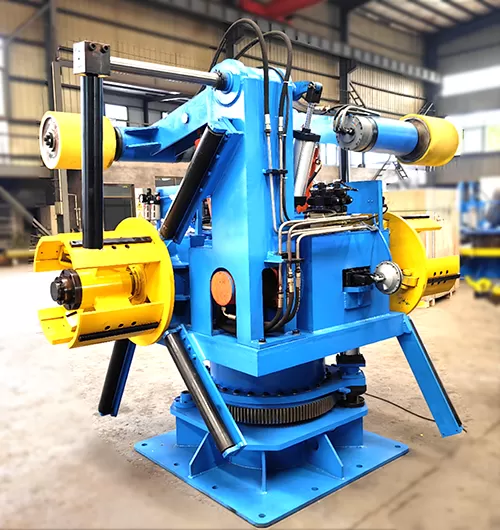
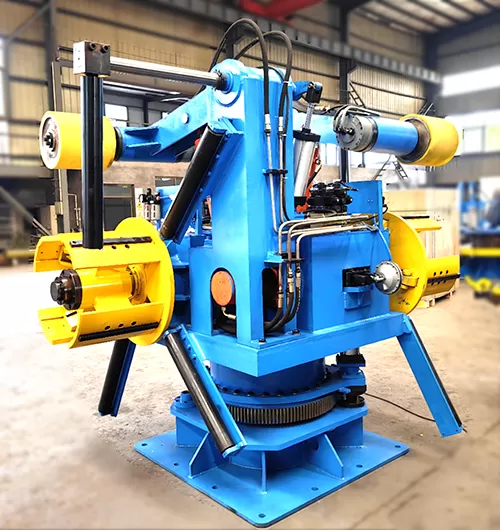
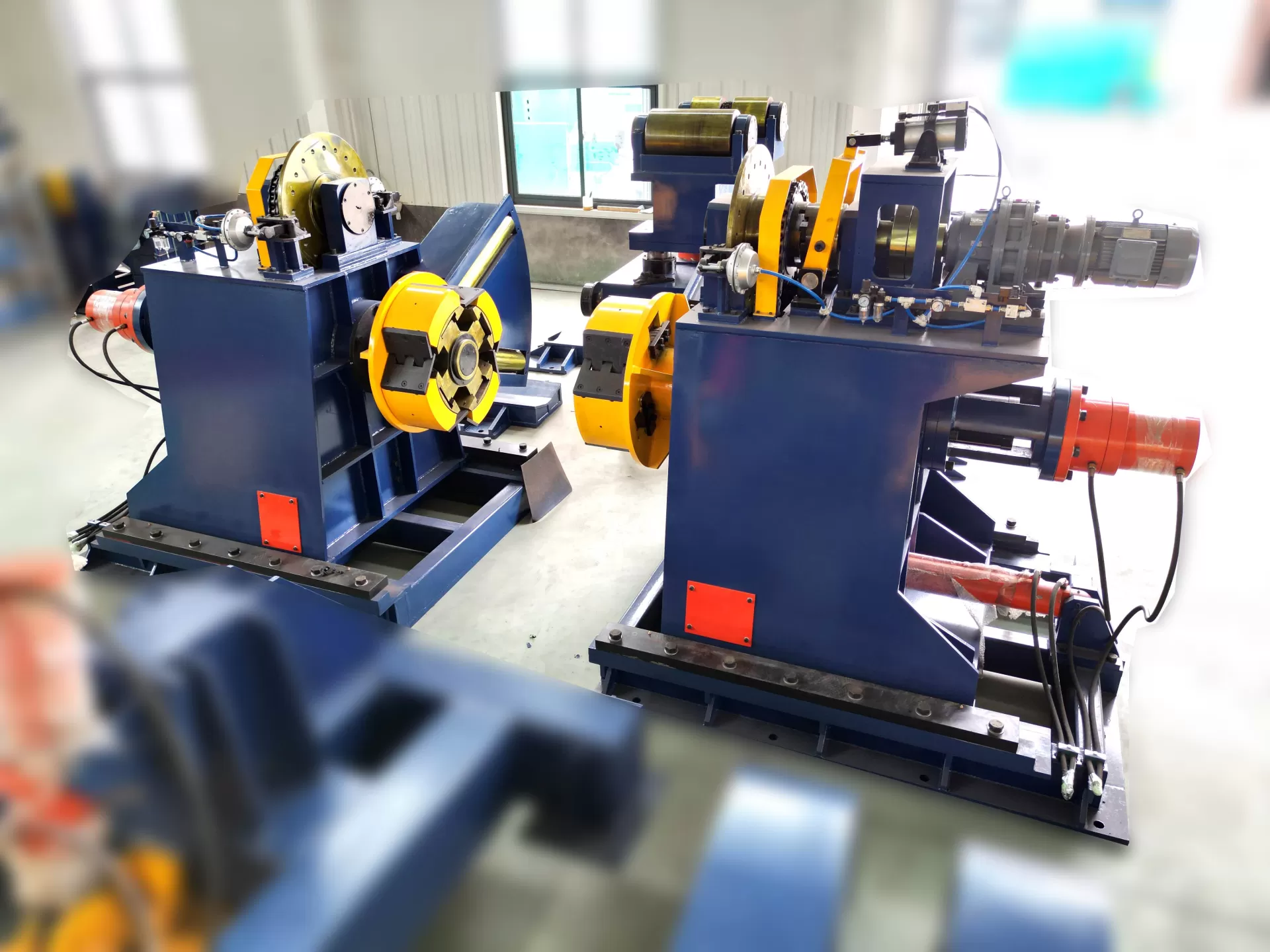
Double-Head Indexing Systems: Feature two opposing mandrels
mounted on a 180-degree rotating base turret. While one mandrel actively feeds
strip into the tube mill, the operator loads a fresh coil onto the rear mandrel.
Once the active coil is depleted, the turret indexes 180 degrees, bringing the
new coil into the pass line instantly. This design minimizes line stop time,
making it the preferred choice for high-speed, light-to-medium gauge tube
manufacturing.
Choosing an automatic decoiler machine configured as a double-head unit
substantially increases overall equipment effectiveness (OEE) on lines running
short coil lengths or rapidly changing product dimensions.
Integrating SANSO Systems into Modern Welded Pipe Lines
Precision mechanical integration ensures that strip material enters the
forming section without angular skew or lateral offset. Engineering teams
installing SANSO uncoiling equipment focus on rigid base alignment, foundation
anchoring, and unified communication protocols.
Laser alignment techniques establish an exact centerline across the entire
line—from the uncoiler base, through the strip joiner, accumulator, and forming
mill entry guide. Even minor angular deviations at the uncoiler shaft lead to
asymmetric edge stretch, causing twist and camber errors in welded pipe
profiles. SANSO equipment designs incorporate fine-adjustment jack screws and
heavy sub-plates to simplify accurate leveling and axial alignment during
installation.
Automation logic forms the operational bridge between uncoiling hardware and
line management controllers. Industrial Ethernet protocols (such as PROFINET or
EtherNet/IP) connect the uncoiler PLC with downstream drive controllers. Sensor
feedback monitors coil diameter, line speed, hydraulic pressure, strip end
position, and brake temperature in real time. Automatic coil-centering systems
utilize photoelectric edge sensors mounted on the coil car frame to center the
incoming material on the machine pass line prior to mandrel loading.
Mechanical Evaluation Parameters for Industrial Procurement
Plant engineers must carefully verify operational requirements against
equipment engineering limits when specifying an uncoiler. Mismatches between
machine capabilities and material specifications lead to structural frame
fatigue, hydraulic overheating, or uncoiler drive motor stalls.
Primary specification criteria include:
Maximum Coil Weight Capacity: Calculated with safety
factors matching peak crane or forklift payload limits (e.g., 5,000 kg up to
30,000 kg).
Strip Width Range: The structural length of the mandrel
expansion segments must cover minimum and maximum strip widths (e.g., 100 mm to
1,500 mm).
Material Thickness and Yield Strength: Heavy-gauge material
requires higher hydraulic expansion pressure, stronger snubber roll down-force,
and higher brake torque.
Expansion Range: Standard internal diameters are typically
480 mm to 520 mm, with optional expansion adapters extending coverage to 610 mm
or 760 mm for large structural mill coils.
Line Speed Rating: Uncoiling rotational speeds must exceed
maximum forming mill speed requirements to allow rapid loop refilling (e.g., 0
to 120 meters per minute).
Properly matching an automatic decoiler machine to the precise coil weight,
width, and gauge envelope prevents excessive mechanical wear, reduces hydraulic
fluid temperature, and extends overall line longevity.
Frequently Asked Questions
Q1: How does a hydraulic coil car increase efficiency during strip
loading?
A1: A hydraulic coil car motorized on floor rails
pre-aligns and elevates heavy steel coils to match the central axis of the
uncoiler mandrel. This automates positioning, avoids crane wait times, prevents
damage to mandrel segments, and shortens coil reload intervals.
Q2: What mechanism prevents high-tensile steel coils from uncoiling
dangerously upon cutting the binding straps?
A2: A top-mounted
hydraulic snubber arm applies direct downward pressure onto the outer wrap of
the coil via a motor-driven roller. This mechanical clamping prevents violent
coil spring-back and keeps material tightly wound while operator crews cut
securing bands.
Q3: How does mandrel expansion adjust to different coil inner
diameters?
A3: Mandrel expansion is driven by a central hydraulic
cylinder pushing internal sliding wedges or link arms outward. For coils with
larger inner diameters, heavy-duty bolt-on extension shoes are attached to the
segmental expanding plates to increase the effective diameter reach.
Q4: What causes strip edge damage during uncoiling and how can it be
avoided?
A4: Edge damage typically results from severe axial
misalignment between the uncoiler mandrel and downstream entry guides, or from
uncontrolled coil telescoping. Precise laser leveling during installation,
dynamic lateral alignment systems, and proper back-tension braking prevent edge
deformation.
Q5: Why is dynamic brake torque control necessary on high-speed tube
mill uncoilers?
A5: As the steel coil unwinds, its effective outer
radius shrinks continuously. If braking torque remains constant, strip tension
increases proportionally, potentially stretching thin-gauge material. Dynamic
braking automatically scales down braking torque as sensors detect decreasing
coil diameter, maintaining stable strip tension.
Submit Your Project Parameters for Custom Engineering
Selecting durable, high-precision front-end equipment is essential for
maximizing tube mill yield and eliminating unpaid line stoppage. SANSO designs
robust coil handling machinery tailored to heavy industrial environments,
demanding duty cycles, and strict tolerance standards.
If you are planning a new welded pipe manufacturing line or upgrading an
existing entry section, send your technical inquiry to SANSO engineers today.
Provide your detailed coil weight, strip width, material thickness, yield
strength, and line speed requirements to receive a detailed engineering proposal
and custom machine quote.