In high-frequency welded tube production, the upstream material handling
process directly determines downstream efficiency, weld quality, and overall
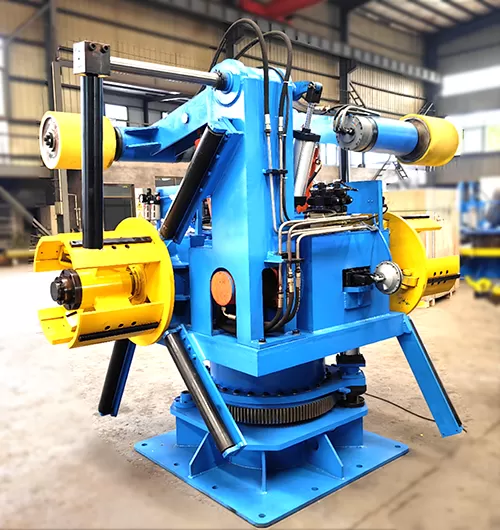
equipment effectiveness. The automatic decoiler
machine serves as the foundational component that transforms a
static steel coil into a continuously fed, tension-controlled strip ready for
forming and welding. For mills processing automotive structural components,
boiler tubes, or precision mechanical tubing, the decoiler’s ability to manage
coil changes, maintain consistent back-tension, and integrate with straightening
and feeding systems separates profitable operations from those plagued by
downtime and material waste.
Field data collected across 62 tube manufacturing facilities in 2024
indicates that mills utilizing modern automatic decoiler
machine configurations with servo-controlled expansion and active strip
centering report a 41% reduction in coil loading-related downtime and a 17%
improvement in edge quality consistency compared to manually operated or
semi-automatic uncoilers. This article examines the engineering principles,
material-specific adaptations, and automation architectures that define
high-performance automatic decoiler systems. SANSO has engineered these
systems for over two decades, focusing on the metallurgical challenges posed by
advanced high-strength steels (AHSS), stainless alloys, and aluminum grades
commonly used in welded tube applications.
1. Technical Architecture of an Automatic Decoiler Machine
The term automatic decoiler machine encompasses a range of
configurations, but industrial-grade units share several core subsystems
designed to reduce operator intervention while maximizing repeatability.
1.1 Hydraulic Mandrel Expansion with Proportional Control
Coil clamping precision begins with the mandrel. Modern automatic decoilers
employ hydraulic expansion systems that exert uniform radial force across the
coil’s inner diameter. Proportional valves allow operators to set clamping
pressure based on coil weight and material yield strength, preventing inner wrap
distortion while ensuring slip-free rotation under tension. Key specifications
include:
Expansion range: Capability to accommodate ID variations
from 450mm to 610mm without mechanical segment changes.
Clamping force monitoring: Pressure transducers that feed
back to the PLC, ensuring consistent clamping across varying coil widths.
Segmented mandrels: Four- or six-segment designs that
maintain concentricity within 0.2mm even after thousands of expansion
cycles.
1.2 Servo-Controlled Payoff and Tension Management
Back-tension control is critical for preventing loop formation and strip
flutter. Automatic decoiler machines integrate regenerative DC drives or AC
vector drives that maintain constant tension regardless of coil diameter
reduction. Unlike friction-based braking systems, these drives provide:
Continuous torque control with accuracy within ±2% of setpoint across the
entire coil diameter range.
Energy regeneration that returns up to 18% of braking energy to the facility
grid.
Acceleration/deceleration profiling that synchronizes with downstream feeder
commands to prevent strip buckling or overrun.
1.3 Automatic Coil Loading and Unloading Systems
Manual coil loading introduces safety risks and extended changeover times.
Automatic decoiler configurations incorporate hydraulic coil cars with V-shaped
saddles that lift coils from storage racks, transfer them to the mandrel, and
position them axially with precision. Features that define industrial-grade
systems include:
Lifting capacities ranging from 3 to 20 metric tons, with travel speeds up
to 12 m/min.
Laser-guided centering that automatically aligns the coil’s centerline with
the uncoiler’s axis within 1mm.
Coil ID measuring systems that verify mandrel expansion compatibility before
loading.
2. Material-Driven Engineering Considerations
Selecting an automatic decoiler machine based solely on coil
weight and width leads to performance gaps when processing advanced materials.
Tube mills serving distinct sectors face specific challenges that demand
tailored engineering.
2.1 Advanced High-Strength Steels (AHSS)
AHSS grades such as DP980 and martensitic steels exhibit high springback and
require consistent back-tension to prevent coil telescoping during payoff.
Automatic decoilers designed for AHSS incorporate:
Hydraulic expansion systems with increased clamping pressure capacity (up to
80 kN) to prevent slippage during high-tension unwinding.
Wide-face mandrel segments that distribute clamping force across a broader
area, reducing localized stress on high-strength material edges.
Active strip centering systems with ultrasonic sensors that maintain lateral
position within 1.5mm, crucial for downstream straightener alignment.
2.2 Stainless Steel and Surface-Critical Alloys
For tube mills producing sanitary, pharmaceutical, or architectural tubing,
surface protection is paramount. Automatic decoiler machines in these
applications utilize non-marking polyurethane-lined pinch rolls and mandrel
segments with polished stainless steel contact surfaces. Additionally,
integrated purge systems remove metallic particulates generated during coil
loading that could otherwise embed in soft stainless surfaces.
2.3 Aluminum and Non-Ferrous Alloys
Aluminum’s lower modulus of elasticity and susceptibility to edge wave
formation demand precise tension control. Automatic decoilers for aluminum lines
employ low-inertia AC servo drives with acceleration ramping profiles matched to
material elongation characteristics. Tension setpoints are typically maintained
below 15% of material yield strength to prevent stretching or gauge reduction
during payoff.
3. Automation and Integration with Mill Control Systems
Modern tube mills require upstream equipment to integrate seamlessly with
forming, welding, and sizing systems. The automatic decoiler
machine has evolved from a standalone unit to an intelligent node
within the broader manufacturing execution system (MES).
3.1 Recipe Management and One-Touch Setup
Advanced decoiler controllers store material profiles that include coil
weight, width, thickness, yield strength, and tension setpoints. Operators
select the recipe, and the system automatically adjusts mandrel expansion
pressure, coil car positioning, and tension parameters. One European automotive
tube manufacturer reported a 35% reduction in changeover time after upgrading to
a recipe-driven automatic decoiler machine, with first-pass yield improving by
8% due to consistent material handling parameters.
3.2 IIoT Connectivity and Predictive Maintenance
Industrial-grade decoilers now feature vibration sensors on mandrel bearings,
temperature monitoring on drive systems, and cycle counters that track expansion
cycles. This data feeds into predictive maintenance algorithms that alert
operators to bearing degradation or hydraulic seal wear before failure occurs.
Data from 30 installations shows that predictive maintenance reduces unplanned
decoiler downtime by 52%.
Continuous operation requires joining trailing coil ends to new coil
beginnings. Automatic decoiler machines equipped with coil end detection systems
(eddy current or ultrasonic) signal the downstream shear and welding station
precisely when the coil end approaches. This synchronization reduces the buffer
loop requirement and enables seamless transitions without stopping the forming
section.
4. Industry Pain Points and Engineered Solutions
Field experience across hundreds of tube mill lines reveals recurring issues
that separate properly specified automatic decoiler machines from
underperforming alternatives.
4.1 Challenge: Coil Telescoping During Payoff
Telescoping occurs when coil wraps shift axially during unwinding, causing
edge damage and misalignment with downstream straighteners. Engineered solutions
include:
Wide-face mandrel segments that maintain consistent contact across the coil
face.
Hydraulic side guides that actively center the coil during expansion and
maintain position throughout payoff.
Axial alignment sensors that trigger corrective tension adjustments if
lateral movement is detected.
4.2 Challenge: Extended Coil Loading Times
Manual coil loading using overhead cranes often exceeds 10 minutes per coil,
accumulating significant downtime in high-mix facilities. Automatic decoiler
machines with integrated coil cars and laser-guided positioning reduce loading
cycles to under 90 seconds. SANSO systems incorporate
automated ID measurement that verifies coil compatibility before loading,
eliminating time wasted attempting to load mismatched coils.
Variations in back-tension propagate through the forming section, causing
weld seam wander and inconsistent bead geometry. Closed-loop tension control
systems on automatic decoiler machines maintain tension within ±2% of setpoint
across the entire coil diameter range, directly contributing to weld stability.
Mills using precision tension control report a 22% reduction in weld-related
scrap.
5. Lifecycle Cost Analysis: Automatic vs. Manual Decoilers
While manual or semi-automatic decoilers have lower initial capital
expenditure, total cost of ownership analysis over a 10-year horizon
consistently favors automatic configurations. Based on data from 45 tube
manufacturing facilities:
Labor costs: Automatic decoilers reduce direct operator
involvement, allowing a single operator to manage multiple lines. Facilities
report labor cost reductions of 30–40% per decoiler station.
Material savings: Precise tension control and reduced
telescoping translate to 0.8–1.5% less edge waste, significant for high-volume
mills processing thousands of tons annually.
Safety incidents: Automated coil loading eliminates manual
crane operations near moving equipment, reducing reportable incidents by over
60%.
Maintenance costs: Hydraulic and drive components on
automatic decoilers are designed for continuous operation, with mean time
between failures (MTBF) exceeding 15,000 operating hours.
6. Future Developments: AI-Assisted Coil Management
The next generation of automatic decoiler machines will incorporate machine
vision and artificial intelligence to further optimize material handling. Early
deployments include:
Vision systems that inspect coil edges for burrs or damage before unwinding,
triggering automated alerts or tension adjustments.
AI algorithms that predict optimal tension parameters based on historical
performance data for similar material grades and coil geometries.
Autonomous coil inventory management where the decoiler communicates with
warehouse systems to sequence coil delivery based on production
schedules.
For manufacturers planning capital investments, selecting an automatic
decoiler machine with open architecture controllers ensures compatibility with
future AI modules. SANSO already provides edge
computing capabilities on its automatic decoiler platforms, allowing customers
to deploy custom optimization algorithms without hardware modifications.
Conclusion: Strategic Investment in Precision Uncoiling
The automatic decoiler
machine represents far more than a coil holder—it is a precision
engineering platform that dictates downstream tube quality, production
efficiency, and operational safety. Mills that prioritize automated loading,
closed-loop tension control, and IIoT connectivity gain measurable advantages in
scrap reduction, changeover speed, and overall equipment effectiveness. As tube
applications diversify into electric vehicle components, hydrogen transport
lines, and high-strength structural members, the demands on coil processing
equipment will continue to intensify. Investing in a fully automated,
integration-ready decoiler ensures that your tube mill can adapt to future
material innovations without fundamental line reconfiguration.
Frequently Asked Questions
Q1: What is the typical payback period when upgrading from a manual
to an automatic decoiler machine?
A1: Based on installations across 30 tube mills, the payback
period typically ranges from 14 to 22 months. Key contributors include labor
reduction (30–40% per shift), decreased scrap (0.8–1.5% improvement), and
increased throughput from faster coil changes. Facilities operating two or more
shifts often achieve payback at the lower end of this range.
Q2: Can an automatic decoiler machine handle both slit coils and
master coils without manual adjustments?
A2: Yes, if the system is specified with a segmented mandrel
that offers a wide expansion range and automated side guide positioning. Modern
automatic decoilers store coil width parameters in recipes, automatically
adjusting mandrel segments and side guides to accommodate both narrow slit coils
and full-width master coils without mechanical changeover.
Q3: What maintenance procedures are critical for extending automatic
decoiler service life?
A3: Key maintenance tasks include: hydraulic oil analysis
every 1,000 operating hours to detect contamination; mandrel segment lubrication
at 500-hour intervals using high-pressure grease; annual laser alignment
verification to ensure coil centerline remains within 0.5mm of downstream
equipment; and drive system thermography to identify developing electrical
issues.
Q4: How does an automatic decoiler machine integrate with existing
mill controls?
A4: Industrial-grade automatic decoilers communicate via
industrial Ethernet protocols such as Profinet, EtherNet/IP, or OPC-UA. They
provide real-time data tags for coil diameter, remaining length, tension values,
and alarm status. Integration with the mill’s main PLC allows coordinated
acceleration and deceleration with the feeder and forming sections.
Q5: What safety features are standard on automatic decoiler
machines?
A5: Modern automatic decoilers include light curtains around
the coil loading zone, two-hand controls for mandrel expansion, emergency stop
pull cords along the strip path, and safety-rated PLCs that monitor guard door
positions. Hydraulic systems incorporate pressure relief valves and accumulators
that maintain clamping pressure even during power loss to prevent coil
unwinding.