Every welded pipe manufacturing line depends on steady material feed. The
reel uncoiler sits at the very start of the tube mill, acting
as the primary gateway for your entire process. If this machine stumbles, your
whole line stops.
A wrong choice creates chronic bottlenecks. You face coil change delays,
dangerous strip slippage, surface scratching, and damaged mandrels. Production
stops, and scrap rates jump. Plant managers cannot afford these oversights when
configuring high-output mills.
Choosing the correct equipment requires a clear match between mechanical
limits and daily production goals. Engineering teams at SANSO help tube
manufacturers eliminate these bottlenecks by designing robust uncoiling systems
that match exact mill speeds. If you are planning an upgrade or setting up a new
line, request a technical assessment from our engineering team today to verify
your specifications.
1. Understand Core Reel Uncoiler Types and Their Plant Applications
Not all decoiling units operate the same way. Matching the frame style to
your pipe mill layout determines your daily tonnage and cycle times.
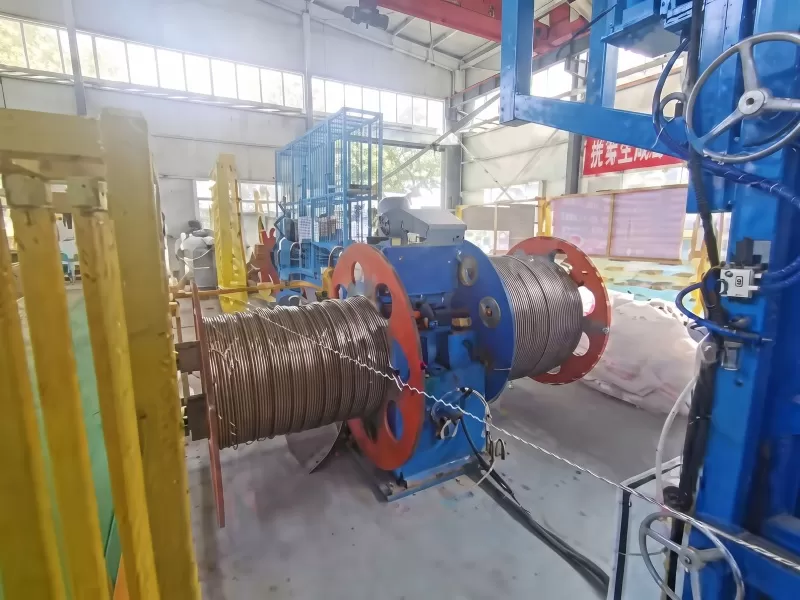
A single mandrel uncoiler uses one cantilevered shaft supported on heavy-duty
bearings. It works best for small-to-medium tube mills running standardized
production schedules where frequent coil changes are unnecessary.
- Footprint: Compact design that fits into tight workshop
spaces.
- Capital investment: Lower upfront machine cost.
- Best fit: Small-diameter tubing, furniture pipe production,
or operations using large overhead cranes with short setup cycles.
Double-Head / Rotary Uncoiler
The double-head rotary uncoiler features two mandrels mounted on a central
indexing turret. While one side feeds the welded pipe manufacturing line, the
operator loads the next coil onto the idle side.
- Changeover speed: Drops coil change time from ten minutes
down to under two minutes.
- Line continuity: Keeps your strip accumulator full,
ensuring the tube mill never stops welding.
- Best fit: High-speed ERW tube mills, structural pipe lines,
and continuous 24/7 manufacturing plants.
Double Cone Uncoiler
Instead of an expanding central shaft, double cone units support the coil by
pushing heavy conical heads into both sides of the coil eye.
- Load limits: Engineered for extreme weights, typically
exceeding 25 to 30 metric tons.
- Width range: Handles wide steel coils without the shaft
deflection issues found on long cantilevered mandrels.
- Best fit: Large-diameter spiral welded pipe mills and
heavy-gauge longitudinal submerged arc welded (LSAW) pipe lines.
Mechanical vs. Hydraulic Expansion
Securing the coil core requires positive expansion inside the inner
diameter.
Mechanical expansion relies on manual screw jacks or link bars. It costs
less, but adjusting it takes physical effort and valuable setup time.
A hydraulic reel uncoiler uses internal hydraulic cylinders
to expand wedge segments evenly against the inner wraps. It grips the strip
securely, handles out-of-round coils without slipping, and speeds up the loading
process. Modern high-output tube mills almost exclusively specify hydraulic
expansion.
2. Five Critical Technical Parameters You Must Evaluate
Reviewing machine datasheets requires strict attention to operational limits.
Never buy based on average coil sizes; plan for your maximum and minimum
extremes.
Coil Specifications (ID, OD, and Width)
Measure your raw material spectrum carefully. A standard tube mill decoiler
must handle:
- Inside Diameter (ID): Common standards are 508 mm and 610
mm. Ensure the mandrel expansion stroke covers both, or install bolt-on shoe
pads for wider variations.
- Outside Diameter (OD): Verify clearance between the fully
expanded coil and the floor or machine base. Standard ODs range from 1,200 mm to
2,000 mm.
- Strip Width: Mandrel length must support your widest strip
without excessive overhang, while still clamping your narrowest strip without
edge distortion.
Weight Capacity and Safety Margins
Never size your reel uncoiler right at your maximum coil weight. Dynamic
shock loads occur when crane operators drop coils onto the mandrel. Always
design with a 15% to 20% safety margin. If your standard coils weigh 10 tons,
select a 12-ton rated spindle to prevent bearing fatigue and shaft sagging over
time.
Strip Thickness and Material Yield Strength
The mechanical behavior of mild carbon steel differs sharply from
high-strength low-alloy (HSLA) steel, galvanized strip, or stainless steel.
Stiff, thick strip exerts tremendous back-spring force when cut open. High-yield
coils need stouter frames, heavier snubbers, and higher hydraulic clamp
pressures to maintain control during feeding.
Line Speed Synchronization
Your uncoiling speed must exceed your tube mill forming speed. In mills
equipped with strip accumulators, the uncoiler runs up to 1.5 to 2 times faster
than the forming section to refill the storage cage quickly after a
shear-and-weld cycle. If your mill forms pipe at 80 m/min, your uncoiling unit
and peelers should safely run at 120 to 160 m/min.
Braking and Tension Control
Controlling strip sag prevents edge damage and tracking errors. Two primary
braking styles dominate:
- Pneumatic Disc Brakes: Reliable, cheap to service, and
well-suited for general carbon steel mills.
- Proportional Regenerative Motor Drives: Supply continuous,
active back-tension. They adjust torque dynamically as the coil diameter
shrinks, preventing strip stretch on light gauges.
3. Essential Automation Add-ons to Maximize Workshop Throughput
A bare-bones mandrel leaves your crew exposed to injury and creates avoidable
line stoppages. Integrating modern coil handling equipment protects both
operators and strip edges.
Coil Car (Loading Car)
A floor-mounted hydraulic coil car lifts the coil, centers it with the
mandrel axis, and slides it onto the shaft smoothly. It takes the burden off
your overhead crane, cuts setup time down to seconds, and stops crane hooks from
denting precision mandrel surfaces.
Snubber Roll and Peeler Arm
Heavy coils want to uncoil like an industrial clock spring once the banding
straps are cut. A motor-driven snubber roll presses down on the outer coil wrap,
while a hydraulic peeler blade lifts the lead edge and guides it forward into
the flattener. This setup protects operators from snap-back accidents.
Automatic Centering Systems
Uneven feed causes twisted strip, camber issues, and poor welds in the
forming stands. Shifting-base uncoilers use optical or ultrasonic sensors to
read strip edges. The system shifts the entire uncoiler base hydraulically on
slide beds to keep the strip dead-center as it enters the shear welder.
Equipment builders like SANSO configure these automated modules directly into
unified mill PLC networks, enabling operators to control loading, peeling, and
feeding from a single touchscreen terminal.
4. Four Costly Mistakes Tube Pipe Plants Make During Procurement
Fabrication plants often make preventable purchasing errors that compromise
their daily output:
1. Focusing Only on Equipment Purchase Price
Buying a low-cost single mandrel uncoiler saves cash initially. However, if
your plant changes coils eight times per shift, and each manual change takes
fifteen minutes, you lose two hours of pipe production every day. Over a single
year, that lost mill run-time dwarfs the price gap of an automated double
mandrel uncoiler.
2. Underestimating Future Material Gauges
Markets evolve. A tube plant running 2.0 mm wall structural pipe today might
bid on 4.5 mm thick automotive or agricultural tubing contracts next year.
Buying a light-duty machine leaves you locked out of profitable heavy-wall
work.
3. Ignoring Downstream Equipment Integration
An uncoiler cannot function as an isolated island. It must talk directly to
your strip accumulator, flattener, and shear welder. Incompatible hydraulic
pressure loops or mismatched digital feedback signals cause strip surges, buckle
defects, and abrupt emergency stops.
4. Neglecting Maintenance Access and Spares
Heavy machinery breaks down without proper care. Choosing machines with
proprietary seals, hard-to-reach grease blocks, or unbranded hydraulic valves
leads to weeks of downtime during a simple cylinder repair. Look for robust
construction featuring standard commercial bearings and valves.
5. ROI Analysis and Maintenance Priorities
High-efficiency equipment pays for itself by turning idle hours into finished
pipe bundles.
The Economics of the Double Mandrel Unit
Consider a standard ERW tube mill producing 60 meters of pipe per minute:
- Manual single-mandrel coil switch: 12 minutes
- Hydraulic double-mandrel indexed switch: 2 minutes
- Time saved per coil: 10 minutes (600 meters of pipe
production)
- At 6 coil changes per shift across two shifts: 7,200 extra meters of
pipe output daily
In mid-to-high capacity mills, the extra tonnage covers the price difference
of a rotary double mandrel unit within six to nine months of continuous
operation.
Essential Preventative Maintenance Checklist
Keep your uncoiler running cleanly with these basic checks:
- Daily: Inspect hydraulic hoses for leaks, check main air
line pressure, and verify emergency stop switches.
- Weekly: Grease the main spindle bearings, check brake pad
wear, and clean scale buildup from the wedge tracks.
- Monthly: Run ultrasonic flaw tests on high-stress weld
joints, change hydraulic return filters, and check foundation anchor bolts for
loosening.
Frequently Asked Questions
Q1: Is a coil car mandatory for my welded pipe manufacturing
line?
A1: A coil car is not strictly mandatory for small coils under
two tons, but it is highly recommended for anything heavier. Using an overhead
crane to position heavy coils directly onto the spindle often damages the
mandrel shoes, takes twice as long, and creates severe crush hazards for your
operators.
Q2: What is the main operational difference between pneumatic and
hydraulic brakes on a reel uncoiler?
A2: Pneumatic disc brakes are
simple, low-cost, and fast-acting, making them ideal for light-to-medium gauge
mills with steady line speeds. Hydraulic brakes generate much higher holding
torque, making them better suited for thick, high-tensile steel coils that
require heavy back-tension to avoid unspooling.
Q3: How do we prevent our reel uncoiler from scratching galvanized or
polished stainless steel coils?
A3: To protect sensitive coil
surfaces, equip the mandrel expansion segments with protective polyurethane or
rubber sleeves. Additionally, install non-marking urethane coatings on the coil
car saddles, hold-down rolls, and support rollers along the entry table.
Q4: Can a single reel uncoiler handle multiple coil inner
diameters?
A4: Yes. Most hydraulic mandrels have an expansion range
of roughly 50 to 80 mm. To bridge larger gaps—such as jumping from a 508 mm (20
in) ID to a 610 mm (24 in) ID—operators install modular bolt-on expansion shoe
pads over the base mandrel segments.
Q5: Why is my strip walking off-center as it leaves the
uncoiler?
A5: Strip mistracking usually stems from three issues:
uneven coil wraps (telescoping), uneven mandrel wedge expansion that tilts the
coil axis, or an uncoiler base that is out of square with the tube mill
centerline. Installing an automatic shifting-base centering system corrects
minor variations on the fly.
Build a Reliable Foundation for Your Tube Mill
Your tube mill is only as productive as its entry section. Sizing your
reel uncoiler around proper weight tolerances, fast changeover
mechanics, and solid safety controls keeps your pipe welding line running at
full capacity shift after shift.
SANSO manufactures rugged tube mill decoilers, coil cars, and entry systems
engineered for demanding production schedules. Contact our engineering
department today to discuss your raw material specifications, review layout
drawings, or receive a formal machinery quote for your upcoming project.