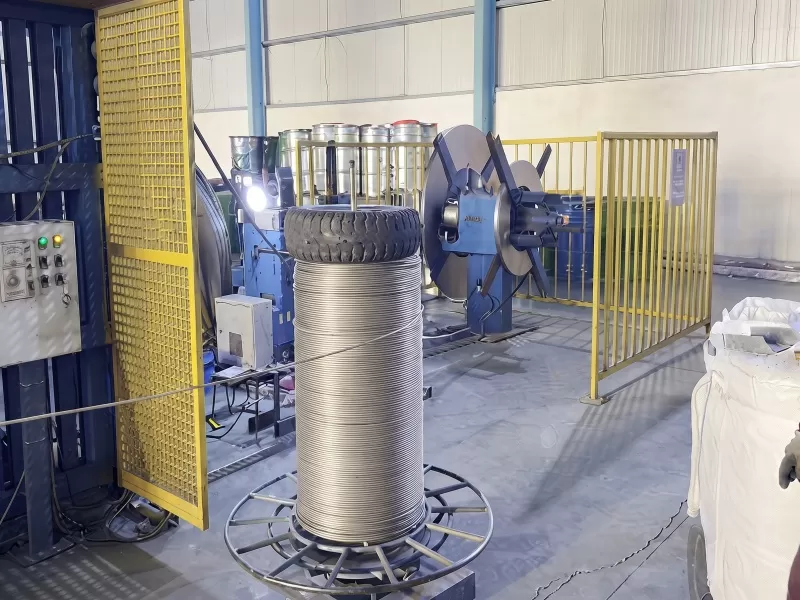
In any high-frequency ERW pipe production line, the reel uncoiler stands as
the very first piece of critical equipment. Its job sounds simple enough—unwind
steel coils smoothly and feed them into the pinch roller leveler downstream. But
in reality, edge scratches on the strip steel remain one of the primary culprits
behind surface defects, customer complaints, and rising scrap rates.
Edge scratches do more than just mar the visual quality of finished pipes.
They can compromise mechanical properties right at the weld zone. For automotive
structural parts, pressure vessels, or precision machinery applications, even a
single tiny scratch can become a stress concentration point that leads to
fatigue failure down the road.
Yet many shops focus narrowly on load capacity and expansion range when
selecting a reel uncoiler. They overlook the design details that directly
determine strip edge integrity. Drawing from 20 years of whole-line
manufacturing experience, SANSO (Hebei Sansuo Machinery Equipment Co., Ltd.) has
compiled eight proven selection tips. These come from real commissioning work
across countless production floors. Use them to eliminate edge scratches at the
source.

Tip 1: Choose a Hydraulic Expanding Mandrel for Positive Inner Coil
Locking
During uncoiling, if relative rotation or axial movement occurs between the
inner coil wrap and the mandrel, friction is inevitable. That friction generates
metal debris and direct abrasion—both of which leave permanent scratches along
the strip edges.
Selection focus: Specify a hydraulic expanding mandrel
rather than a manual mechanical type. Hydraulic expansion delivers uniform,
controllable radial clamping force. It creates a static fit between the mandrel
and the coil inner diameter, eliminating relative motion. Look for a system with
pressure sensors that automatically adjust clamping force based on coil diameter
and weight. This prevents over-expansion (which distorts the inner wrap) and
under-expansion (which invites slipping).
What SANSO does: Every reel uncoiler we build comes standard
with a hydraulic expanding mandrel. For pipe diameters ranging from 8mm to
508mm, we custom-tailor the expansion taper design to match strip thickness—from
light-gauge 1.0mm material all the way up to 16mm heavy plate. Stable inner-coil
locking holds across the entire range.
Tip 2: Inspect Mandrel Surface Hardness and Roughness
A mandrel surface that lacks wear resistance or carries excessive roughness
will directly "bite" the inner edge of the steel coil under expansion pressure.
This damage often goes unnoticed in the first few wraps. But as the strip
continues to pay out, those edge burrs keep scraping against subsequent layers,
creating long, continuous scratches.
Selection focus: The mandrel surface should undergo
hardening treatment. Hardness should meet or exceed HRC 50, with surface
roughness (Ra) at or below 1.6μm. Additionally, all mandrel edges must feature
rounded transitions—no sharp corners that contact the strip edge.
What SANSO does: We manufacture mandrels from monolithic
alloy steel forgings. After CNC turning and precision grinding, each piece
receives medium-frequency quenching and low-temperature tempering. This balances
hardness with toughness. Every mandrel undergoes surface roughness and hardness
spot checks before shipment.
Tip 3: Install Adjustable Side Guide Rollers and Axial Stops
At the uncoiler exit, strip steel tends to oscillate laterally. If side-swing
amplitude grows too large, the strip edges repeatedly collide with machine
frames or guide structures. The result: mechanical gouging. At line speeds
exceeding 80 m/min, even minor swings magnify into severe edge wear.
Selection focus: The uncoiler exit should include adjustable
side guide rollers and axial stops. The side guides require manual or hydraulic
adjustment to precisely match strip width. Roller surfaces should use
polyurethane or nylon to avoid hard metal-on-metal contact. Axial stops must
allow fine adjustment along the coil width direction, keeping the strip centered
on the mandrel throughout payoff.
What SANSO does: We design independent side-guide assemblies
for every uncoiler, with adjustment ranges that cover each customer's specified
strip width envelope. Guide roller bearings use heavy-duty designs to resist
deflection or sticking over years of continuous operation.
Tip 4: Select a Hold-Down Arm with Cushioning for Impact Protection
During the first few wraps of a new coil, irregular coil shape and released
internal stress often cause "spring-back" or bouncing. If the hold-down arm
lacks flexible cushioning, rigid downward impact will dent or scratch the strip
edges immediately.
Selection focus: The hold-down arm should incorporate
hydraulic or pneumatic cushioning. This provides soft initial contact while the
strip stabilizes, then gradually increases clamping force once running smoothly.
The hold-down roller itself requires soft, wear-resistant materials, and its
width should cover the full strip width to avoid localized pressure points.
What SANSO does: Our hold-down arms come standard with
hydraulic damping cylinders. The polyurethane rollers deliver constant, gentle
clamping force across the entire uncoiling cycle. They effectively suppress
strip flutter without damaging surface quality.
Tip 5: Match Uncoiler Speed with Downstream Processes
Speed mismatch is an easily overlooked cause of edge scratches. When the
pinch leveler or forming mill changes speed abruptly, the uncoiler must respond
just as quickly. If it lags, the strip either goes slack or experiences
over-tension at the exit. Both conditions force the strip edges to rub
abnormally against guide components.
Selection focus: The uncoiler drive system should offer AC
variable-frequency drive capability and integrate with the line-wide PLC for
speed-following and closed-loop tension control. Fast braking is equally
important—emergency stops must prevent overrun that creates loose wraps.
What SANSO does: We equip our reel uncoilers with Siemens or
ABB variable-frequency drives. Communication runs over PROFIBUS or PROFINET to
the main line controller. Speed response time stays below 200ms, ensuring
precise dynamic tracking.
Tip 6: Verify Base and Rail Rigidity—Vibration Is a Hidden Culprit
During high-speed operation, insufficient base rigidity or excessive
guide-rail clearance introduces high-frequency micro-vibration. You won't see it
with the naked eye. But those tiny oscillations cause the strip edge to
repeatedly impact mandrel corners or guide rollers at microscopic scale. The
visible result: periodic light scratches along the edge.
Selection focus: The uncoiler base should feature a welded
box-section structure, with stress-relief annealing after welding. Heavy-duty
linear guide rails paired with precision ballscrews or hydraulic cylinders keep
sliding clearances within 0.02mm.
What SANSO does: We fabricate uncoiler bases from plate
steel 20mm or thicker. After welding, the entire assembly undergoes annealing,
then one-fixture machining on a gantry machining center for guide-rail mounting
surfaces. This ensures flatness and parallelism that resist vibration through
structural stiffness redundancy.
Tip 7: Choose an Intelligent Uncoiler with Edge Position Sensing
Human eyes cannot monitor strip edge behavior in real time throughout the
entire uncoiling process. Sensors can. An edge position sensor (EPS) tracks
lateral edge displacement continuously and automatically adjusts side guides or
axial mandrel position to correct deviation. This keeps edge wander within ±1mm,
preventing edge-to-hardware collisions from the start.
Selection focus: Prioritize uncoilers with photoelectric or
laser-based EPS. These offer fast signal response and strong noise immunity. The
correction actuator should be hydraulic servo or electric linear drive with
response frequency of 10 Hz or higher.
What SANSO does: We can equip any uncoiler with an EPS
closed-loop system that seamlessly integrates with our side-guide design. This
delivers fully automatic edge tracking—particularly beneficial for thin strip or
wide-coil precision uncoiling applications.
Tip 8: Evaluate the Manufacturer's Whole-Line Experience
Here's the most overlooked point: A reel uncoiler never works in isolation.
It might perform beautifully during standalone testing. But if dynamic
coordination with downstream equipment—the pinch leveler, shear welder, looping
tower, and forming mill—is off, edge scratches will still appear.
Selection focus: Work with suppliers that design and
manufacture complete production lines. Only a whole-line provider understands
the speed chain, tension matching, and dynamic response requirements well enough
to incorporate coordination interfaces and control margins from the very start
of the uncoiler design phase.
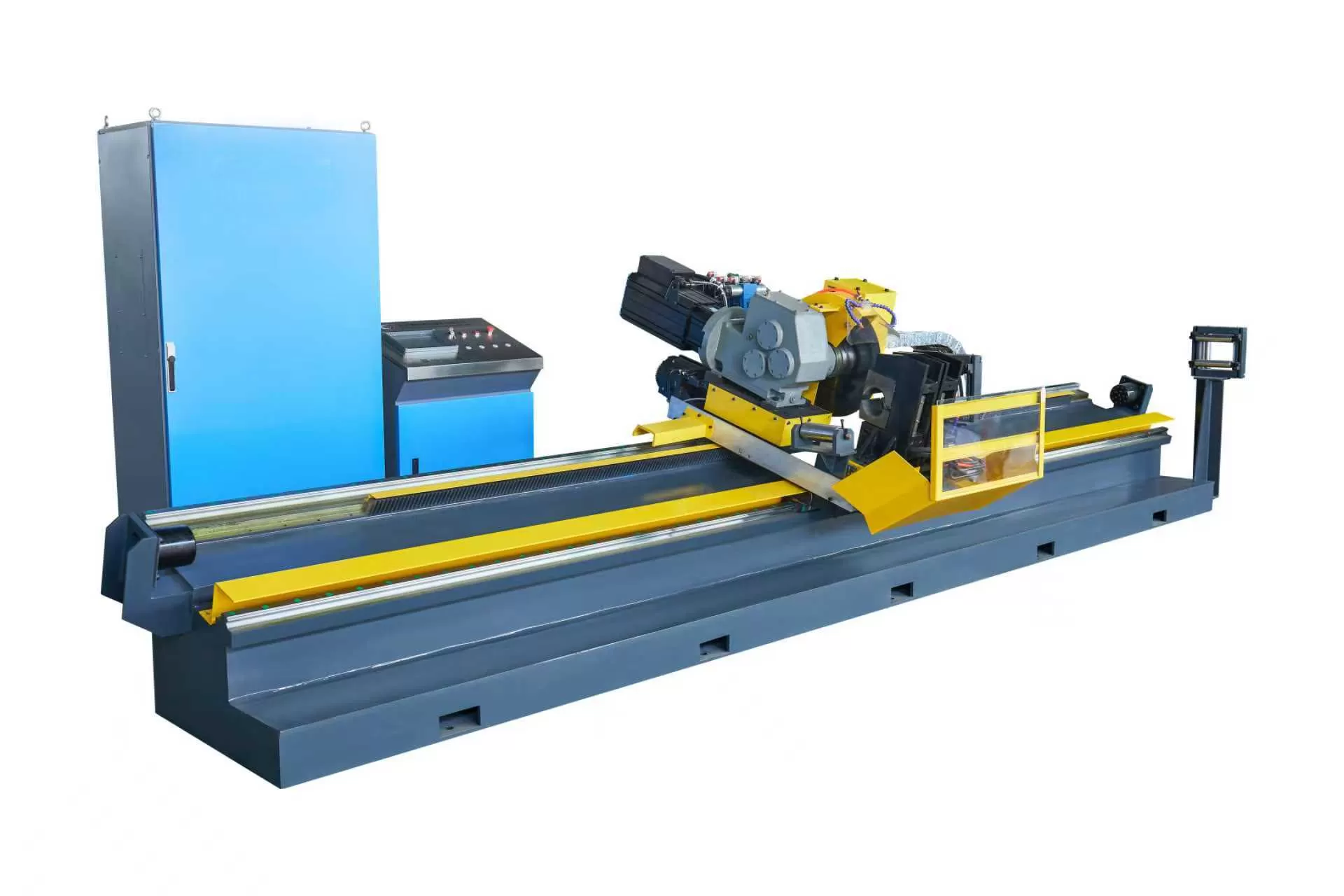
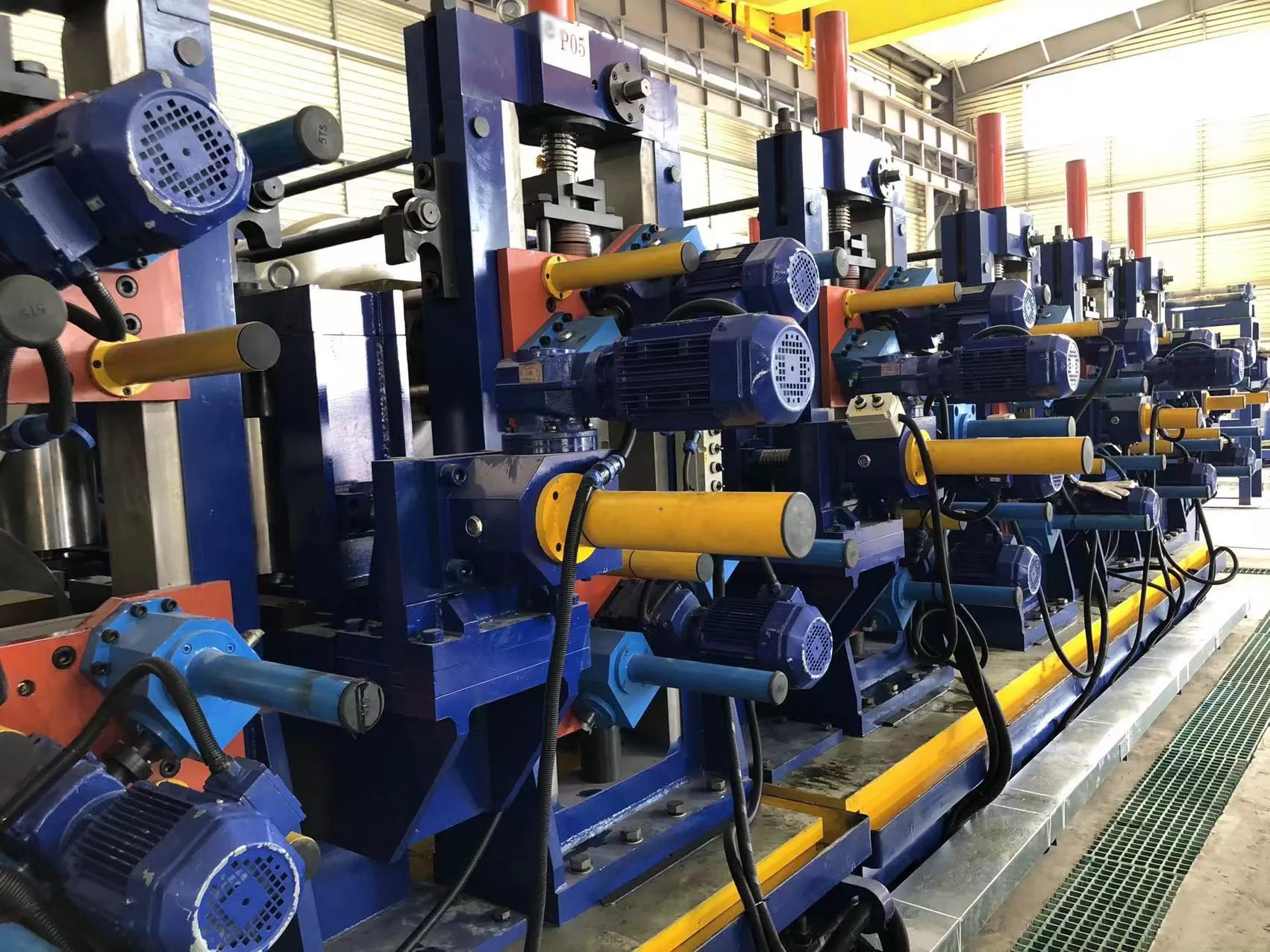
What SANSO does: We are not an assembly shop that merely
bolts together bought-in components. SANSO designs and manufactures complete ERW
straight-seam pipe production lines covering diameters from 8mm to 508mm. Beyond
the reel uncoiler, we produce pinch levelers, shear welders, horizontal spiral
accumulators, and fully automatic packing systems. Even more importantly, SANSO
fabricates roughly 90% of all parts in-house (excluding standard purchased items
like bearings, hydraulic cylinders, gearboxes, and electrical components). From
bed casting to precision machining, everything happens under our own roof. This
gives us far tighter control over fit and coordination between the uncoiler and
follow-on equipment than any outsourced-assembly competitor can offer.
Final Word: Scratch-Free Edges Start with the Right Reel Uncoiler
Edge scratches may seem like a minor nuisance. In high-frequency pipe
welding, however, they often become the deciding factor in yield rates, customer
satisfaction, and production costs. SANSO's eight selection tips cover every
critical dimension: mandrel design, hold-down structure, guiding systems, drive
control, base rigidity, intelligent sensing, and whole-line synergy. Each tip
draws from two decades of real-world production-floor verification.
If you are evaluating a new reel uncoiler, or if you want to solve existing
scratch problems on your line, reach out to SANSO's technical team. We will work
from your actual strip parameters—width, thickness, material grade, coil weight,
and line speed—to deliver a tailored selection calculation and system design.
You will get more than a product spec sheet. You will get a solution built for
your specific conditions.
FAQ: Five Common Questions About Reel Uncoiler Selection
Q1: What is the most common cause of edge scratches in a reel
uncoiler?
A1: The most frequent root cause is relative motion
between the coil inner wrap and the mandrel. When the mandrel fails to lock the
inner diameter securely, the coil rotates or shifts axially during payoff. This
friction generates metal particles and direct abrasion that mark the strip
edges. Hydraulic expanding mandrels with pressure sensors effectively eliminate
this problem by maintaining a consistent static fit.
Q2: How does line speed affect the risk of edge
scratches?
A2: Higher line speeds amplify every vibration and
alignment issue. At speeds above 80 m/min, even minor lateral swing or
micro-vibration creates repeated edge impacts. Speed mismatches with downstream
equipment also induce slack or over-tension, both of which force edge contact
with guide surfaces. AC variable-frequency drives with fast response and
closed-loop speed control are essential for high-speed lines.
Q3: Can I retrofit an existing reel uncoiler with edge position
sensing (EPS)?
A3: Yes, most conventional uncoilers can be
retrofitted with photoelectric or laser EPS systems. The retrofit typically
includes adding sensors at the exit side, installing correction actuators, and
integrating control logic with the existing PLC. However, the mechanical
structure must have sufficient adjustment range and rigidity to respond
effectively. SANSO offers EPS retrofit packages for most major uncoiler
brands.
Q4: Why does mandrel surface hardness matter for edge
quality?
A4: A mandrel that is too soft wears quickly under
expansion pressure. Worn surfaces become rough or develop localized depressions
that transfer irregularities to the coil inner edge. Once that inner edge
develops burrs or roughness, those defects propagate outward as the strip
uncoils, causing scratches along the entire length. Hardness above HRC 50 and
proper surface finishing prevent this degradation.
Q5: How do I know if my uncoiler needs upgrading versus
repair?
A5: If you see edge scratches that appear consistently at
the same location on the strip, or if the pattern worsens with newer coils, the
uncoiler may have structural issues like worn guide bearings, loose mandrel
segments, or degraded hydraulic pressure stability. When repairs address these
items but scratches persist, the uncoiler's basic design—such as inadequate base
rigidity or missing buffering—may be the limiting factor. An upgrade to a modern
hydraulic expanding design with closed-loop control often delivers immediate,
lasting improvement.
Ready to eliminate edge scratches from your ERW pipe line?
Get in touch with SANSO for a no-obligation consultation. Send us your strip
specs and line requirements. We will recommend the right reel uncoiler
configuration and share case studies from customers who solved similar
edge-scratch challenges. Contact SANSO today—because every perfect pipe
starts with a perfect uncoiling process.