In heavy-duty industrial manufacturing, particularly within tube and pipe
production, the feeding phase sets the standard for the entire production line.
Continuous operation relies on the seamless payoff of sheet metal or steel strip
from massive coils. If the initial feeding process experiences tension
fluctuations or misalignment, the downstream roll forming and welding processes
suffer from defects. This makes the search for a reliable decoiler for sale a
primary task for plant managers and procurement teams aiming to maintain
consistent throughput. SANSO offers engineering solutions designed to address
these initial production stages, ensuring that raw material is fed with steady
tension and precise alignment.
The role of coil payoff equipment extends beyond merely holding a steel roll.
It serves as the primary regulator of material flow, managing the transition
from static, tightly wound coils to a flat, continuously moving strip. Without
precise control at this stage, downstream processes such as high-frequency
welding or structural roll forming face compounding errors. Selecting an
appropriate system requires a deep understanding of mechanical capacities, drive
configurations, and integration possibilities.
Addressing Common Failures in Heavy-Duty Coil Handling
Coil handling presents several operational obstacles. Large steel coils,
often weighing between 5 to 20 metric tons, possess significant rotational
inertia. When a tube mill starts, accelerates, or stops, the decoiling equipment
must synchronize perfectly with these speed variations. If synchronization
fails, several mechanical issues occur that can disrupt the entire manufacturing
schedule.
One common issue is coil overrun, which occurs when the tube mill slows down
but the heavy coil continues to spin due to momentum. This leads to loop
sagging, material damage, or severe mechanical jams. Another challenge is strip
center-line deviation. If the mandrel does not maintain a perfectly
perpendicular axis relative to the forming mill, the steel strip feeds at an
angle. This misalignment results in uneven forming pressures, premature roll
wear, and spiraled weld seams.
From an operational safety standpoint, structural deflection is also a major
concern. Overloading a cantilevered mandrel causes angular drooping. This
deflection changes the entry angle of the strip into the flattener or entry
guide, leading to edge wave defects in the finished pipe. Consequently,
identifying a heavy-duty decoiler for sale with a robust main shaft and
high-capacity bearings is necessary to avoid these structural failures.
Additionally, surface marking on sensitive materials like stainless steel or
pre-painted coil remains a concern. Standard steel mandrels can scratch the
inner wraps during expansion. Selecting a specialized decoiler with customized
mandrel segments or protective sleeves helps prevent these surface
imperfections, preserving material quality throughout the process.
Key Engineering Parameters of Modern Decoilers
When researching a decoiler for sale, evaluating structural specifications
prevents premature equipment wear and operational bottlenecks. The mechanical
architecture must support the maximum weight, width, and outer diameter of the
incoming coils.
Mandrel Expansion Mechanics
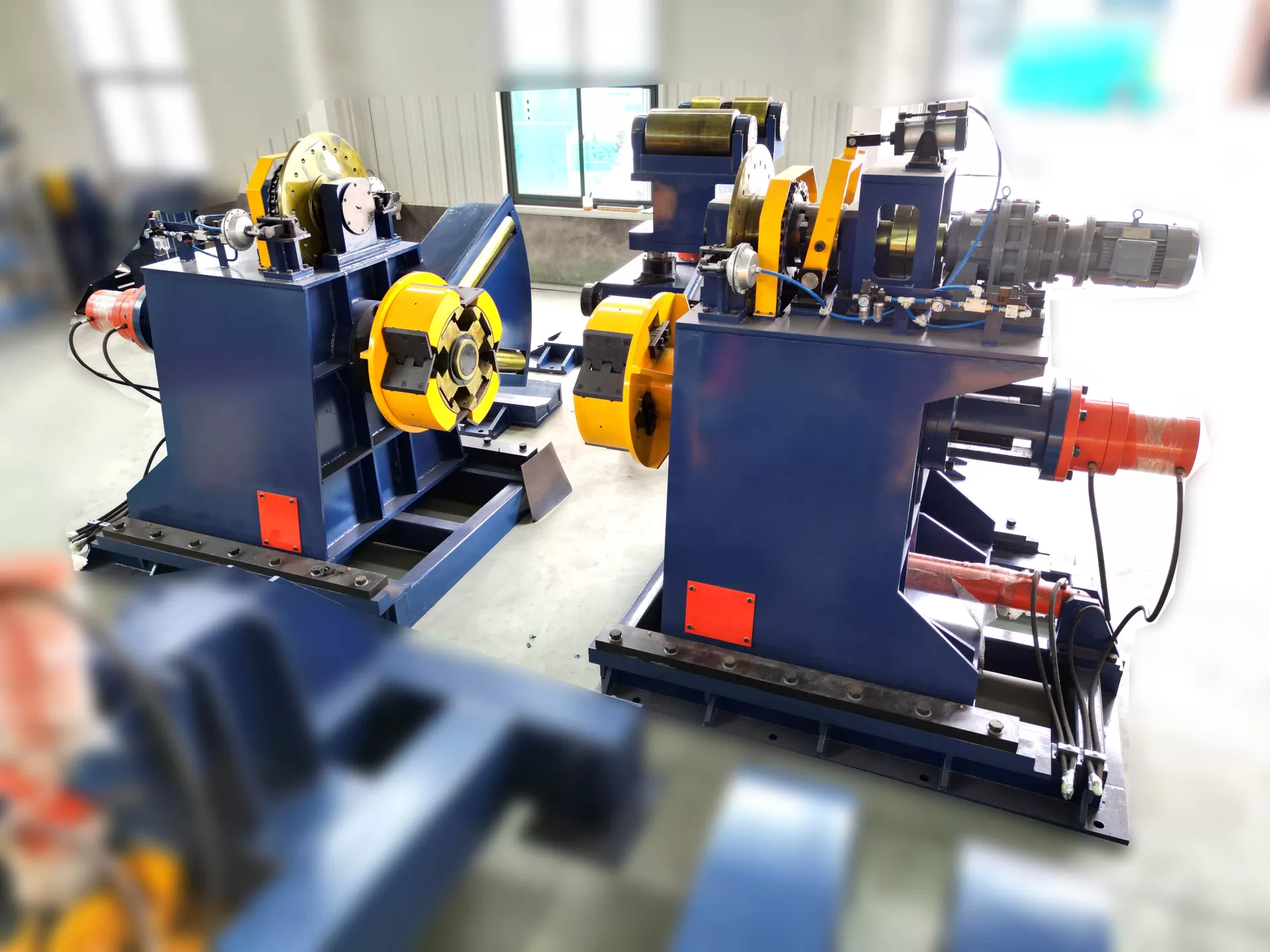
The mandrel is the central shaft that secures the coil from the inside. There
are two primary expansion methods: manual and hydraulic. Manual expansion,
operated via a hand crank or wedge mechanism, is suitable for lighter coils
under 3 tons where quick changeovers are not the primary concern. For
high-output operations handling heavy coils, hydraulic expansion is preferred. A
hydraulic cylinder drives a wedge-link mechanism to expand the mandrel segments
evenly, exerting constant radial force against the inner diameter of the coil to
prevent slippage during acceleration.
Tensioning and Braking Assemblies
Maintaining back-tension is required to prevent the outer wraps of the coil
from clock-springing or unwinding prematurely. Passive systems use mechanical
friction bands or pneumatic disc brakes to apply a constant resistive torque.
For more demanding configurations, active regenerative AC drive systems assist
in both decoiling and rewinding. These active systems adjust the torque
dynamically as the coil diameter decreases, keeping the strip tension constant
without manual intervention.
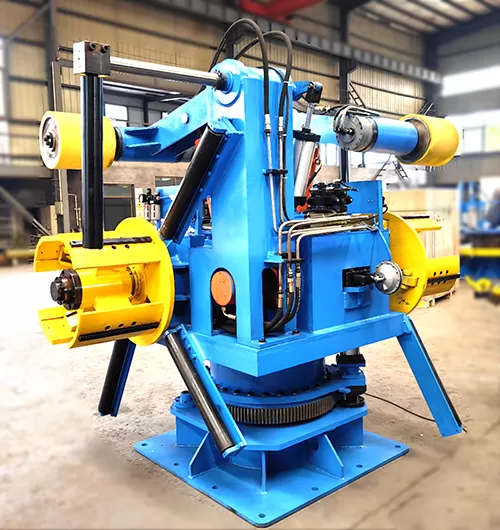
Support Structures: Single-End vs. Double-End Configurations
Single-end decoilers feature a cantilevered mandrel supported by a robust
frame on one side. This design allows for easy loading of coils via overhead
cranes or coil cars. Double-end decoilers, on the other hand, feature two
mandrels mounted on a rotating base. While one side feeds the active line, the
operator can load the next coil onto the opposite side. This arrangement reduces
changeover times in high-volume production facilities.
Integrating a Decoiler with SANSO Tube Mill Lines
The relationship between the payoff station and the entry guide section of a
tube mill is direct. A mismatch in speed or tension propagates down the line,
affecting the high-frequency induction welding quality. SANSO designs decoiling
systems to communicate directly with the central PLC of the tube mill line.
In a typical setup, loop control sensors—such as ultrasonic sensors or
photoelectric arrays—are positioned between the decoiler and the shear and
welder unit. These sensors continuously monitor the depth of the slack loop. If
the loop becomes too shallow, indicating that the mill is pulling material
faster than the decoiler is paying it out, the PLC signals the decoiler motor to
speed up. Conversely, if the loop becomes too deep, the braking system engages
to decelerate the spool. This closed-loop control system protects the strip from
stretching and avoids abrupt tension spikes that can misalign the forming
rolls.
Beyond loop control, modern systems utilize variable frequency drives (VFDs)
to manage acceleration and deceleration curves. When processing thin-walled
tubes, sudden jerks can deform the strip edges. Smooth ramping, coordinated
between the SANSO pay-off unit and the forming mill, prevents material waste
during line start-stop cycles.
Material Adaptability and Width Capacities
Industrial manufacturers work with a wide range of materials, from soft
aluminum and copper to high-strength low-alloy (HSLA) steels. Each material
exhibits distinct spring-back characteristics and surface sensitivities.
When evaluating a decoiler for sale for HSLA steel applications, the
equipment requires high-torque expansion mechanisms to overcome the natural
resistance of the material. Heavy-duty snubber arms, powered pneumatically or
hydraulically, are also necessary. These arms press against the outside diameter
of the coil during the banding-cut phase, preventing the high-strength steel
from spring-uncoiling violently and injuring operators. For softer or polished
alloys, polyurethane segment covers or non-marking rollers are integrated into
the path to ensure the strip surface remains pristine.
Width capacity is another dimension that requires careful matching. A machine
designed for narrow strips may experience shaft bending if loaded with a wide,
cantilevered coil. Conversely, using a wide-capacity machine for extremely
narrow strips can lead to uneven tension distribution across the mandrel
segments. Proper alignment guides and adjustable lateral locators must be
verified when selecting a configuration.
Key Factors to Verify Before Purchasing a Decoiler
Selecting a suitable unit involves analyzing several operational variables
beyond weight capacity. Procurement teams should focus on structural integrity
and future line scalability.
Width and OD/ID Range: Ensure the mandrel expansion range
accommodates all expected coil inner diameters (typically 508mm to 610mm in
standard steel mills).
Coil Load Car Compatibility: For operations handling coils
over 5 tons, manual loading becomes inefficient and poses safety challenges. A
motorized coil load car lifts the coil, aligns it axially with the mandrel, and
slides it onto the shaft smoothly, reducing loading times to under five
minutes.
Safety Interlocks: The system should feature emergency stop
integration, physical safety barriers, and pressure-switch interlocks that
prevent the mandrel from collapsing while the coil is rotating.
Drive System Coordination: Determine whether a
non-motorized (pull-off) decoiler with a drag brake is sufficient, or if a
motorized unit is necessary to feed the material without relying solely on the
tube mill’s forming stands to pull the strip.
By conducting a thorough assessment of these factors, manufacturers can
prevent operational bottlenecks and ensure their raw material preparation stage
aligns with downstream production speeds.
Frequently Asked Questions
Q1: What is the primary difference between a motorized and a
non-motorized decoiler?
A1: A motorized decoiler uses an electrical or hydraulic motor to actively
rotate the mandrel and feed the material, regulated by loop sensors. A
non-motorized decoiler relies on the downstream machine (such as a tube mill or
roll former) to pull the material, utilizing a friction brake to maintain
tension and prevent overrun.
Q2: How do you select the correct mandrel expansion range for varying
coil inside diameters?
A2: Most industrial coils have standard inside diameters of 508mm or 610mm. A
versatile decoiler for sale should feature adjustable mandrel segments or
expansion shoes that can bridge these dimensions, allowing the machine to clamp
securely onto both sizes without needing custom tooling.
Q3: Why is a snubber arm necessary for high-strength steel
coils?
A3: High-strength steels possess significant elastic memory. When the
strapping bands holding the coil are cut, the steel strip tends to unwind
violently. A hydraulic snubber arm holds the outer wrap securely against the
coil body, allowing safe threading of the material into the entry guides.
Q4: How does a coil car improve efficiency in a tube production
line?
A4: A coil car pre-stages the next coil while the current one is running.
When the line stops, the car aligns and transfers the new coil onto the mandrel,
minimizing crane dependency, reducing manual labor, and shortening changeover
times.
Q5: Can a single decoiler handle both narrow and wide strips
efficiently?
A5: Yes, provided the mandrel length matches or exceeds the maximum strip
width, and the tension system can be calibrated for lower resistance when
handling narrower, thinner strips to prevent stretching.
Technical Consultation and Support from SANSO
Selecting the correct equipment requires matching mechanical capabilities
with specific production targets. SANSO manufactures tailored decoiling and coil
handling systems designed to withstand continuous industrial operations. To
discuss your line layout, material specifications, or to request a quote for an
industrial decoiler for sale, please contact our engineering department for a
detailed consultation.