Every continuous welded tube production line starts with a heavy coil of
steel. If the raw material cannot enter the line smoothly, safely, and without
interruption, downstream forming stands, high-frequency welders, and flying
cut-offs simply sit idle.
The uncoiler serves as the mechanical anchor of your entire tube mill. A
failure here brings the entire mill to an immediate halt. In 2026, tube
manufacturers face heavier coils, harder high-strength steel grades, and tight
delivery schedules that leave no room for unscheduled downtime.
This technical guide explains how to evaluate, select, and configure the
right un coiler for your welded tube operations. Written by the engineering team
at SANSO, this guide draws upon over two decades of heavy machinery
manufacturing experience to help you make an informed capital investment.
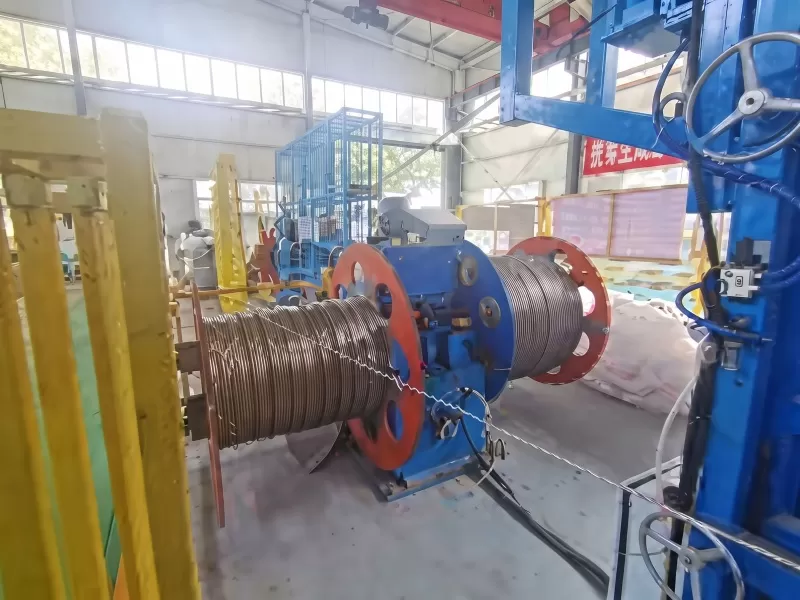
Understanding Uncoiler Types for Modern Tube Mills
Selecting the correct welded tube mill decoiler depends on your pipe diameter
range, wall thickness, coil weight, and target line speed. Tube mills generally
utilize two primary uncoiler configurations.
The single mandrel cantilever design supports the coil from its inner
diameter on an overhung shaft. A hydraulic cylinder actuates internal wedge
segments to expand the mandrel and grip the coil firmly.
Best applications: Small to medium ERW tube mills producing
outer diameters (OD) from 8mm to 76mm.
Weight capacities: Typically configured for coils weighing
between 1.5 tons and 10 tons.
Key advantages: Compact footprint, lower initial capital
cost, and straightforward mechanical maintenance.
For operations running lighter gauges or where floor space remains
constrained, a single mandrel hydraulic uncoiler provides reliable performance.
However, every coil change requires line stoppage unless paired with a large
capacity strip accumulator.
2. Double-Head Swivel / Double Cone Decoiler
High-speed lines and heavy-gauge pipe mills require continuous operation. A
double-head swivel uncoiler features two independent mandrels mounted on a
rotating central base. While one mandrel pays off strip into the tube mill, the
crane operator loads the next coil onto the idle mandrel on the opposite
side.
Best applications: Medium-to-heavy ERW pipe mills producing
diameters from OD 76mm up to 508mm and structural square tubes.
Weight capacities: Heavy-duty versions handle from 10 tons
up to 35 tons per side.
Key advantages: Coil preparation happens off-line. Once the
running coil ends, the unit rotates 180 degrees, cutting coil changeover time
down to seconds.
For thick-walled materials and high-yield line configurations, double cone
decoilers provide dual-sided support. This dual cone design eliminates excessive
cantilever stress when supporting massive steel coils.
3. Specialized Tension Decoiler for Premium Materials
When running polished stainless steel, pre-galvanized strip, or advanced
high-strength steels (AHSS), standard passive uncoiling can cause surface
scratching or edge stretching. Motorized uncoilers equipped with variable
frequency drives (VFD) and closed-loop back-tension control feed the strip
precisely without allowing loose wraps or slippage.
Critical Technical Specifications to Evaluate Before Purchasing
Selecting an uncoiler based only on maximum weight capacity leads to
operational bottlenecks. A reliable ERW pipe making machine uncoiler must match
multiple mechanical and operational parameters.
1. Coil Physical Dimensions and Yield Strength
Your equipment fabricator must design the machine base around your actual
coil specifications:
Coil Weight: Account for maximum incoming master coil
weight, including a 20% safety margin.
Inner Diameter (ID) Range: Standard master coils arrive
with 508mm (20 in) or 610mm (24 in) inner cores. Your hydraulic mandrel must
expand and contract smoothly across this full range, often utilizing bolt-on pad
extensions when necessary.
Outer Diameter (OD) Range: Verify clearance between the
expanded mandrel centerline and the mill floor line.
Strip Thickness and Width: Thicker strip (above 4mm)
requires significantly higher holding torque and a motorized snubber arm to
prevent dangerous outer-wrap springing.
2. Mandrel Expansion and Shaft Integrity
Cheap uncoilers often suffer from shaft deflection. When an uncoiler shaft
flexes under load, bearings wear prematurely and strip tracking wanders
off-center before reaching the pinch rolls.
Ensure the main mandrel shaft uses forged 42CrMo alloy steel, heat-treated
and precision-ground. Hydraulic expansion cylinders should incorporate dual
pilot-operated check valves to prevent loss of hydraulic grip if line power
drops.
3. Braking and Tension Control Systems
When a tube mill stops abruptly, coil inertia causes loose wraps
(clockspringing). An effective tube mill uncoiler incorporates heavy-duty
pneumatic or hydraulic disc brakes.
Proportional brake control adjusts clamping force as the coil diameter
decreases. This maintains steady back-tension, protecting the strip leveler and
accumulator from tension spikes.
4. Snubber Rolls and Peeler Blades
Thick-gauge strip contains extreme residual bending stress. Once retaining
straps are cut, the leading strip end can snap open violently.
A heavy duty hydraulic uncoiler should include a motorized hold-down
(snubber) roll to press against the outer diameter. A hydraulic peeler blade
lifts the leading strip edge and guides it straight into the flattener or pinch
roll without manual operator handling.
5. Automated Coil Loading Cars
Waiting for an overhead crane to position every single coil drastically
lowers Overall Equipment Effectiveness (OEE). Integrating a hydraulic coil car
turns coil loading into a continuous process.
The coil car retrieves a coil from a storage saddle, raises it hydraulically
to the mandrel centerline, and traverses horizontally onto the shaft. This
allows rapid, centered loading while keeping crane hooks free for other plant
tasks.
An uncoiler does not work in isolation. It functions as the feed module of
the entry section, which directly affects strip tracking and weld
consistency.
The uncoiler must align perfectly with the strip flattener, shear and end
welder, and the spiral or horizontal strip accumulator. If the uncoiler sits
even two millimeters out of parallel with the entry guide, the strip will
camber. Cambered strip enters the forming stands off-center, producing
asymmetric tube edges and high-frequency weld defects.
SANSO designs integrated entry-section systems where the un coiler, coil car,
and entry flattener share a unified sub-base. This pre-aligned structure
eliminates alignment errors during field installation and keeps the strip
centered under continuous tension.
Why Global Tube Manufacturers Choose SANSO Machinery
Purchasing an uncoiler represents a multi-decade machine commitment. Tube
mill owners need heavy structural fabrications built to withstand continuous
industrial vibration.
Direct Manufacturing, Not Sourced Assembly
SANSO manufactures more than 90% of all mechanical components in-house. From
cutting heavy steel plates and stress-relieving welded machine frames to
precision CNC boring of bearing housings, SANSO controls quality at every
production phase. We do not re-badge outsourced equipment.
Over 20 Years of ERW Pipe Mill Expertise
SANSO brings over two decades of dedicated engineering focus across the
entire welded tube sector. Our experience covers light-gauge precision tube
mills (OD 8mm) up to heavy API-grade pipe plants (OD 508mm). We understand the
practical physics, strip forces, and brake torques required for various steel
grades.
Designs Informed by Field Commissioning
Our mechanical and electrical engineers spend months on factory floors
commissioning lines worldwide. We design equipment based on real operator
feedback:
Accessible lubrication points so maintenance teams can grease bearings
quickly.
Protected hydraulic lines routed inside the frame to prevent damage from
falling steel straps.
Intuitive operator control stations with manual overrides for smooth
setup.
Custom Unit Retrofits and Full Turnkey Lines
Whether you need a complete, automated tube mill line or a standalone custom
coil reel machine to replace an outdated decoiler, SANSO builds equipment to
match your exact floor dimensions and operational goals.
Return on Investment: How Upgrading Your Uncoiler Saves Money
Upgrading from an obsolete, manual uncoiler to a high-efficiency double-head
swivel system produces measurable cost savings.
Consider a standard ERW tube line producing 60 meters per minute on
medium-gauge hollow sections:
Manual coil loading: 12 to 18 minutes per coil change using
an overhead crane.
Double-head swivel uncoiler with coil car: Less than 3
minutes to rotate and feed the new strip end into the shear welder.
Production gained: Saving 10 minutes per coil over 15 coil
changes per day yields 150 minutes of recovered production time daily.
Over a standard 250-day production year, this recovered time generates
hundreds of additional production hours. The uncoiler pays for itself within
months through raw volume output and reduced crane dependency.
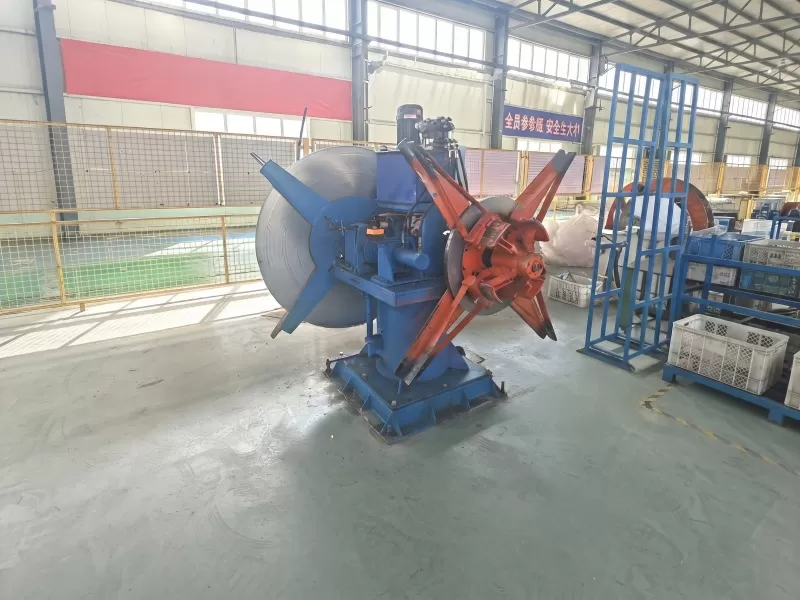
Essential Maintenance Checklist for High-Uptime Uncoilers
Keep your welded tube mill decoiler operating at peak efficiency by enforcing
routine preventative maintenance routines.
Daily Checks
Inspect hydraulic pressure gauges on the expansion circuit to confirm
correct clamping force.
Verify that pneumatic disc brake pads are free from oil and grease
contamination.
Check the snubber roll rubber or polyurethane sleeve for surface gouges or
wear.
Weekly Checks
Grease the main mandrel spindle bearings and swivel base ring gear.
Inspect the expansion wedge slides for metal debris; clean and apply fresh
high-load grease.
Check hydraulic hose connections on the coil car and lift cylinders for
leaks or chafing.
Monthly Checks
Measure brake disc thickness and pad wear; replace pads before metal backing
makes contact.
Verify mechanical alignment between the uncoiler spindle and downstream
flattener rolls.
Check hydraulic oil cleanliness and replace return line filters as
scheduled.
Frequently Asked Questions (FAQ)
Q1: Should I choose a single mandrel or double-head uncoiler for my
tube mill?
A1: Choose a single mandrel uncoiler if you run
small-diameter pipes, produce lower daily tonnage, or have limited floor space.
Choose a double-head swivel uncoiler if you run continuous, high-speed lines or
medium-to-large diameter pipes where cutting coil changeover time directly
increases daily profitability.
Q2: How do I prevent high-strength steel coils from uncoiling
dangerously when cutting the straps?
A2: Always specify an uncoiler
equipped with a heavy-duty hydraulic snubber arm (hold-down roll) and a
hydraulic peeler blade. The snubber roll applies direct downward pressure on the
coil outside diameter while the straps are cut, allowing the operator to feed
the lead edge forward safely without manual contact.
Q3: Can a SANSO uncoiler integrate with my existing, older tube mill
line?
A3: Yes. SANSO regularly builds custom retrofit uncoilers
designed to match existing centerline heights, strip widths, and control
interfaces. We can configure the electrical and hydraulic systems to interface
with your existing line PLC or supply a dedicated standalone control
station.
Q4: What is the standard expansion range for tube mill decoiler
mandrels?
A4: Most standard mandrels provide an expansion range
between 470mm and 520mm to grip standard 508mm (20-inch) inner diameter coils.
By attaching bolt-on expansion shoe segments, the same mandrel can expand from
580mm to 620mm to handle 610mm (24-inch) ID coils securely.
Q5: What braking system works best on a heavy-duty tube mill
uncoiler?
A5: Pneumatic or hydraulic caliper disc brakes combined
with proportional pressure regulating valves provide the best performance. This
setup allows the operator to fine-tune back-tension as the coil unwinds,
preventing over-spin during emergency line stops while avoiding excessive drag
on small coils.
Upgrade Your Tube Mill Entry Section with SANSO
A reliable tube mill starts with a rigid, high-performance uncoiler built for
tough factory environments. Avoid costly downtime caused by undersized frames,
slipping mandrels, and slow manual coil changes.
The technical team at SANSO will review your coil dimensions, steel grades,
line speeds, and factory floor plan to build an uncoiling system matched to your
exact production requirements.
Contact our engineering department today. Send us your coil
weight, strip thickness, and tube size parameters to receive a detailed
engineering proposal and commercial quotation for your plant.