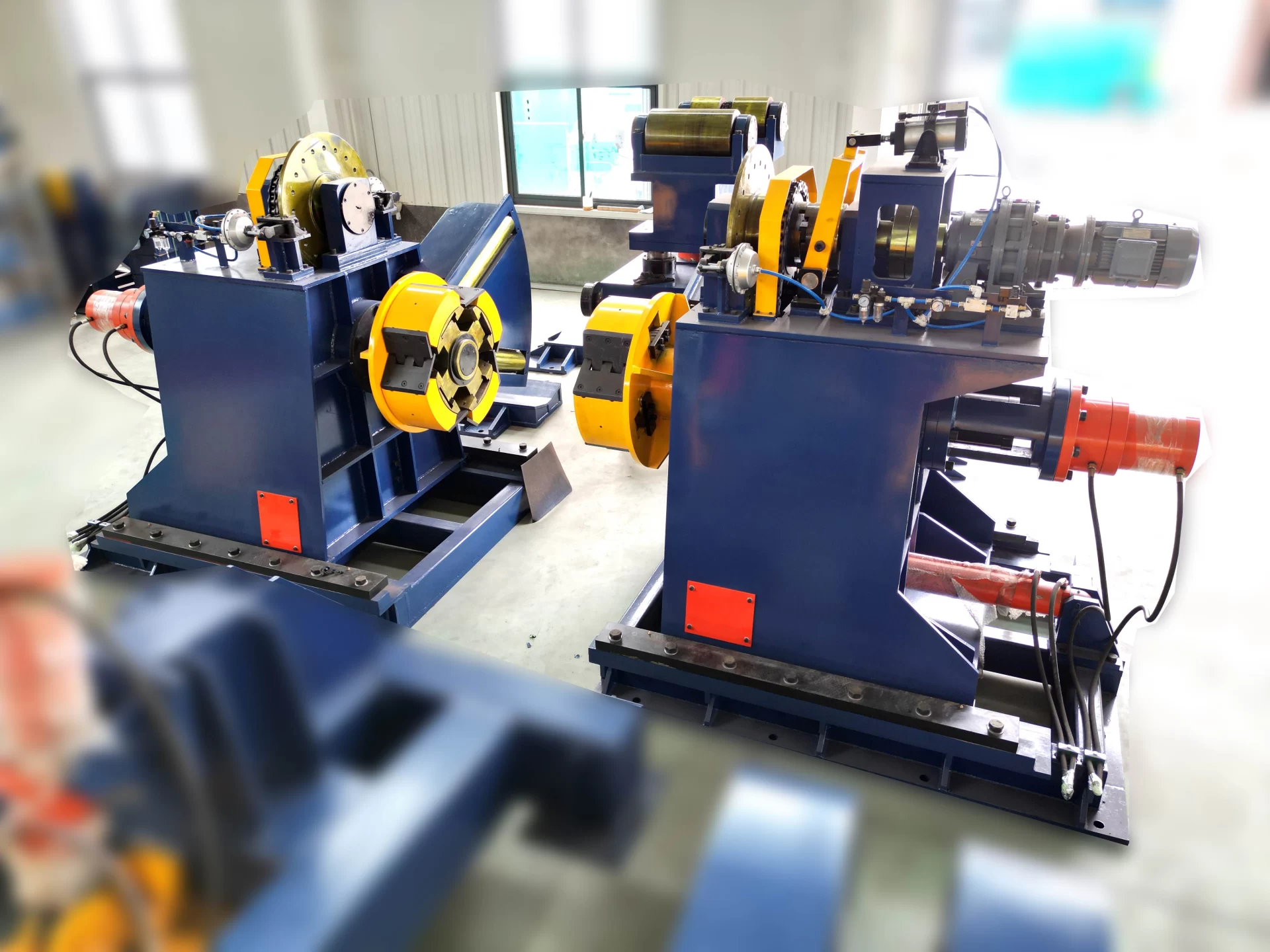
A tube mill is only as fast as its front-end feed system. If you run into
coil-loading bottlenecks, misaligned strip edges, or slow coil changeovers, your
entire tube welding line stalls. Choosing the right machinery prevents these
costly shutdowns.
At SANSO, we help pipe and tube manufacturers configure
robust feeding equipment engineered for tough plant conditions. If you are
planning an equipment upgrade or commissioning a new line, contact our technical team today for an upfront equipment assessment.
Tube mills face tougher demands heading into 2026. Processors run thicker
gauges, wider master coils, and advanced high-strength steels (AHSS). At the
same time, floor managers must cut downtime and protect workers from handling
hazards. This guide breaks down the mechanical vs. hydraulic debate so you can
specify the right uncoiling solution with total confidence.
The Critical Role of the Steel Coil Decoiler in Modern Tube Mills
Every tube mill operates as a continuous production system. While downstream
components like high-frequency solid-state welders and cold saws receive heavy
investment, upstream feed stability sets the baseline for the entire
process.
A steel coil decoiler does far more than hold raw strip. It
centers the coil, matches the line feed rate, controls strip tension, and guides
the leading edge straight into the shear and end welder. When an uncoiler lacks
rigidity or slips under dynamic braking, edge-wave defects follow
immediately.
Modern tube manufacturing prioritizes scrap reduction and rapid changeover.
An improper decoiler causes coil-slip, strip marking, and off-center tracking
into the breakdown forming stands. Those issues quickly damage precision roll
tooling. Upgrading your uncoiling system removes these systemic production
bottlenecks.
Core Mechanics: Mechanical vs. Hydraulic Steel Coil Decoiler
Understanding the mechanical differences helps clarify performance
expectations on the plant floor. Both systems support and pay off slit steel
coils, but their mandrel expansion, weight handling, and tensioning methods
differ significantly.
Mechanical Steel Coil Decoiler: Operating Principles
A mechanical uncoiler relies on manual or screw-driven linkages to expand the
mandrel segments. The operator inserts a hand crank or turns a mechanical screw
to spread the arbor leaves outward until they press against the inner diameter
(ID) of the steel coil.
- Drive System: Friction-brake tensioning or simple
fixed-speed gearmotors.
- Mandrel Expansion: Manual hand crank, screw-jack, or
scissor linkage.
- Typical Capacity: Designed for light coils, usually under 3
to 5 metric tons.
- Best Suited For: Low-speed ornamental tubing, thin-wall
conduit, and low-volume batch runs.
Because the mechanical link requires physical effort to engage, achieving
consistent clamping force across the entire coil width is difficult. Heavy
vibration during high-speed payoff can cause mechanical wedges to loosen over
extended production hours.
Hydraulic Steel Coil Decoiler: Power and Automation
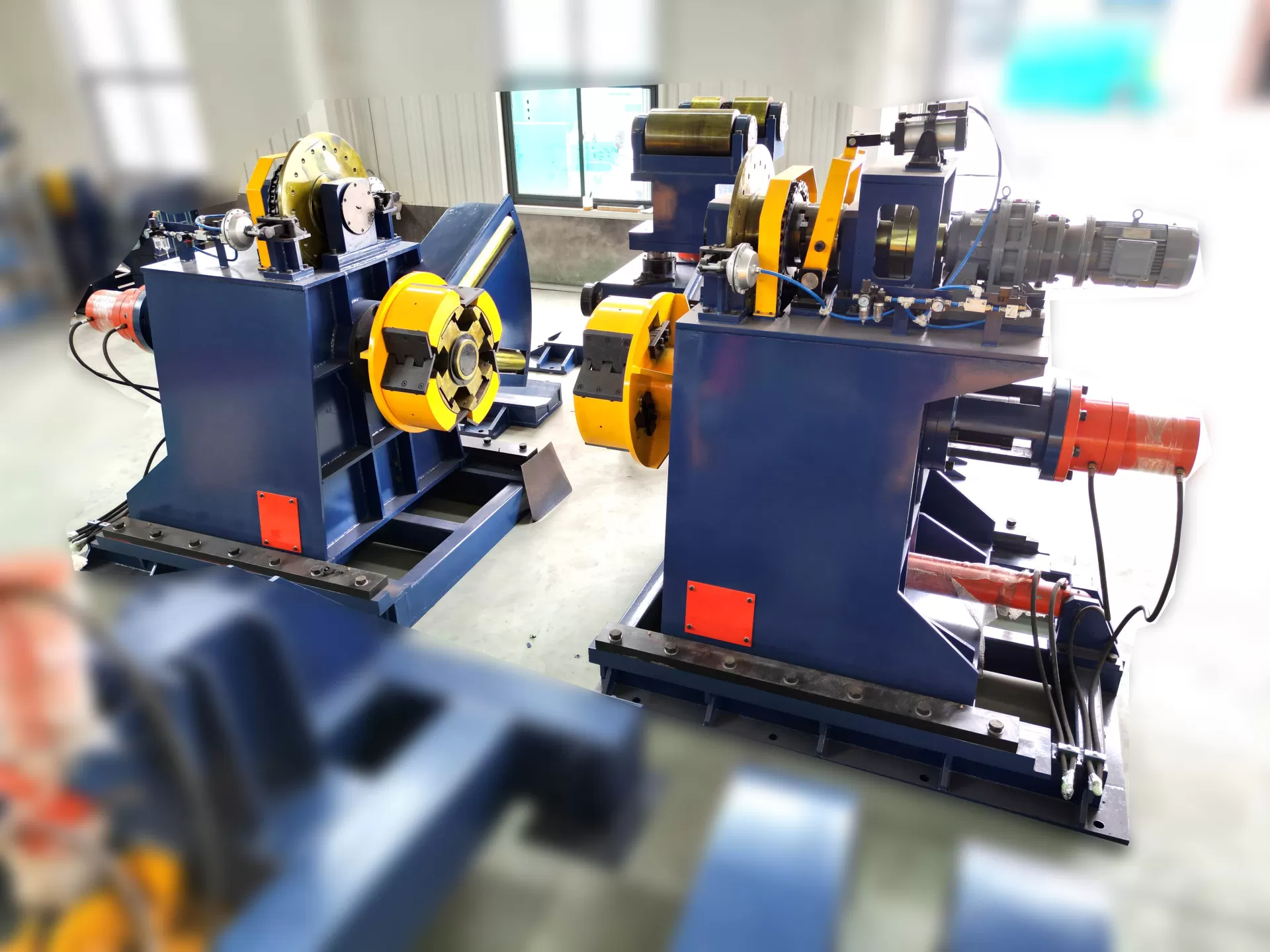
A hydraulic steel coil decoiler uses high-pressure cylinders
to drive a wedge-type or sliding-block mandrel. When energized, hydraulic fluid
pushes a central pull-rod, driving the steel segments radially outward with tons
of continuous clamping force.
- Drive System: Variable Frequency Drives (VFD) paired with
hydraulic back-tensioning or dynamic disc brakes.
- Mandrel Expansion: Heavy-duty hydraulic cylinder with
continuous pressure maintenance.
- Typical Capacity: 5 metric tons to well over 30 metric
tons.
- Auxiliary Modules: Integrated hydraulic hold-down arms
(snubber rolls), coil car lifts, and strip pushers.
This automated expansion ensures the mandrel stays locked against the coil
ID, even under rapid stops or dynamic acceleration. Hydraulic systems form the
core of heavy-duty, high-output tube mill feeding lines.
Head-to-Head Comparison: Tube Mill Performance Metrics
Selecting between these two uncoiler designs requires evaluating daily
throughput, material grades, and labor safety. Below is a detailed performance
breakdown for tube manufacturers.
| Performance Metric | Mechanical Decoiler | Hydraulic Decoiler |
|---|
| Load Capacity | Low (Typically up to 3–5 tons) | High (5 to 35+ tons) |
| Coil Changeover Time | 15 to 30 minutes (Manual) | 3 to 7 minutes (Automated with Coil Car) |
| Strip Centering Control | Manual crane shifting / Spacers | Hydraulic base-shifting cylinder |
| Mandrel Expansion Force | Limited by manual torque | High radial pressure (Prevents coil slippage) |
| High-Strength Steel Suitability | Poor (Risk of clock-springing) | Excellent (Snubber and peeler arm support) |
| Initial Capital Cost | Lower initial investment | Moderate to higher capital investment |
| Operating Safety | Higher manual handling risks | High (Hands-free remote operation) |
Load Capacity and Strip Dimensions
Mechanical units max out quickly. As master coil outer diameters (OD) push
toward 2,000 mm to reduce downtime, coil weights easily exceed 10 tons.
Mechanical mandrels simply cannot support these cantilevered loads without shaft
deflection.
A heavy duty steel decoiler powered by hydraulics features
forged alloy arbors, dual spherical roller bearings, and heavy structural
frames. These machines easily carry structural-grade strip up to 16 mm thick
without spindle runout.
Coil Changeover Speed and Centering Precision
Changeover time directly cuts into tube mill uptime. On a mechanical
uncoiler, operators must hoist the coil using an overhead crane, manually align
it with the spindle, slide it on, and hand-crank the mandrel tight. This process
takes 15 to 30 minutes of non-productive line stoppage.
A hydraulic system pairs directly with an automated pit-type or floor-level
coil car. The operator loads the coil onto the saddle, and the car lifts,
traverses, and centers the coil over the collapsed mandrel automatically. With
hydraulic base-shifting, the operator adjusts the strip center-line on the fly
using a pendant control, cutting changeover to under five minutes.
Tension Control and Weld Seam Consistency
High-frequency induction welding demands continuous, flat strip presentation.
Inconsistent back-tension causes the strip to sag or wander between the
accumulator and break-down rolls, introducing edge strain.
Mechanical uncoilers rely on manual friction bands that fade as heat builds
up during the shift. Conversely, an automatic coil decoiler
machine with hydraulic or closed-loop pneumatic brakes maintains
constant back-tension from full coil down to the bare core. For technical
guidance on maintaining strip tension during roll forming, review best practices
published by the Fabricators and Manufacturers Association (FMA).
Total Cost of Ownership (CapEx vs. OpEx)
Mechanical uncoilers require less upfront cash. However, that low entry price
tag hides persistent operating costs:
- Longer changeover cycles mean lower overall line OEE (Overall Equipment
Effectiveness).
- Manual cranking and crane rigging pull two to three operators away from the
welding station.
- Uneven clamping causes internal coil-core damage, wasting valuable
steel.
Hydraulic uncoilers cost more initially, but they pay for themselves quickly.
High-speed tube mills running three shifts can recoup the initial capital
difference within months simply by saving 20 minutes on every coil change.
Operator Safety and Ergonomics
Safety regulations are tightening worldwide. Cutting steel strapping bands on
heavy-gauge coils creates a major hazard: the outer wraps spring open violently
like an industrial clock-spring. The Occupational Safety and Health
Administration (OSHA) regularly details the severe pinch-point and strike
hazards associated with manual coil handling.
A modern hydraulic steel coil decoiler keeps operators clear
of the hazard zone. A hydraulic hold-down roll (snubber arm) presses firmly
against the coil's outer circumference before the bands are cut. A hydraulic
peeler blade then lifts the lead edge and threads it forward into the flattener
without workers touching the strip.
Machinery manufactured by SANSO integrates redundant safety
circuits, remote pendant interfaces, and safety interlocks to shield operators
from these high-risk areas.
Looking Ahead to 2026: Trends Shaping Uncoiler Selection
The tube and pipe sector is transforming. Smarter automation and stronger
alloys are changing the baseline requirements for feed-line machinery over the
coming years.
Seamless Integration with Horizontal Accumulators
Tube mills running high-speed strip accumulators need uncoilers that can pay
off material rapidly. When the accumulator demands an emergency refill, the
decoiler must spin up to double line speed, maintain dynamic balance, and
decelerate smoothly without over-running.
Hydraulic uncoilers equipped with AC variable-frequency drives and
closed-loop dancer arms communicate instantly with downstream storage systems.
This smooth coordination prevents strip snapping and loop collapse.
Industry 4.0 and Predictive Sensor Packages
By 2026, intelligent monitoring will be standard on high-spec tube mills.
Decoiler mandrels now feature embedded wireless sensors to track operating
parameters:
- Real-time hydraulic cylinder pressure logs confirm the mandrel never loses
its grip.
- Main spindle bearing temperature sensors alert maintenance teams before a
bearing seizes.
- Vibration transducers identify arbor deflection and mechanical fatigue
early.
Industrial processors track these operational metrics to maintain continuous
production standards outlined by the World Steel Association.
Processing Advanced High-Strength Steels (AHSS)
Automotive and structural tube markets are shifting toward high-strength,
low-alloy (HSLA) and dual-phase (DP) steels. These materials carry massive
internal yield stress. Mechanical units simply lack the frame mass and radial
clamping force to prevent these stiff coils from unwinding erratically.
Heavy-duty hydraulic systems use motorized snubber rolls to control tough
strip materials through the entire decoiling sequence.
Energy Efficiency and Demand-Flow Hydraulics
Old hydraulic units ran large hydraulic power units (HPUs) continuously,
wasting electricity and generating excess fluid heat. Next-generation systems
use variable-displacement pumps or servo-driven hydraulic units that deliver oil
volume only when an axis moves.
This design cuts plant energy draw, lowers system operating temperatures, and
extends hydraulic seal life.
Decision Matrix: Which Decoiler Fits Your Mill?
Every plant has different capacity requirements and budget constraints. Use
this quick decision matrix to identify the right system for your facility.
When to Choose a Mechanical Steel Coil Decoiler:
- Coil weights remain strictly under 3 metric tons.
- Strip thickness is less than 2.0 mm (mild carbon steel or aluminum).
- Line run speeds are low (under 30 meters per minute).
- Your mill runs small, infrequent custom batches where changeover speed is
not critical.
- Available capital budget is limited.
When to Choose a Hydraulic Steel Coil Decoiler:
- Coil weights exceed 5 metric tons.
- You process high-strength structural strip, API pipe grades, or heavy wall
gauges.
- High-frequency tube lines run continuously with automated accumulators.
- You want single-operator coil changeover using a mechanized coil car.
- Zero-downtime, safe, hands-free coil threading is a priority.
Frequently Asked Questions (FAQ)
Q1: Can I convert my existing mechanical decoiler to a hydraulic
system?
A1: Retrofitting the expansion mechanism is rarely
cost-effective. Mechanical decoiler frames and main spindles are not engineered
to handle the high radial stresses exerted by hydraulic cylinders. Replacing the
uncoiler with a purpose-built hydraulic unit provides higher reliability,
greater capacity, and modern safety features.
Q2: What is the ideal mandrel expansion range for a tube
mill?
A2: Most worldwide master coils feature an inner diameter (ID)
of 508 mm (20 inches) or 610 mm (24 inches). A versatile hydraulic mandrel
covers an expansion range of 470 mm to 620 mm. Modular bolt-on shoe pads or
polyurethane sleeves expand this reach up to 760 mm without requiring a complete
spindle change.
Q3: Does a hydraulic decoiler require a motorized drive for tube
milling?
A3: Yes, for modern operations. While a tube mill forming
section can pull strip through the line, a driven decoiler offers motorized jog
forward and reverse for fast strip threading. It also drives the dynamic
back-tension system, preventing strip slack and protecting the line from sudden
pull surges.
Q4: How does a hydraulic hold-down arm improve factory floor
safety?
A4: The hydraulic hold-down (snubber) arm applies firm,
direct downward pressure on the outer diameter of the steel coil. When an
operator cuts the steel bands, the arm keeps the coil from springing open,
eliminating a major crush and strike hazard for nearby workers.
Q5: What daily maintenance does a hydraulic steel coil decoiler
require?
A5: Daily maintenance is straightforward: inspect hydraulic
lines for leaks, check operating pressure at the manifold gauge, verify oil
levels in the main HPU reservoir, and grease the main spindle bearings. Most
systems require a full hydraulic fluid and filter change only once per year.
Setting the Standard for 2026 and Beyond
Mechanical uncoilers still serve niche applications in light, low-volume
workshops. However, high-speed tube mills operating in 2026 demand the strength,
safety, and rapid changeover capabilities of a hydraulic steel coil
decoiler.
Investing in a hydraulic system eliminates coil prep bottlenecks, safeguards
line operators, and keeps your tube mill welding at peak capacity hour after
hour.
Upgrade Your Tube Mill Feeding Line with
SANSO
Looking to increase your tube mill's run time? SANSO designs
and manufactures heavy-duty hydraulic decoilers, motorized coil cars, and entry
feeding tables tailored to your plant's exact gauge and weight specs.
Ready to configure your line? Contact our engineering sales
group today to request an equipment specification review and line layout
proposal.