Process engineers and tube mill operators often face persistent weld defects
during electric resistance welding (ERW). When split seams, mismatch, or
pinholes occur, troubleshooting usually begins at the high-frequency weld box or
the fin pass rolls. Technicians adjust squeeze roll pressure, tweak induction
coil alignment, or swap out worn roll tooling. Yet, in many cases, scrap rates
remain high because the true cause lies 100 feet upstream at the entry section
of the mill.
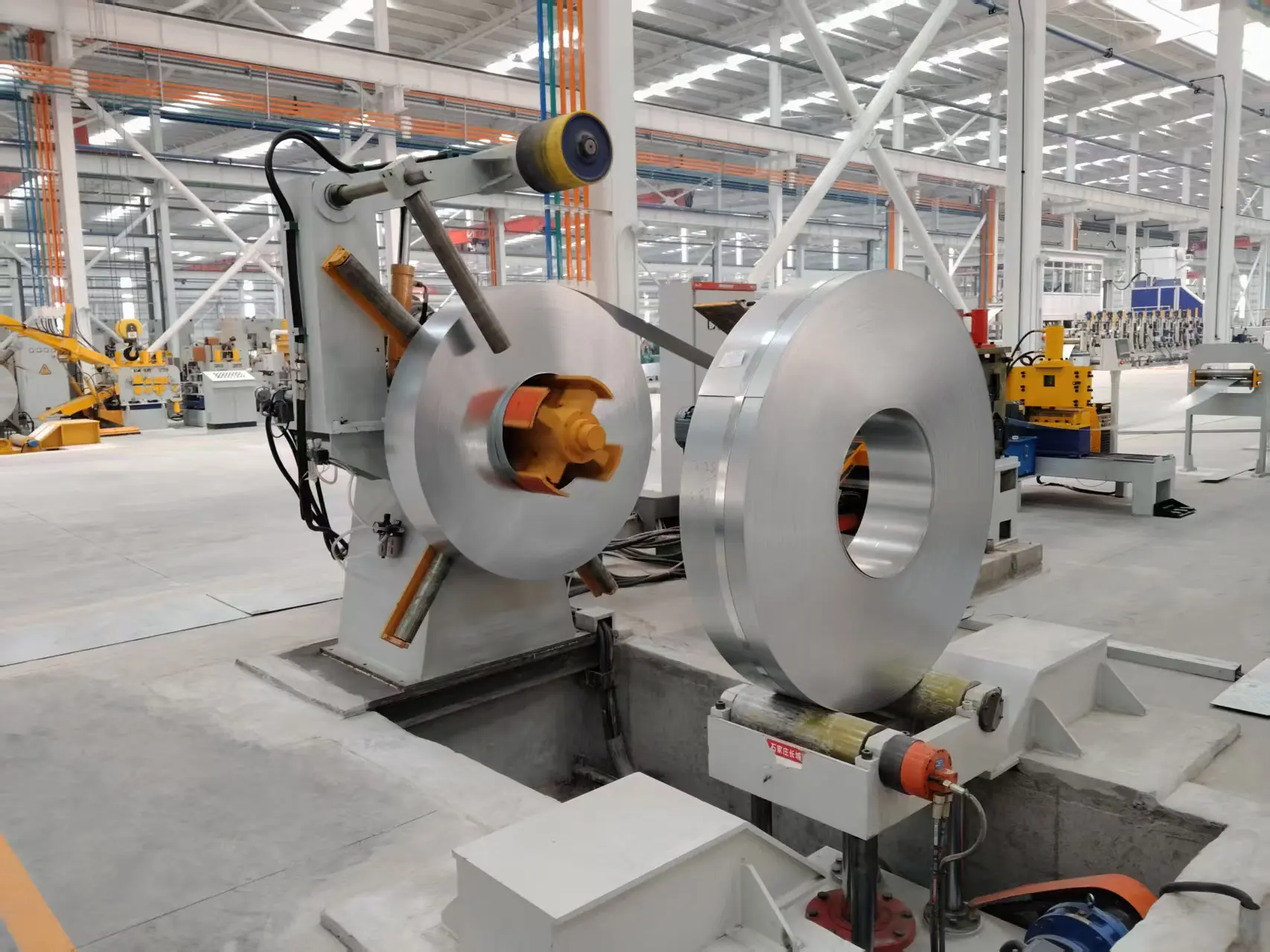
The uncoiler machine sets the mechanical baseline for the entire tube
production line. If strip payoff lacks consistent, calibrated back-tension,
every forming stand downstream inherits mechanical instability. At SANSO, we
engineer entry-line systems that isolate and eliminate these early-stage process
variations. If your ERW line struggles with seam defects or excessive mill
downtime, contact our engineering team for an equipment
audit.
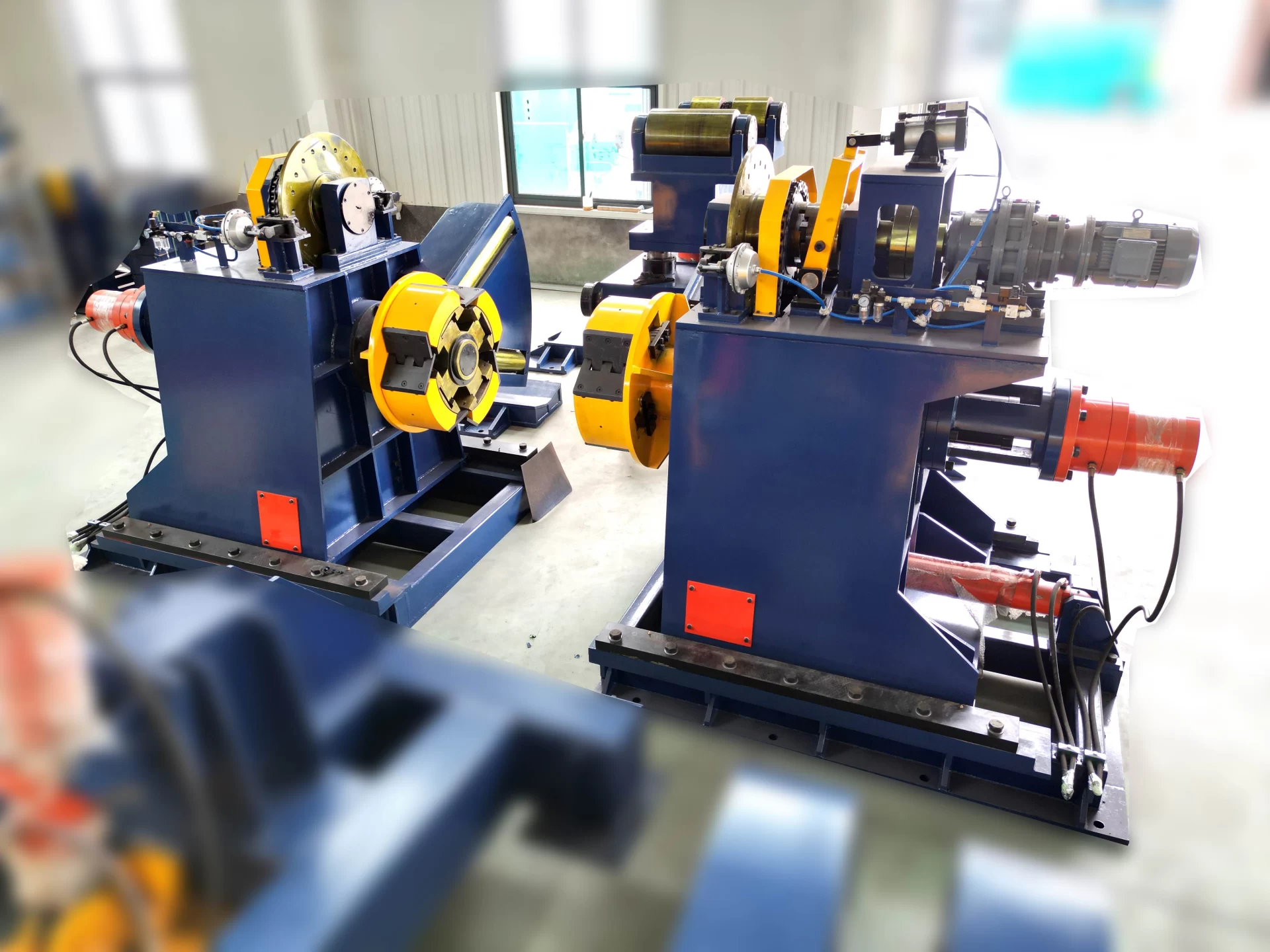
1. Introduction: The Overlooked Root Variable in ERW Tube Production
High-frequency ERW relies on mill synchronicity. Flat steel strip must
transition through breakdown, forming, fin pass, and squeeze sections at tight
dimensional tolerances. Process manuals outline precise roll clearances and
welding temperatures, but they often overlook strip entry dynamics.
An uncoiler machine does far more than hold a steel coil and let it rotate.
It serves as the primary anchor for strip stability. Without controlled
back-tension, the strip can enter the breakdown passes with slack, lateral sway,
or inconsistent camber. These upstream irregularities ripple down the line,
disrupting the precise contact geometry needed at the squeeze rolls.
When the strip enters the forming section improperly tensioned, the edges
travel unevenly. Operators then apply excessive corrective force at the fin
passes, introducing localized stress that compromises the forge weld.
Stabilizing the strip at the payoff point prevents downstream issues and
protects overall weld integrity.
2. Understanding Uncoiler Machine Back-Tension: Principles and
Mechanics
Back-tension is the controlled resisting torque applied to the mandrel of an
uncoiler machine as the downstream pinch rolls or breakdown stands pull the
strip. Its primary role is to eliminate strip slack, prevent over-spinning
during line deceleration, and maintain a taut, centered pass line.
Maintaining constant tension is complex due to changing coil geometry. As the
strip feeds into the ERW tube mill, the coil outer diameter (OD) continuously
shrinks down to the inner diameter (ID). The mechanical relationship is governed
by the torque formula:
T = F × r
Here, T represents braking torque, F is the desired linear
strip tension, and r is the instantaneous coil radius. Because radius
r continuously decreases, the uncoiler machine must reduce its braking
torque in direct proportion to keep line tension F constant.
- Mechanical/Pneumatic Systems: Older equipment uses manual
friction pads or basic air brakes. These setups require continuous operator
adjustment; otherwise, strip tension rises sharply as the coil empties.
- Closed-Loop Automated Systems: Modern installations use
laser or ultrasonic sensors to monitor coil diameter continuously. An automated
controller adjusts proportional pneumatic valves or electric regenerative drives
to hold tension rock-steady from full coil to core.
Without dynamic compensation, strip tension fluctuates widely from the start
of a master coil to its tail end. This variation degrades product uniformity and
causes ongoing seam stability issues.
3. Direct Hazards of Insufficient Back-Tension on ERW Seams
When an uncoiler machine produces inadequate back-tension, the strip travels
into the entry guides with loose, uncontrolled motion. This lack of restraint
triggers a sequence of mechanical defects that compromise the longitudinal
seam.
3.1 Strip Wandering and Edge Buckling
Insufficient tension allows the strip to drift laterally between the uncoiler
and the first breakdown stand. Loose strip reacts unpredictably to edge-guide
friction. As the strip wanders off the true centerline, the edges experience
asymmetrical compression.
This off-center feeding causes edge buckling, commonly known as wavy edges.
When buckled edges reach the fin passes, the strip rolls fail to present clean,
parallel edges to each other. The strip enters the weld apex with uneven height
profiles, making consistent high-frequency induction nearly impossible.
3.2 Forming Mismatch and Step Defect
Mismatch, or offset, occurs when the two strip edges meet at the squeeze
rolls on different horizontal or vertical planes. This defect directly reduces
the effective wall thickness along the weld line. It frequently violates
structural standards like ASTM A500, which requires strict
dimensional consistency across the weld area.
If low uncoiler tension allows the strip to twist, one edge enters the
squeeze rolls ahead of or higher than the other. The resulting "stepped" weld
creates a stress riser. Under hydrostatic pressure testing or flaring tests,
pipes with this defect split along the fusion boundary at values well below
nominal yield strength.
3.3 Porosity, Inclusions, and Trapped Oxides
High-frequency electric resistance welding does not rely on filler metal.
Instead, it heats strip edges to a forge-welding temperature (roughly 1350°C to
1450°C for low-carbon steel) and expels molten metal and oxides via squeeze-roll
pressure, as outlined in technical resources from the American
Welding Society.
When an unstable uncoiler machine causes the strip to flutter, the "V-angle"
oscillates. This movement alters the electrical impedance of the Vee, causing
erratic power delivery from the induction coil or contact tips. Flashing becomes
erratic, and squeeze rolls trap liquid metal oxides instead of expelling them
into the ID and OD weld beads. The resulting seam suffers from micro-porosity
and oxide inclusions (often called "black spots" or "pasty welds"), which fail
ultrasonic inspection.
4. The Hidden Defects Caused by Excessive Back-Tension
Some mill operators overcompensate for slack strip by applying maximum
braking force at the payoff reel. While this keeps the strip taut, excessive
back-tension introduces its own set of weld defects.
4.1 Edge Stretching and Thickness Reduction
When an uncoiler machine exerts high mechanical resistance, the downstream
breakdown stands must pull hard on the raw strip. For thin-walled material or
high-strength low-alloy (HSLA) steels, this high pulling force exceeds the
material's elastic limit along the outer fibers.
The edges stretch longitudinally while thinning across their cross-section.
When these thinned edges meet at the squeeze rolls, there is insufficient metal
mass to support proper upset force. The forge pressure drops, producing a cold
weld with low impact toughness. SANSO designs heavy-duty uncoilers with
precision tension limits to prevent this type of edge thinning on high-yield
materials.
4.2 Slippage, Surface Scratches, and Weld Contamination
Excessive uncoiler drag frequently causes roll slippage in the first driven
breakdown stands. When hardened steel rolls slip against the incoming strip,
they gall and gouge the steel surface. This slippage can damage the strip finish
and create loose metallic particles.
These fine iron shavings are drawn down the tube interior toward the weld
box. The strong electromagnetic fields generated during high-frequency welding
pull these particles directly into the molten apex. Trapped particulates create
inclusions, short out seam contacts, and lead to early seam failure in
downstream flanging and bending operations.
5. How Optimum Tension Stabilizes the High-Frequency "V-Angle"
The core requirement of quality ERW pipe manufacturing is a stable V-angle.
This triangular zone forms where the two open strip edges converge just ahead of
the squeeze roll center point. Both apex location and convergence angle must
stay steady to achieve reliable forge welding.
A properly calibrated uncoiler machine isolates the forming line from
upstream vibrations and coil-drag fluctuations. By feeding strip into the
breakdown stands under steady tension, the system ensures consistent edge
presentation through every stage:
- Breakdown Passes: Uniform tension prevents strip lifting
and holds the material centered against bottom roll contours.
- Fin Passes: Predictable entry tension allows the fin blades
to cleanly coin the strip edges, creating flat, parallel bonding surfaces free
of burrs or bevels.
- The Weld Apex: Because the strip moves without surge or
slip, the mechanical V-angle (typically between 2° and 5°) remains fixed.
Electrical current flows uniformly along the strip edges, concentrating energy
right at the apex.
This stability produces a clean, narrow Heat-Affected Zone (HAZ). A uniform
HAZ limits the development of brittle martensitic microstructures and ensures
that dynamic upset force expels all molten phases, leaving a clean solid-state
forge weld. Standardized energy distribution also protects compliance with
rigorous line pipe specifications like ISO 3183.
6. Essential Tension Control Technologies in a Modern Uncoiler Machine
Achieving stable back-tension requires purpose-built hardware. Pipe and tube
producers should assess three main payoff control technologies when upgrading or
sourcing an uncoiler machine for an ERW line.
Pneumatic Disc Brakes with Proportional Regulation
A cost-effective, dependable solution for medium-speed tube mills. Pneumatic
calipers act on ventilated brake discs mounted to the main uncoiler spindle. A
non-contact sensor monitors the changing coil radius, and an electro-pneumatic
proportional valve lowers air pressure smoothly as the coil unrolls. This system
avoids abrupt friction changes and maintains steady strip tension without
demanding constant manual oversight.
Closed-Loop AC Vector and Servo Drives
Modern high-speed mills running thin-wall structural tubing or precision
automotive pipe benefit from motorized uncoiler systems. Rather than relying
solely on friction brakes, these machines couple an AC vector motor or servo
drive directly to the mandrel shaft through a heavy-duty gearbox.
A load-cell dancer roller or a pivoting tension arm downstream reads actual
strip tension in real time. The drive instantly adjusts motor torque to
neutralize micro-surges caused by out-of-round coils or intermittent
strip-accumulator feed. These motorized units can also reverse under power,
helping operators rewind partially run coils safely and quickly.
Regenerative Braking Systems
Heavy-gauge pipe mills handle master coils weighing 20 to 30 tons. Mechanical
friction brakes on these lines dissipate massive amounts of kinetic energy as
heat, causing rapid brake-pad wear and variable braking torque from thermal
fade.
Regenerative uncoiler drives replace friction braking with electrical
resistance, converting braking force into clean electricity that feeds back into
the plant power grid. These drives offer precise torque control down to zero
speed while eliminating brake-pad changes and lowering operating costs.
When selecting an uncoiler machine, evaluate your complete range of strip
widths, gauges, and material yields. Running diverse products—from soft
commercial-quality strip to 700-MPa HSLA steel—demands an entry uncoiler with a
wide, precisely controllable torque range.
7. Conclusion and Next Steps
High-frequency ERW weld seam quality depends directly on raw strip stability.
Blaming fin passes, squeeze rolls, or welding electronics for edge mismatch and
oxide inclusions often overlooks the primary culprit: erratic payoff tension.
Upgrading to an uncoiler machine with dynamic back-tension control stabilizes
the weld apex, narrows the HAZ, and substantially lowers production scrap.
SANSO manufactures rugged, automated coil-handling and uncoiler systems
tailored to high-demand ERW tube and pipe mills. Whether you need to retrofit an
existing line with closed-loop tension braking or build a high-capacity turnkey
mill entry section, our engineering team is here to assist. Contact
SANSO today to request a system consultation and improve your mill's
running efficiency.
Frequently Asked Questions (FAQ)
Q1: What is the ideal back-tension value for an ERW uncoiler
machine?
A1: There is no universal tension setting for every line.
Ideal strip tension typically ranges from 10% to 20% of the material's yield
strength, multiplied by the strip cross-sectional area (width × thickness). The
goal is to keep the strip completely flat and centered without causing plastic
deformation or edge stretching before the breakdown passes.
Q2: How can an operator tell if poor weld seam quality is caused by
the uncoiler?
A2: Watch for periodic defects that shift in frequency
as the coil pays off. If edge mismatch, weld spitting, or cold welds grow more
severe near the inner diameter (core) of the coil, the uncoiler machine is
likely failing to compensate for radius changes. You can also spot this problem
by looking for strip bounce or lateral wander at the entry guides.
Q3: Can a strip accumulator compensate for poor uncoiler
tension?
A3: An accumulator decouples payoff speed from the mill
during coil splicing, but it cannot fix baseline tension problems. If strip
enters the accumulator loose or buckled, it can twist within the storage baskets
or tracking rolls. In lines that feed directly from payoff to forming without an
accumulator, uncoiler back-tension dictates entry stability entirely.
Q4: Why do manual friction brakes produce poor results on high-yield
steel coils?
A4: High-yield steels (like API line-pipe grades)
require higher overall pull forces and are sensitive to tension spikes. Manual
friction brakes heat up during production, which changes their friction
coefficient. As the coil diameter shrinks, torque must drop; manual systems
cannot make these continuous fine adjustments, causing strip wander and
irregular seam alignment.
Q5: How does an uncoiler machine prevent out-of-round coil
shudder?
A5: Heavy coils can sag or deform under their own weight
during transport, taking on an elliptical shape. As this out-of-round coil
turns, the strip pull-rate surges with every rotation. Modern uncoilers use
closed-loop dancer arms or ultra-responsive vector drives to absorb these
cyclical tension spikes, delivering smooth strip flow to the breakdown
stands.