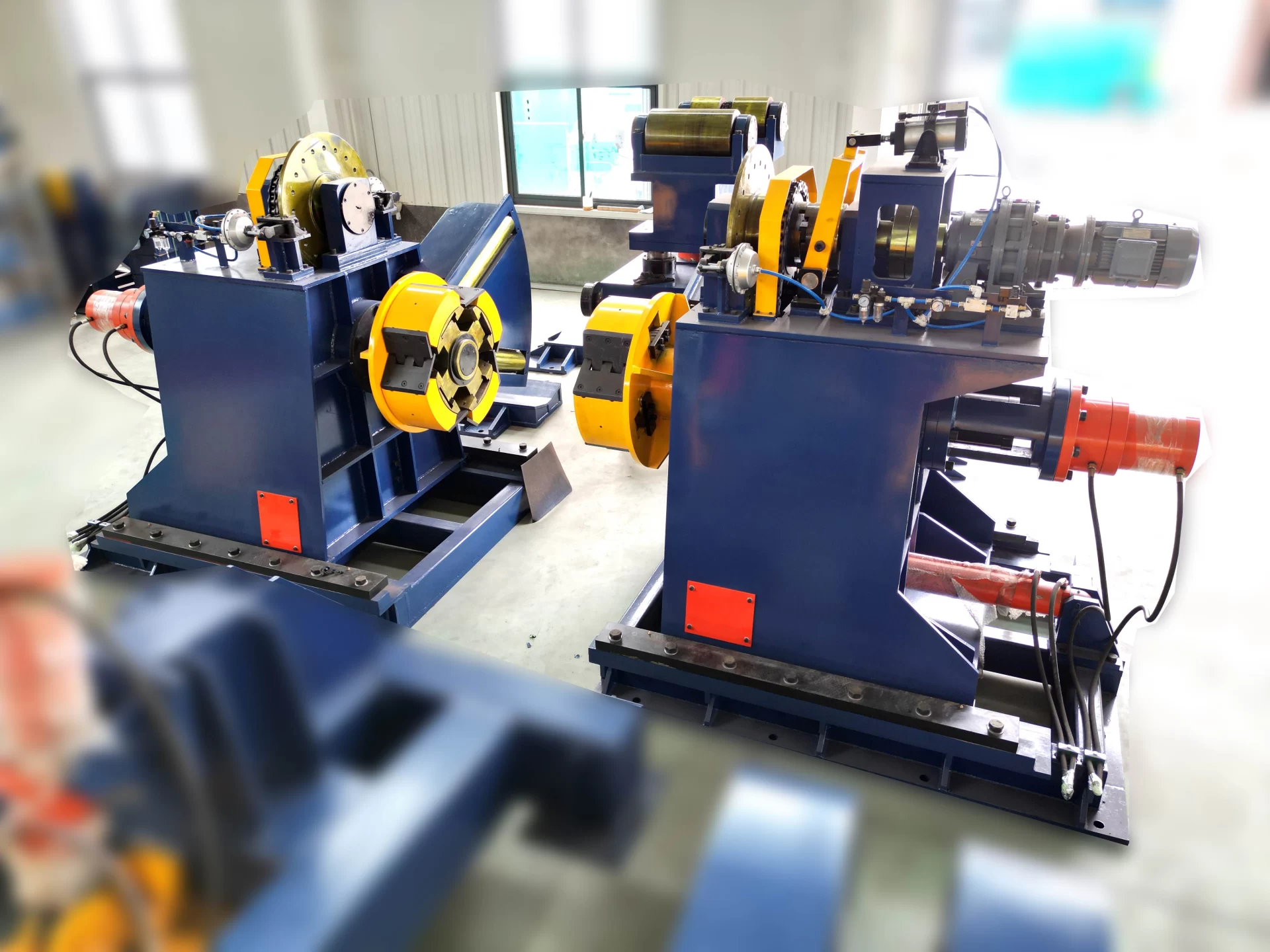
Every tube mill line relies on smooth strip entry. If the coil payoff fails,
the forming passes, high-frequency welding stations, and flying cut-off units
all grind to a halt. Sourcing the right coil handling machinery prevents costly
bottlenecks before commissioning starts.
If you are actively evaluating a decoiler for sale, the
first critical choice lies between a manual uncoiler and a heavy-duty hydraulic
system. Each mechanism serves distinct plant throughputs, coil gauges, and
budgets.
At SANSO, we engineer coil payoff systems tailored to high-precision tube
mills. This comparative breakdown evaluates load capacities, changeover speeds,
mechanical safety, and total operational costs so you invest in the correct
machine for your shop floor. Before committing capital, review our technical
analysis below or contact our engineering staff directly to request a targeted
quote.
Understanding the Basics: How Manual and Hydraulic Decoilers Work
Coil payoff systems must expand within the coil core, grip the internal
diameter (ID) securely, and release strip stock under uniform back-tension. The
distinction between manual and hydraulic units lies in how this gripping force
and rotation are generated.
A manual decoiler relies entirely on mechanical leverage. The operator
expands the mandrel segments manually by rotating a centralized hand crank,
screw-jack assembly, or wedge mechanism inside the drum.
- Mandrel Expansion: Manual screw-spindle or wedge mechanism
tightened with hand tools.
- Braking Mechanism: Mechanical friction bands or manual
caliper brakes to prevent coil overrunning.
- Typical Load Limits: Generally restricted to coils under
3,000 kg (3 metric tons).
- Drive System: Typically non-powered (pulled by the tube
mill's breakdown rolls or powered flattener), though basic motorized options
exist.
What Is a Hydraulic Decoiler?
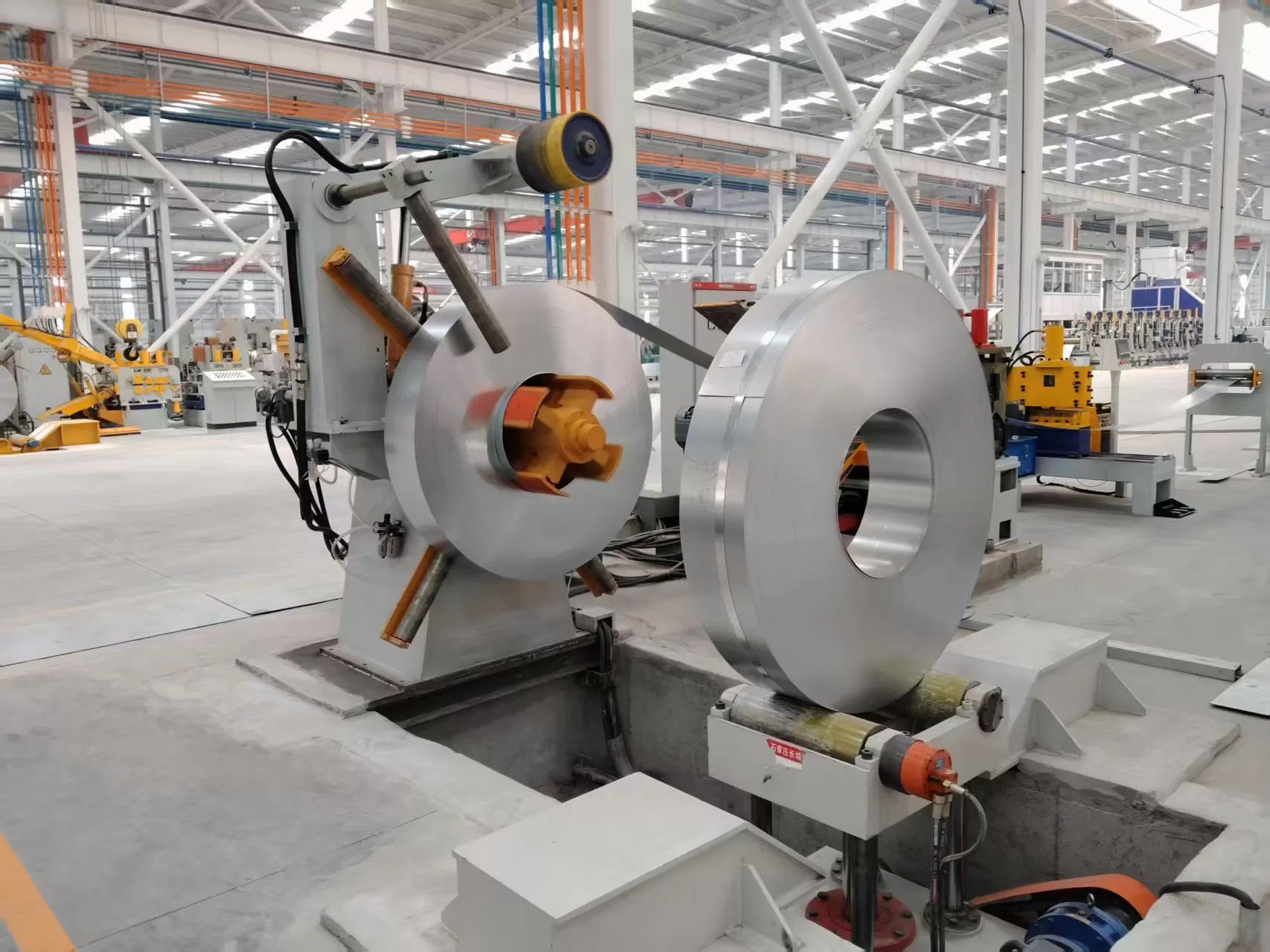
A hydraulic decoiler uses high-pressure fluid power to actuate the mandrel
expansion segments, drive the main spindle, and engage fail-safe braking. These
heavy-duty units frequently integrate with motorized coil loading cars to
automate loading.
- Mandrel Expansion: Hydraulic cylinder acting on expanding
wedges for uniform internal radial force.
- Spindle Drive: Hydraulic motor or AC inverter motor with
gearbox for controlled jogging, forward threading, and reverse rewinding.
- Typical Load Limits: Ranges from 3 metric tons to well over
25 metric tons for structural steel mills.
- Auxiliary Automation: Outfitted with snubber arms,
hold-down rolls, and hydraulic peeler tables to handle heavy-gauge strip
springback.
Core Engineering Comparison: Key Metrics for Tube Mills
Selecting between these two designs requires checking your daily production
schedules against concrete mechanical constraints. Tube manufacturing places
unique demands on continuous strip feed, where raw material must meet precise
standards such as ASTM A1011/A1011M specifications for
hot-rolled steel strip.
| Operational Metric | Manual Decoiler Machine | Hydraulic Decoiler |
|---|
| Max Coil Weight | 500 kg to 3,000 kg | 3,000 kg to 25,000+ kg |
| Coil Width Range | 50 mm to 400 mm | 100 mm to 1,800 mm |
| Strip Thickness | Light gauge (0.3 mm to 2.0 mm) | Heavy gauge (1.5 mm to 12.0+ mm) |
| Average Coil Loading Time | 15 to 30 minutes | 2 to 5 minutes (with Coil Car) |
| Mandrel Expansion | Manual crank or lead screw | Hydraulic cylinder push/pull link |
| Tension Control | Manual friction band adjustment | Proportional pneumatic/hydraulic disc brake |
| Capital Cost | Low entry cost | Moderate to high investment |
1. Load Capacity and Coil Specs
Manual units handle light, narrow coils suited for electrical conduits,
decorative tubing, or thin-wall furniture pipes. Once strip thickness exceeds
2.0 mm or coil weight tops 3 tons, manual expansion links cannot supply adequate
radial clamping force. Insufficient grip allows inner wraps to telescope or
slip, damaging the strip surface.
For industrial tube mills processing heavy-gauge structural hollow sections
(HSS) or API-grade line pipe, a heavy-duty hydraulic decoiler is non-negotiable.
Heavy coils require thousands of pounds of hydraulic pressure to clamp the inner
wraps securely without deforming the drum structure.
2. Mill Speed and Coil Changeover Downtime
Tube mills run most profitably when operating continuously. In lines
utilizing horizontal or spiral strip accumulators, downtime during coil-end
joining (shear and butt welding) must stay within accumulator storage
limits.
Changing a coil on a manual uncoiler requires overhead crane rigging, manual
balancing, operator-driven lead-screw adjustment, and trial-and-error alignment.
This manual setup takes 15 to 30 minutes. If your accumulator empties in 5
minutes, your tube mill stops running.
A hydraulic decoiler paired with a coil car pre-stages the next master coil
off-line. Once the active coil finishes, the coil car shifts forward, raises the
coil onto the mandrel, expands the hydraulic jaws, and aligns the strip within
minutes. The engineering research provided by the Society of Manufacturing Engineers
(SME) confirms that automating coil preparation cycles directly boosts
overall equipment effectiveness (OEE) across metal forming lines.
3. Plant Safety and Ergonomics
Operator injury risks escalate around unconstrained sheet metal coils. Thick
steel strip retains severe elastic memory. Cutting the banding straps on a
manually restrained heavy coil can cause the outer wrap to whip open
unpredictably.
A properly equipped hydraulic decoiler for sale incorporates
safety mechanisms complying with international industrial norms, such as ISO 12100 machinery safety standards. Hydraulic hold-down arms
(snubber rolls) clamp the coil from the top during de-banding, while a peeler
wedge safely drives the leading strip edge into the flattener without direct
operator hands-on intervention.
4. Capital Expense vs. Production ROI
Manual decoilers offer an undeniably low upfront ticket price. For custom
fabricators running a few hundred meters of pipe per shift, this small
investment makes financial sense.
However, running a high-speed ERW (Electric Resistance Welded) tube mill with
a manual reel introduces major hidden costs. The lost production hours spent
mounting coils, paired with increased scrap rates from inconsistent
back-tension, quickly wipe out initial machinery savings. SANSO designs
high-durability hydraulic payoff equipment specifically to recoup capital
quickly through reduced downtime and steady line speeds.
Application Matching: Selecting the Ideal Configuration
To pinpoint the ideal machine, match the payoff unit to your line's output
rate, wall thickness, and strip width.
When to Purchase a Manual Decoiler:
- Your mill focuses on light-gauge ornamental tubing (0.4 mm to 1.5 mm wall
thickness).
- Coil packages stay consistently under 2.5 metric tons.
- You run small, custom batches with frequent tooling changeovers where line
uptime is not the primary driver.
- Your facility has strict budget limits or lacks hydraulic power
access.
When to Purchase a Hydraulic Decoiler:
- You run high-speed ERW or laser tube mills requiring uncoiling speeds above
50 m/min.
- Strip thickness exceeds 2.5 mm, creating high springback that requires a
powered snubber arm.
- Coils weigh between 5 and 20+ tons, common for water pipe, scaffolding, and
automotive tube manufacturing.
- Your operation runs multiple shifts daily and relies on automated entry
systems to hit shift production targets.
Purchasing Guide: Engineering Points to Check
Before issuing a purchase order for any decoiler for sale,
scrutinize the engineering specifications with the machine manufacturer.
- Mandrel Expansion Range: Ensure the wedge travel
accommodates both tight coil inner diameters (typically 508 mm) and larger drums
(610 mm or 760 mm) using modular shoe extensions.
- Back-Tension Control: Look for pneumatic disc brakes
governed by proportional valves or load-cell dancer loops. Irregular tension
leads to strip cambering and tube edge overlap inside the mill's forming fin
passes.
- Spindle Construction: Verify that the main shaft uses
forged alloy steel (such as 42CrMo) with ultrasonic testing to prevent fatigue
fracture under cantilevered coil loads.
- Hydraulic Station Quality: Inspect the valving, pump
reliability, and manifold layout. High-grade directional valves maintain
reliable jaw grip throughout eight-hour shifts without pressure drops.
- Integrated Coil Car Interface: Confirm whether the decoiler
base can integrate track rails for a scissor-lift coil loading car to simplify
material staging.
Frequently Asked Questions
Q1: Can I upgrade a manual decoiler to hydraulic operation
later?
A1: While technically possible, retrofitting a manual machine
with a hydraulic cylinder, rotary union, and power unit is rarely
cost-effective. Manual frames and bearings rarely withstand the high hydraulic
thrust forces required for automatic expansion. It is almost always more
economical to purchase a dedicated hydraulic unit from the start.
Q2: What is the main cause of strip slippage on a decoiler
mandrel?
A2: Slippage occurs when the internal mandrel expansion
force drops below the line's pull tension, or when the coil inner diameter does
not match the mandrel arc. Hydraulic units prevent this problem by maintaining
constant hydraulic back-pressure on the expanding wedge assemblies.
Q3: Does a hydraulic decoiler need a driven motor, or can it
free-wheel?
A3: Most hydraulic units feature a motor connected via a
slip clutch or hydraulic bypass. The motor feeds the heavy strip leading end
into the entry flattener or leveler. Once the strip reaches the tube mill, the
motor disengages and the mandrel free-wheels against an adjustable disc brake to
provide steady strip tension.
Q4: How do I calculate the correct weight capacity for a tube mill
decoiler?
A4: Check the maximum coil outer diameter (OD), inner
diameter (ID), and width supplied by your master coil vendor. Calculate the
maximum theoretical volume and weight of the steel. Always add a 20% to 25%
safety margin above your heaviest expected coil to avoid overstressing bearings
and structural supports.
Q5: Why do thick strip coils require a snubber arm on a
decoiler?
A5: High-yield steel strip stores tremendous mechanical
springback tension. When steel retention bands are cut, the outer coil wrap
violently springs open. A hydraulic snubber arm clamps the outer diameter,
letting the operator safely cut bands and jog the material forward under
complete mechanical control.
Secure the Right Coil Payoff System for Your Line
Selecting the right payoff equipment balances upfront capital against
long-term operating costs. A manual uncoiler serves low-speed, light-capacity
shops well. However, for industrial tube production lines that demand reliable
up-time, modern hydraulic decoilers deliver the loading speed, high payload
stability, and operator safety needed to keep your mill running profitably.
SANSO manufactures rugged, customizable hydraulic and mechanical coil
machinery built to match your tube mill's exact speed, gauge, and weight
requirements. Browse our line of heavy-duty equipment or get in touch with our
engineering team today to discuss your plant layout and request a detailed
quotation.