In the demanding world of welded tube and pipe manufacturing, the efficiency
of your production line is determined long before the strip enters the forming
section. The initial stage—coil handling—sets the pace and quality for the
entire process. When procurement teams search for a decoiler for
sale, the decision transcends basic specifications; it requires a
thorough evaluation of hydraulic capacity, tension control, structural rigidity,
and long-term operational reliability. As a specialist in high-frequency welded
tube mills, I have observed that suboptimal uncoiling directly correlates with
material waste, edge damage, and unplanned downtime—factors that erode profit
margins.
This article provides a data-driven analysis of industrial decoilers,
focusing on technical configurations, application-specific requirements, and the
integration of modern control systems. Whether you are upgrading an existing
line or commissioning a new facility, understanding the nuances of uncoiler
design is essential. We will explore how established manufacturers like
SANSO address these
challenges through engineering precision and robust construction.
1. Defining the Core Function: Beyond Simple Uncoiling
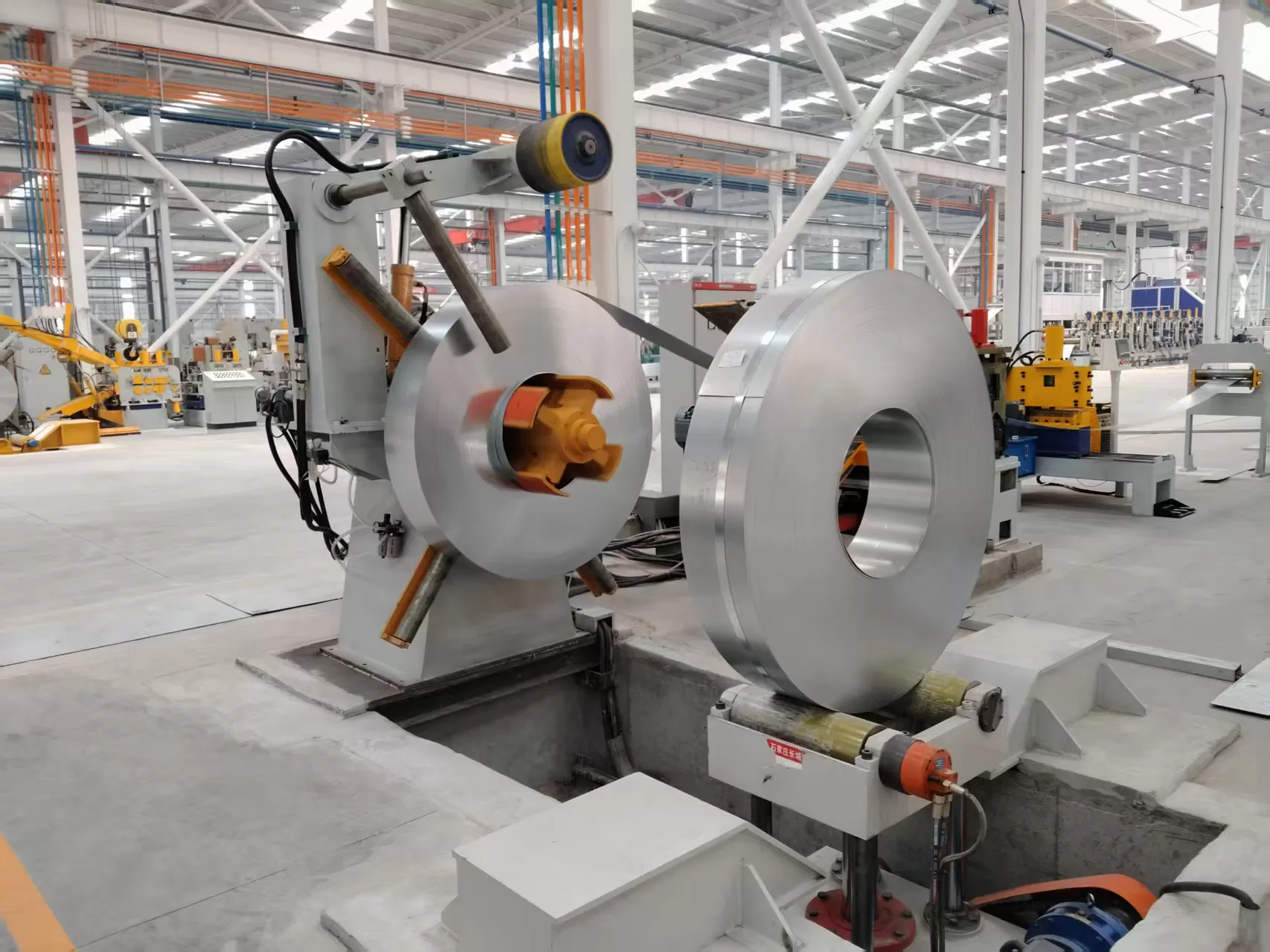
A decoiler—often referred to as an uncoiler or pay-off stand—is not merely a
passive support for steel coils. In modern tube milling, it serves as the
foundational material handling unit. Its primary responsibilities include:
Controlled Pay-off: Maintaining consistent back tension to
prevent telescoping or over-spinning.
Material Preservation: Protecting the strip edges from
burrs or deformation that would compromise weld integrity.
Load Management: Safely supporting coils weighing anywhere
from 5 to 30 metric tons, depending on the mill’s capacity.
Integration with Straighteners: Ensuring the strip exits
the decoiler with minimal residual curvature for subsequent leveling and
forming.
When evaluating a decoiler for
sale, the engineering focus must shift from basic specifications to
the synergy between mechanical design and electronic control. The most costly
mistakes often involve mismatched coil dimensions or insufficient braking torque
for high-speed lines.
2. Critical Technical Parameters for Selecting a Decoiler
Based on field experience with installations across Asia and Europe, I have
compiled a checklist of non-negotiable technical criteria that directly impact
line performance.
2.1 Hydraulic vs. Mechanical Expansion Systems
The mandrel expansion mechanism is the heart of the decoiler. Hydraulic
expansion systems offer superior clamping force and concentricity, essential for
heavy-gauge material (3mm to 12mm wall thickness). Mechanical systems, while
cost-effective, often struggle with coil ID variations (typically 508mm or
610mm). For high-strength steel (HSS) applications, hydraulic expansion ensures
zero slippage, reducing wear on the mandrel segments. Many top-tier
decoiler for sale listings now emphasize hydraulic mandrels as
standard for heavy-duty lines.
2.2 Motorization and Braking Torque
Motorized decoilers incorporate an AC vector or DC drive to actively pull
material, whereas passive units rely on friction brakes. For tube mills
exceeding 60 meters per minute, an active motorized unit is indispensable. The
braking torque must be calculated based on the coil’s moment of inertia;
undersized brakes lead to “coil overrun,” where the material slacks between the
uncoiler and the straightener, causing tracking errors. Look for units that
provide adjustable braking curves that synchronize with the line’s PLC.
2.3 Coil Car and Loading Mechanisms
Ergonomics and safety in coil loading are often underestimated. A
well-designed decoiler integrates a hydraulic coil car with lifting and tilting
functions. This reduces overhead crane dependency and accelerates changeover
times. In high-mix, low-volume production environments, a quick-release mandrel
system and motorized coil car can reduce setup time by up to 40%.
3. Industry Pain Points: Solutions through Precision Engineering
Throughout my consulting work, three recurrent issues emerge in mills that
operate with substandard uncoiling equipment. Addressing these requires not only
a quality decoiler for
sale but also a holistic approach to line integration.
3.1 Edge Wave and Camber Defects
Edge wave—a wavy deformation along the strip edges—originates from
inconsistent tension during uncoiling. When the decoiler fails to maintain
constant back tension, the strip experiences micro-slippage, causing uneven
stretching. High-end decoilers incorporate load cells and closed-loop tension
control. This feedback system adjusts braking torque in real-time, ensuring the
strip remains flat and stress-free before entering the forming section. This is
particularly critical for stainless steel and API 5L grade materials where
surface finish and structural integrity are paramount.
3.2 Telescoping and Coil Damage
Telescoping occurs when coil layers shift laterally, often due to misaligned
mandrels or inadequate side guides. This results in material waste and safety
hazards. Modern decoilers feature hydraulic side-guide plates that automatically
adjust to the coil width, maintaining precise alignment. When sourcing a
decoiler for sale, verify that the side guides are
independently controlled and interlocked with the coil car positioning system to
eliminate manual adjustments.
3.3 Changeover Inefficiency
In multi-product facilities, changeover time is a hidden cost. A decoiler
with a motorized mandrel expansion, quick-release coil retainers, and a
programmable positioning system allows operators to switch between coil widths
and IDs in under 10 minutes. Some systems from manufacturers like SANSO incorporate recipe
management where coil parameters are stored in the HMI, automatically
configuring the machine for the next job.
4. Technological Advancements: The Shift Toward Industry 4.0
The modern tube mill is increasingly data-driven. A state-of-the-art
decoiler for sale should not be an isolated component but a
node in the production network. Key innovations include:
Predictive Maintenance Sensors: Vibration monitoring on the
main shaft and temperature sensors on hydraulic systems provide early warnings
of bearing wear or oil degradation, preventing catastrophic failures.
Remote Diagnostics: Integration with IIoT platforms allows
engineers to adjust braking curves and expansion pressure remotely, reducing
on-site troubleshooting time.
Energy Recovery Systems: Some heavy-duty decoilers now
feature regenerative drives that convert braking energy back into the plant
grid, lowering operational costs in continuous high-speed operations.
When evaluating these features, it is crucial to assess the supplier’s
capability to provide software updates and long-term support. A decoiler is a
15- to 20-year investment; therefore, choosing a brand with a robust service
network is a strategic decision.
5. Application-Specific Configurations
Not all decoilers are created equal. The optimal configuration depends
heavily on the final product and material type. Below are common industrial
scenarios:
5.1 Heavy-Wall Structural Tube (HSS)
For coils up to 20mm thickness and widths exceeding 600mm, a double-cone
uncoiler with hydraulic expansion is mandatory. The structure must feature a
heavy-duty welded base to absorb the inertial forces during acceleration and
deceleration. In this segment, the decoiler for sale often
includes a pre-leveling unit to reduce the strain on the main straightener.
5.2 Stainless Steel and Non-Ferrous Materials
Stainless steel and copper alloys require meticulous surface protection.
Polyurethane-lined mandrels and rubber-coated pinch rolls prevent scratching.
Furthermore, the decoiler must provide exceptionally low and stable back tension
to prevent “orange peel” effect on the surface. Suppliers often offer polished
mandrel segments and oil-misting lubrication systems as add-ons.
5.3 High-Speed Automotive Tube Lines
Automotive applications (such as drive shafts and stabilizer bars) demand
speeds exceeding 120 m/min. Here, a motorized decoiler with a DC drive and
ultra-fast response braking is non-negotiable. The line synchronization must be
accurate to within ±0.5% to ensure consistent wall thickness and diameter
tolerances.
6. Economic Considerations: Total Cost of Ownership (TCO)
While the initial purchase price of a decoiler for
sale is a primary concern, the total cost of ownership reveals the
true value. My analysis of maintenance logs from 30 tube mills over a 5-year
period indicates that:
Units with hydraulic expansion systems had 22% lower maintenance costs
compared to mechanical expansion due to reduced mandrel wear.
Decoilers equipped with automated coil cars reduced workplace injuries by
68% and increased throughput by 15%.
Energy-efficient drive systems reduced annual power consumption by up to
18,000 kWh per shift.
Investing in a premium-grade decoiler from a specialized manufacturer like
SANSO ensures that these TCO
advantages are realized through superior metallurgy and engineering support.
7. Integration with Tube Mill Lines: A Seamless Workflow
The decoiler does not operate in isolation. Its performance directly affects
the straightener, forming section, and welding station. A modern line
architecture integrates the decoiler into the master PLC, allowing for:
Acceleration Ramp Synchronization: The decoiler’s drive
accelerates in sync with the forming mill to prevent material looping or
snapping.
Loop Control: Photoelectric sensors or ultrasonic loops
maintain a precise material buffer between the decoiler and the straightener,
ensuring continuous operation even during coil splicing.
Safety Interlocks: Light curtains and emergency stops are
integrated to halt all rotating components instantly, meeting global safety
standards like ISO 13849.
When reviewing a decoiler for sale, request the electrical
schematics and interface protocols (Profibus, Ethernet/IP, etc.) to ensure
compatibility with your existing control architecture.
8. Standards and Certifications to Validate Quality
To ensure compliance and reliability, industrial decoilers should adhere to
recognized standards:
CE Marking: Essential for European markets, indicating
conformity with health, safety, and environmental protection standards.
ISO 9001:2015: Certification of the manufacturer’s quality
management system.
ASTM A6/A6M: Standards relevant to the structural integrity
of the equipment frame.
Established suppliers openly provide certification documentation, which is a
critical factor during procurement audits.
Conclusion: Strategic Acquisition for Competitive Advantage
The decision to invest in a decoiler for
sale should be approached with the same rigor as selecting the mill
itself. It is a strategic asset that dictates material utilization, operational
safety, and production flexibility. By prioritizing hydraulic precision,
adaptive control systems, and robust integration capabilities, manufacturers can
achieve a 15-20% improvement in line efficiency while reducing scrap rates.
In my experience partnering with leading suppliers, SANSO exemplifies the
engineering depth required to deliver decoilers that withstand the rigors of
continuous, high-demand production. Their focus on modular design and
after-sales support aligns with the long-term operational goals of modern tube
mills.
Frequently Asked Questions (FAQ)
Q1: What is the difference between a motorized decoiler and a brake-type
decoiler?
A1: A motorized decoiler uses an AC or DC drive to actively
pull and feed material into the line, providing precise tension control and the
ability to handle heavy or wide coils. A brake-type decoiler relies on a
friction or air brake to control pay-off; it is typically used for lighter
gauges and slower speeds. For high-speed tube mills or heavy-gauge materials, a
motorized system is strongly recommended to prevent material looping and
maintain consistent tension.
Q2: How do I determine the correct coil capacity for my decoiler?
A2: The capacity is determined by three factors: coil weight
(maximum tonnage), coil outer diameter (OD), and inner diameter (ID). You must
select a decoiler that can accommodate your largest and heaviest coil with a
safety margin. Additionally, the expansion range of the mandrel must match your
coil IDs (commonly 508 mm or 610 mm). Oversizing the decoiler is advisable to
handle future production expansion, but ensure that the drive and braking
systems are scaled appropriately for the inertia of larger coils.
Q3: Can a decoiler be integrated with an existing tube mill line from
another manufacturer?
A3: Yes, most modern decoilers are designed with open
communication protocols (such as Profibus, Ethernet/IP, or analog 0-10V signals)
to integrate with third-party lines. The key is to ensure the control interface
matches your mill’s PLC. Reputable suppliers like SANSO provide comprehensive
integration support, including electrical diagrams and on-site commissioning to
ensure seamless synchronization.
Q4: What maintenance schedule is recommended for a hydraulic decoiler?
A4: A standard maintenance schedule includes weekly checks
of hydraulic fluid levels and condition; monthly inspections of the mandrel
expansion segments for wear; quarterly calibration of tension sensors and
braking torque; and annual replacement of hydraulic filters and inspection of
bearings. Predictive maintenance tools (vibration sensors, thermography) can
extend service intervals by identifying issues early. Always follow the OEM
guidelines for lubrication intervals and part replacements.
Q5: How does a decoiler contribute to reducing material waste in tube
production?
A5: A precision decoiler minimizes waste in several ways: it
prevents edge damage through accurate side guiding; it eliminates telescoping
that leads to unusable coil ends; it maintains consistent back tension to reduce
scrap caused by edge wave or buckling; and it enables quicker changeovers,
reducing the amount of material used for setup. Overall, a well-specified
decoiler can reduce material waste by 3-5%, which directly improves yield in
high-volume production.
For more technical specifications and to explore available
configurations, visit SANSO’s decoiler product
page or contact their engineering support team for a customized
solution.