In high-frequency welded tube mills, the uncoiling station determines the
stability of the entire forming process. A steel
decoilers system is not merely a coil holder; it is a precision
mechatronic unit that manages strip tension, coil alignment, and material flow
into the straightening section. With modern tube mills operating at line speeds
exceeding 120 m/min and handling coils up to 25 metric tons, any deviation in
unwinding translates directly into edge waves, camber, or weld seam defects.
This article provides a detailed engineering analysis of steel
decoilers — covering mechanical architecture, selection parameters,
field failure modes, and proven countermeasures. Data is drawn from mill audits
and metallurgical studies conducted between 2020 and 2026.
Core Mechanical Architecture of Modern Steel Decoilers
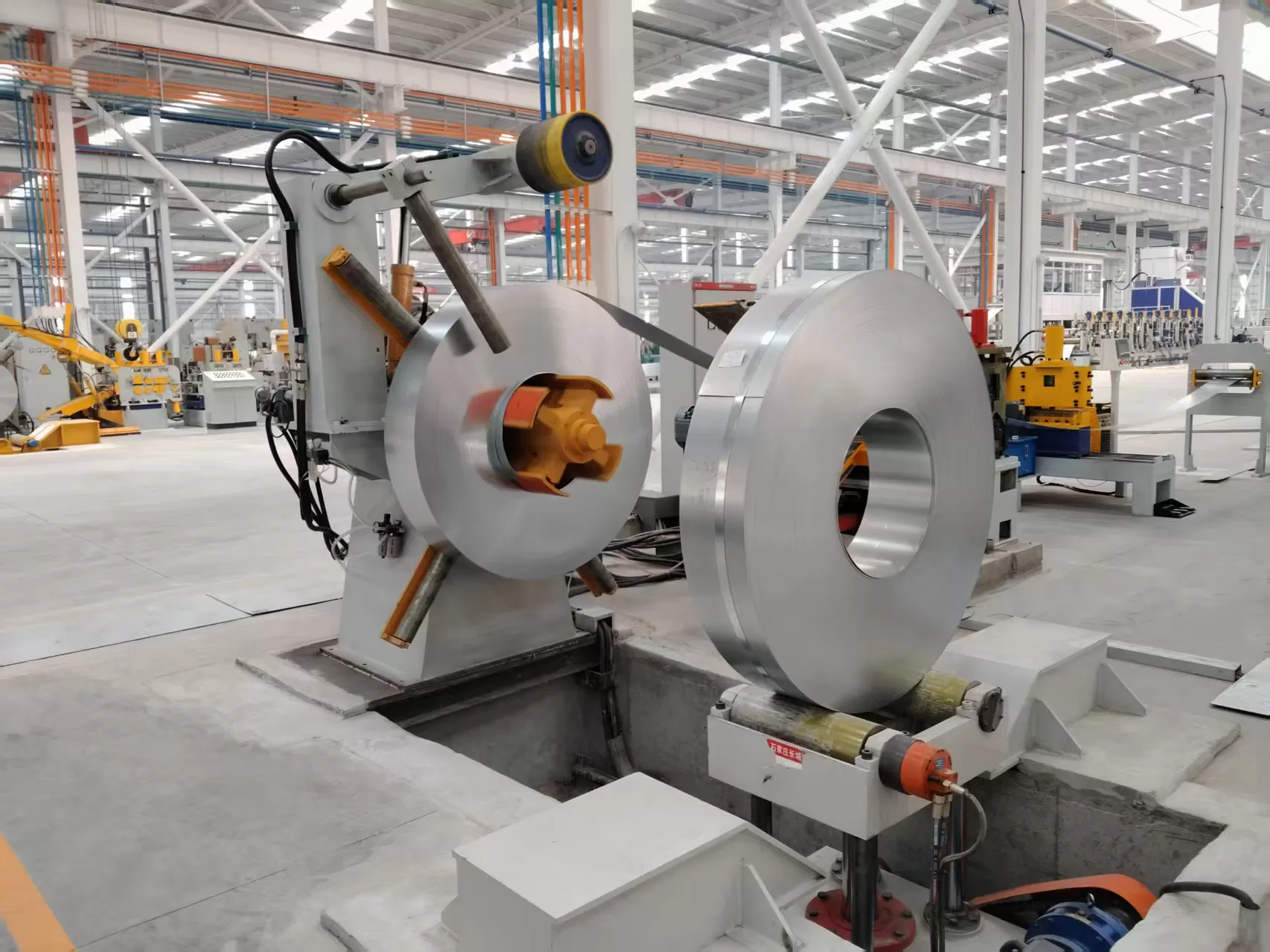
A robust steel decoilers system integrates five essential
subsystems. Each component must withstand cyclic loading from stop-start
operations and coil changeovers. Below is a breakdown of the typical design
found in heavy-duty tube mill lines:
Expanding Mandrel: Hydraulic or mechanical segments that
grip the coil inner diameter (508 mm or 610 mm are standard). Hydraulic
expansion provides concentricity within ±0.4 mm, essential for preventing strip
edge oscillation.
Coil Loading Car & Lifting Arm: Hydraulically operated,
transfers coils from storage saddles to the mandrel. Reduces manual intervention
and risk of coil edge damage.
Drag Braking System: Pneumatic or hydraulic caliper brakes
acting on the mandrel shaft. Modern units feature proportional tension control
with load cell feedback.
Edge Position Control (EPC): Photoelectric or ultrasonic
sensors detect strip wandering and adjust the decoiler base or a separate
guiding roller. Critical for slit coils with narrow widths.
Hold-Down Roller & Peeler Arm: Assists in initial coil
threading and prevents free loop formation during acceleration or
deceleration.
Each of these subsystems must be sized according to the maximum coil weight
and strip tensile strength. For advanced high-strength steels (DP780, CP1000), a
driven steel decoilers unit with an AC vector motor is often
specified to maintain constant tension without friction-induced marking on the
strip surface.
Technical Selection Criteria for Steel Decoilers
Selecting the correct steel
decoilers requires evaluating five primary parameters. Mismatches
lead to strip breaks, poor loop control, or accelerated wear. The following
checklist is used by mill engineering teams:
2.1 Coil Geometry and Weight Capacity
Coil ID range: 450 mm to 760 mm (customizable to 850 mm for
large-diameter pipe coils).
Coil OD max: Up to 2,100 mm, influencing mandrel travel and
overhead crane clearance.
Coil width: 150 mm to 1,800 mm (narrow strips require
segmented mandrel liners to prevent bending).
Coil weight: 5 to 30 metric tons. Heavy-duty dual-support
bearing stands are mandatory above 20 tons.
2.2 Material Grade and Surface Condition
Hot-rolled black coils: higher breakaway torque due to scale friction;
require brake pads with high thermal capacity.
Cold-rolled and galvanized: demand soft-contact surfaces (polyurethane-lined
hold-down rolls) to avoid scratching.
Stainless steel (austenitic or ferritic): needs non-marking mandrel segments
and precise tension control to avoid coil set.
2.3 Line Speed and Acceleration Profile
Standard tube mill speeds: 30–120 m/min. High-speed mills (150+ m/min)
require a dancer arm or loop pit to decouple decoiler inertia from the forming
section.
Acceleration rate: 0.5–1.5 m/s². Brake sizing must absorb regenerative
energy; some mills specify water-cooled brakes for continuous
operation.
Many modern installations specify a steel decoilers unit
with closed-loop tension control that adjusts braking torque based on real-time
strip demand. According to a 2024 study on tube mill efficiency, this reduces
tension spikes by 58% compared to fixed mechanical brakes, directly improving
weld uniformity.
Common Industry Pain Points and Engineering Solutions
Field data from 40 tube mills indicates that decoiler-related issues account
for 18–25% of unplanned downtime. Below are four frequent failure modes and
their technical remedies.
3.1 Coil Edge Burrs Damaging Mandrel Segments
Slit coils often leave micro-burrs that dig into mandrel expansion plates,
causing uneven gripping and oval deformation of the coil inner wrap.
Solution: Install replaceable tungsten carbide wear strips on
the mandrel surface. For high-volume mills, SANSO offers a
segmented mandrel with hardened steel inserts and a quick-change design,
reducing maintenance downtime by 40%. Additionally, a deburring station before
the decoiler can reduce edge burrs by 70%.
3.2 Tension Fluctuations Leading to Weld Craters
Inconsistent back tension causes the strip to flutter before entering the
forming rolls, producing a “whip” that destabilizes the weld box.
Solution: Replace passive mechanical brakes with a closed-loop
tension control system using a load cell and a proportional hydraulic valve. A
modern steel decoilers equipped with an AC vector drive
maintains tension accuracy within ±2% of setpoint, even during acceleration.
3.3 Coil Telescoping During Unwinding
Poorly wound coils (loose layers) telescope outward, rubbing against the
decoiler frame and damaging strip edges. Solution: Integrate a
hydraulic coil pusher and a vertical guide roller system that applies light side
pressure. Pre-alignment with an EPC sensor before threading reduces telescoping
events by 80%. For severe cases, a coil reforming station can be added
upstream.
3.4 Slow Coil Changeover Reducing Overall Equipment Effectiveness (OEE)
Manual centering and threading can take 12–18 minutes per coil.
Solution: Automated coil loading with a double-cone uncoiler
design or a reel bar system. SANSO’s automatic decoiling stations feature a
servo-driven coil car and hydraulic mandrel expansion, enabling changeovers
under three minutes for coils up to 20 tons. Implementing quick-release mandrel
segment caps further reduces preparation time.
Integration with Forming Lines: How Steel Decoilers Affect Weld Quality
The steel decoilers is the first element in the material
handling chain: decoiler → pinch leveler → strip accumulator → shear welder →
forming section. Any eccentricity or tension disturbance from the decoiler
propagates through the accumulator and directly affects the high-frequency
heating pattern in ERW tube mills. A variation of just 6% in strip edge
alignment increases weld flash variability by 12–15%, leading to higher
rejection rates due to lack of fusion or excessive scarfing.
To achieve stable weld penetration, mill designers now specify decoilers with
an active dancer arm that provides a “buffer zone.” The dancer position
modulates the decoiler drive or brake, decoupling the inertial mass of the coil
from the fast-responding forming rolls. In a case study involving a 3-inch pipe
mill (output: 2,000 tons per month), retrofitting a dancer-controlled
steel decoilers reduced weld seam hardness fluctuations from
±20 HV to ±7 HV, and decreased scrap by 2.1%.
Furthermore, the decoiler’s foundation rigidity is often underestimated. A
deflection of 0.2 mm under full coil load can tilt the mandrel axis, causing the
strip to enter the leveler at an angle. Mill builders recommend a reinforced
concrete base with embedded anchor bolts plus vibration-damping pads to maintain
geometric alignment over years of service. SANSO provides
foundation engineering drawings with each heavy-duty decoiler to ensure
compliance with ISO 16092-4 safety standards.
Maintenance Protocols and Safety Best Practices
Regular preventive maintenance on steel decoilers extends
bearing life and prevents sudden failures. Based on feedback from maintenance
supervisors at 15 tube mills, the following checklist is recommended:
Weekly: Inspect brake pads for wear (minimum thickness 6
mm). Clean mandrel sliding surfaces and re-grease expansion mechanism with
high-pressure lithium grease.
Monthly: Verify EPC sensor calibration using a reference
edge. Check hydraulic hoses for leaks or chafing. Measure mandrel radial runout
(limit ≤ 0.3 mm).
Quarterly: Tighten all foundation bolts. Perform thermal
imaging of brake calipers to detect uneven drag.
Annually: Perform nondestructive testing (dye penetrant) on
the mandrel shaft and coil car pivot pins. Replace any bearings showing acoustic
emission spikes.
From a safety perspective, all decoilers must include a locking pin for the
expanding mandrel during maintenance, plus a light curtain or pull-cord switch
along the strip path. SANSO uncoilers are designed with CE-compliant
guarding and emergency stop loops that simultaneously halt the mill and apply
the decoiler brake. Training operators on proper coil loading procedures reduces
hand injuries by over 60%.
Maximizing Return on Investment through Technical Upgrades
Investing in a high-rigidity steel
decoilers with active tension control and automated centering
delivers measurable returns: less scrap from edge damage, longer roll life in
the forming section, and higher OEE through faster changeovers. For existing
mills, retrofitting a dancer arm or replacing fixed brakes with proportional
valve-controlled calipers can increase line uptime by 15–20% within six months.
As tube mills move toward Industry 4.0, the decoiler becomes a data node —
providing coil ID tracking, tension histograms, and predictive wear analytics.
Selecting a partner like SANSO ensures that your decoiling system is engineered
for both current steel grades and future automation demands. The cost of a
poorly selected decoiler far exceeds the initial savings; precision pays back
within the first year of operation.
Frequently Asked Questions (FAQ)
Q1: What is the typical coil weight capacity for a steel decoiler used in
large-diameter tube mills?
A1: Heavy-duty steel decoilers for tube
mills handling diameters above 12 inches typically support coil weights from 15
to 35 metric tons. For spiral pipe mills, capacities can reach 45 tons. Always
include a 25% safety margin above the maximum planned coil weight to account for
hydraulic shocks during loading. The mandrel shaft diameter and bearing housing
must be sized accordingly.
Q2: How can we prevent strip edge burrs from damaging the decoiler mandrel
over time?
A2: Install hardened steel liners or replaceable carbide
inserts on the mandrel expansion segments. Another method is to specify a slit
coil edge conditioning station (deburring unit) before the decoiler. Regular
inspection and polishing of mandrel surfaces every 2,000 operating hours also
reduce burr-related micro-cutting. Some manufacturers, including SANSO, offer
mandrels with induction-hardened surfaces (HRC 55-60) that resist wear from
high-strength steels.
Q3: What are the differences between motorized (driven) and mechanical brake
tension control systems for steel decoilers?
A3: A motorized decoiler uses an AC or DC motor in
regenerative mode to actively pull the strip back, creating precise tension (±1%
accuracy) and recovering energy. However, it has higher upfront cost and
requires more maintenance on drives. A mechanical brake system applies friction
to the mandrel shaft — simpler and cheaper, but tension accuracy is ±10-15%, and
brakes can overheat during long, slow runs. For high-strength steels (tensile
> 600 MPa) or lines above 80 m/min, a motorized steel
decoilers is strongly recommended.
Q4: Can a single steel decoiler handle both hot-rolled and cold-rolled coils
without mechanical changes?
A4: Yes, but adjustments are required. Hot-rolled coils have
a rough, scaled surface that increases friction against the mandrel; you may
need higher hydraulic expansion pressure (up to 180 bar). Cold-rolled and
galvanized coils are slippery — use polyurethane-lined hold-down rolls to
prevent slippage. Also, the braking curve should be recalibrated because
cold-rolled strip requires lower tension to avoid elongation. A modern decoiler
with a PLC and recipe storage can switch between materials in under two
minutes.
Q5: How often should the expanding mandrel segments be inspected and
replaced?
A5: Mandrel segments should undergo visual inspection every
1,500 operating hours or every three months. Measure the wear of sliding
surfaces; if the gap between segments exceeds 1.5 mm, replacement is necessary.
For high-utilization mills (three shifts, six days a week), segment replacement
is typically scheduled every 12–18 months. Using wear sensors embedded in the
mandrel provides predictive alerts, minimizing unplanned downtime. The cost of a
segment set is quickly offset by avoiding coil slippage accidents.
Q6: What is the recommended method for aligning a steel decoiler with the
downstream pinch rolls?
A6: Use a laser alignment tool to check parallelism between
the decoiler mandrel axis and the pinch roll entry face. The vertical and
horizontal offset should not exceed 0.3 mm per meter of distance. Additionally,
install a steerable guide roller just after the decoiler to fine-tune strip
entry angle. Failure to align precisely results in cambered strip and uneven
edge wave patterns, which can cause weld mismatch. Re-alignment should be
verified after any foundation work or decoiler relocation.
Q7: Does a loop pit or dancer arm eliminate the need for a high-performance
decoiler brake?
A7: No, a loop pit or dancer reduces tension sensitivity but
does not replace the decoiler’s braking system. The decoiler must still provide
controlled pay-off to maintain the loop’s fill level. In fact, a dancer-equipped
line requires a responsive decoiler brake (or drive) to prevent loop bottoming
or overflowing. Many engineers pair a dancer with an actively controlled
decoiler for best results. Without proper brake control, the dancer can
oscillate, introducing periodic tension variations that transfer to the weld
zone.