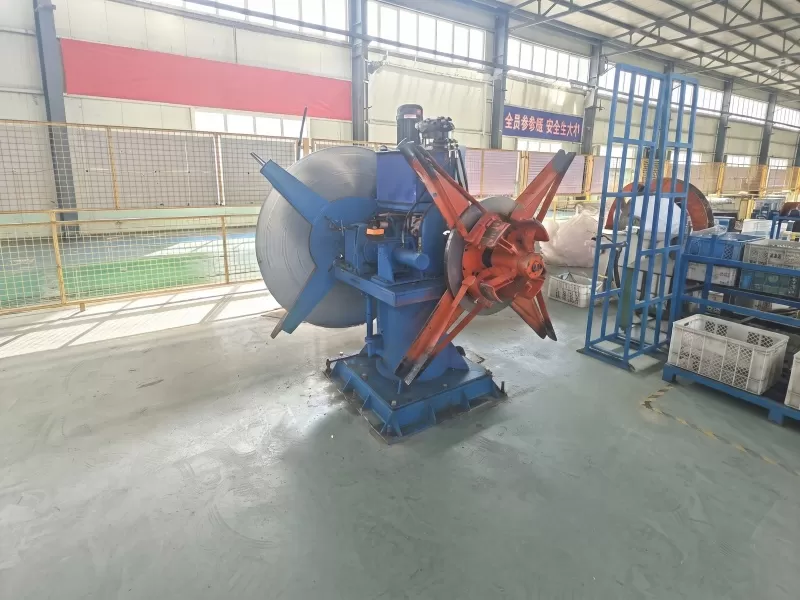
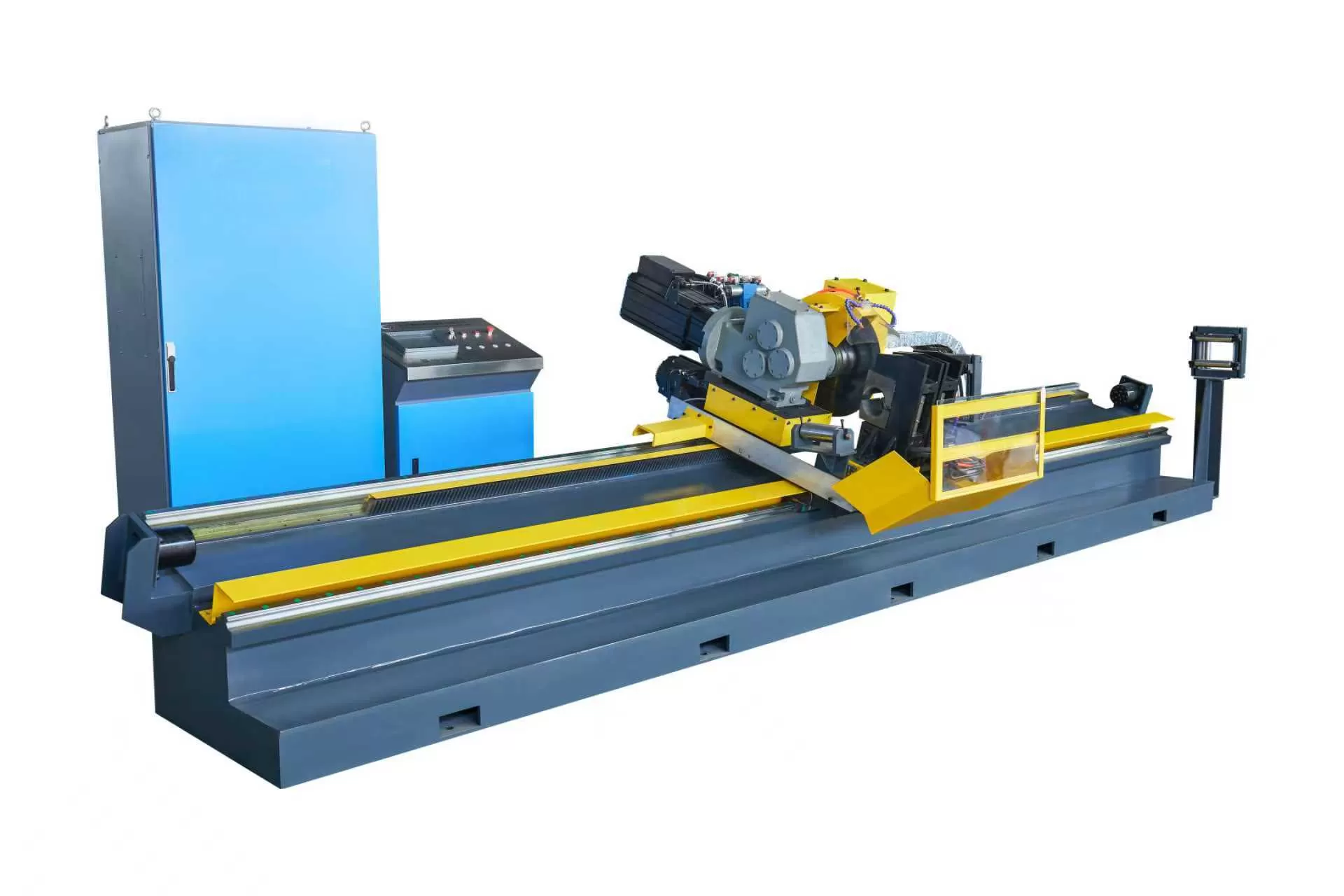
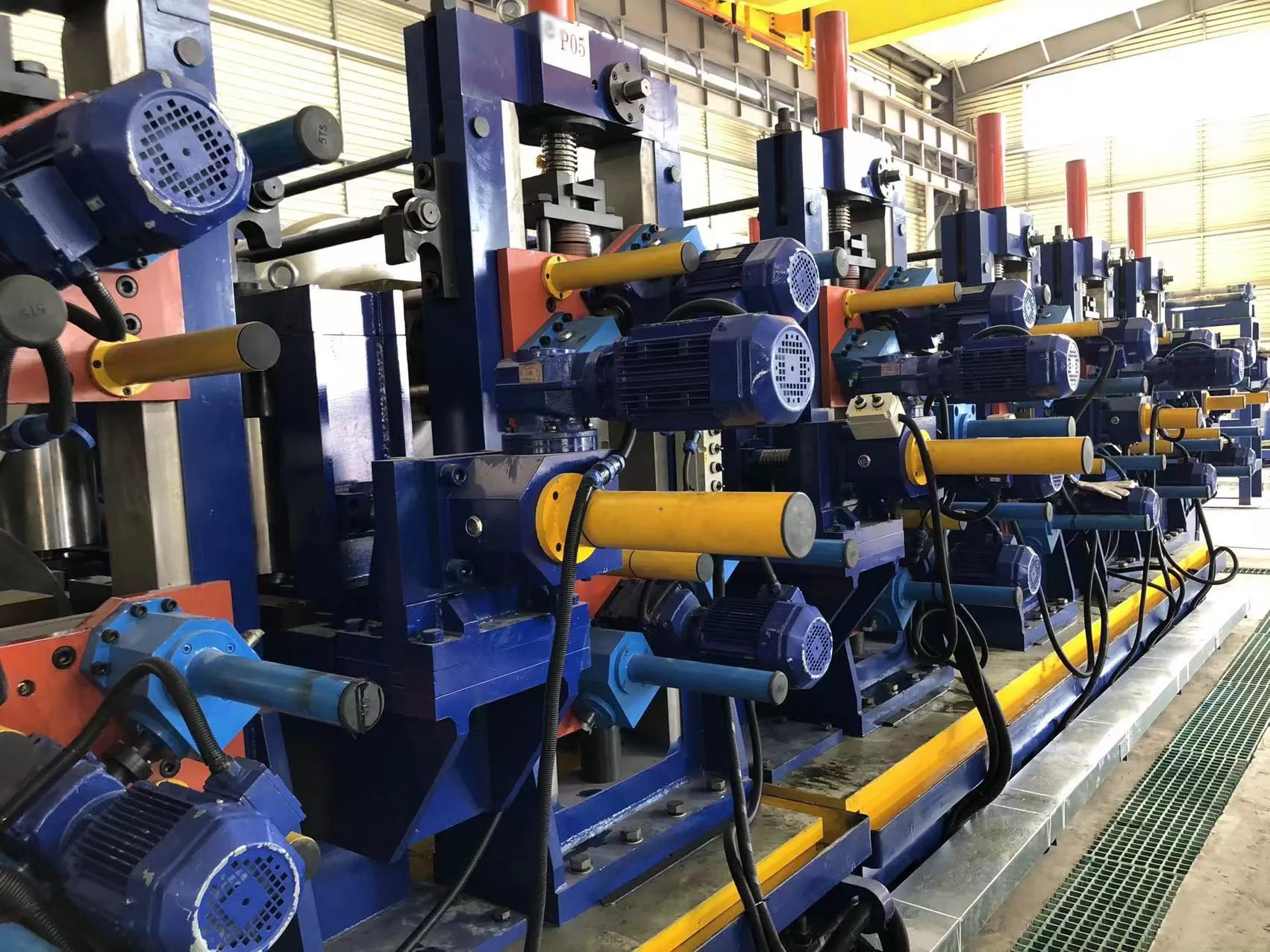
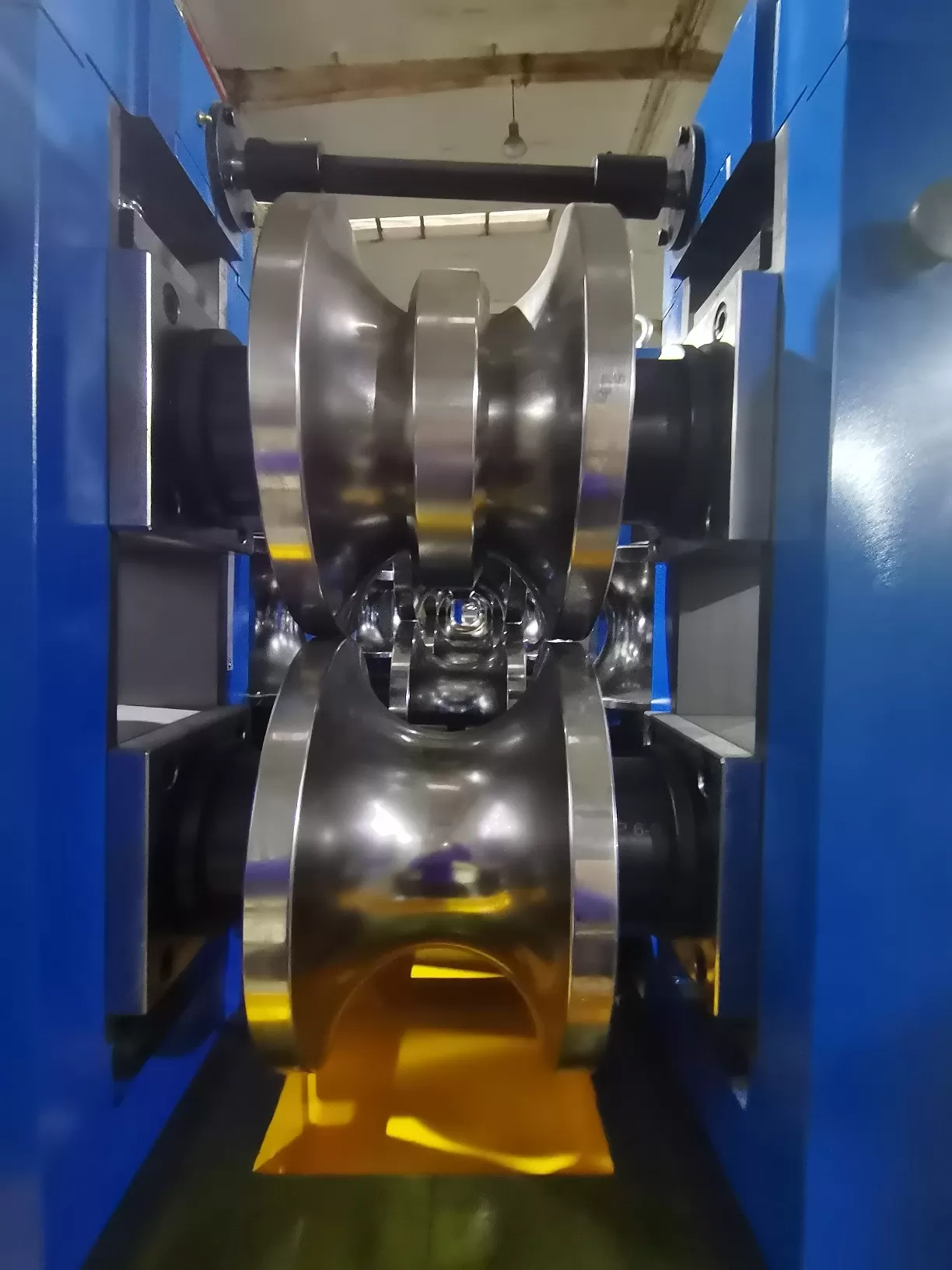
A motorized decoiler is a powered uncoiling system
designed to handle heavy steel coils (5–30 tonnes) at line speeds exceeding 80
m/min, where manual or hydraulic uncoilers become impractical. Unlike passive
decoilers that rely on the pull of downstream equipment, a motorized
decoiler uses an AC vector or DC motor to actively pay off strip,
maintaining precise back tension via regenerative braking or torque control.
This design prevents strip slippage, reduces edge damage, and enables continuous
operation in high-output ERW tube mills and roll forming lines. This article
provides engineering specifications for motorized decoilers, including motor
power (15–90 kW), mandrel expansion methods (hydraulic or electric), and tension
control algorithms (dancer roller or load cell feedback). Drawing on data from
60 tube mill installations, we compare motorized decoilers against manual and
hydraulic types, examine common issues (coil inertia mismatch, motor
overheating, tension hunting), and provide solutions such as field-oriented
control (FOC) and dynamic braking resistors. SANSO manufactures a complete range of motorized single-head and double-cone
decoilers, integrated with pinch levelers and accumulators for seamless tube
mill feeding.
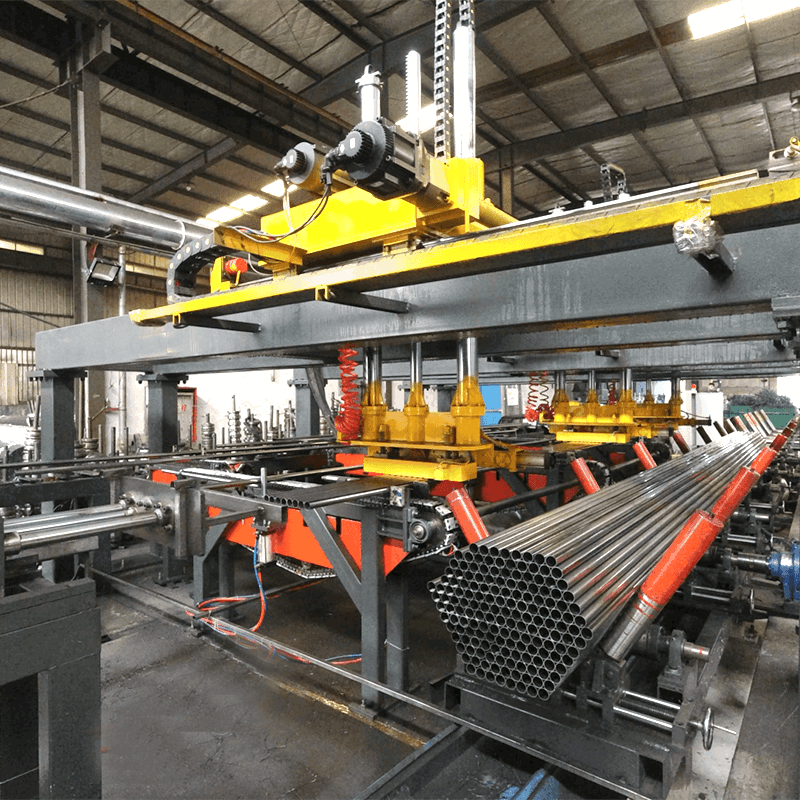
1. Core Components of a Motorized Decoiler
Every motorized decoiler integrates five critical
subsystems:
Drive motor and gearbox: AC induction motor (15–90 kW) with
a helical-bevel gearbox (reduction ratio 15:1 to 30:1). For precision tension
control, a 4-quadrant AC drive with encoder feedback is used (e.g., ABB ACS880
or Siemens Sinamics). The motor operates in torque control mode, pulling against
the downstream feeder.
Expansion mandrel (shaft): Hydraulic or electric expansion.
Hydraulic: a cylinder pushes a tapered wedge to expand segmented shells
(diameter range 450–610 mm). Electric: a motor-driven lead screw expands the
mandrel. Both types include limit switches to prevent over-expansion. Mandrel
material: 42CrMo steel with induction-hardened segments (HRC 52–56).
Coil loading car: A hydraulically operated cart that lifts
coils from the floor, aligns them with the mandrel, and pushes them onto the
expanded shaft. Load capacity matches the decoiler rating (10–30 tonnes).
Hold-down roll and anti-telescoping guides: A pneumatically
actuated roller presses on the coil OD to prevent bouncing during acceleration.
Side guides (motorized or manual) keep the coil layers aligned.
Tension feedback system: A dancer roller with a
potentiometer or a load cell mounted on a deflection roller. The signal is fed
to the drive controller to adjust motor torque in real time (response time
<50 ms).
A well-designed motorized decoiler from SANSO includes
a touchscreen HMI for setting coil diameter, tension setpoint (500–5,000 N), and
acceleration/deceleration ramps (0.5–2.0 m/s²). The system automatically
calculates motor torque based on coil inertia, reducing setup time.
2. Technical Specifications and Selection Criteria
Selecting a motorized decoiler requires matching six parameters
to the upstream slitter and downstream tube mill:
| Parameter | Typical
range | Selection
criteria |
|---|
| Coil
weight capacity | 5–30
tonnes | Based
on slitter output; heavier coils reduce changeover frequency but require larger
motor |
| Coil
inner diameter (ID) | 508
mm (20"), 610 mm (24") | Match
mandrel expansion range; double-cone mandrels handle multiple IDs |
| Coil
outer diameter (OD) | 1,200–1,800
mm | Larger
OD increases inertia – requires higher motor torque and regenerative braking
capacity |
| Strip
width | 100–600
mm | Wider
strips need wider mandrel face and side guides |
| Max
uncoiling speed | 60–150
m/min | Motorized
decoilers are mandatory above 60 m/min to prevent strip overrun |
| Strip
thickness | 0.8–6.0
mm | Thicker
strips require higher motor torque to overcome bending
resistance |
For a typical ERW tube mill producing 100 mm diameter pipe from 2.5 mm thick
strip at 80 m/min, a motorized
decoiler with 15 tonne capacity, 30 kW motor, and 610 mm mandrel is
recommended. SANSO provides a selection software that calculates
required torque and regenerative power based on coil geometry and line
speed.
3. Tension Control Strategies: Dancer vs. Load Cell
Maintaining constant strip tension is the primary function of a motorized
decoiler. Two feedback methods dominate:
Dancer roller with potentiometer: A free-floating roller
(weighted or air-loaded) moves vertically as tension varies. Its position is
measured by a rotary potentiometer or linear encoder. The drive adjusts motor
torque to keep the dancer at the setpoint (e.g., mid-position). Advantages:
simple, low cost, absorbs shock loads. Disadvantages: slower response (200–300
ms), requires mechanical maintenance of roller bearings.
Load cell (tension transducer): A pair of strain-gauge
sensors mounted on a fixed deflection roller measure the actual strip tension
(in N). The signal is fed to a PID controller that commands the motor torque.
Advantages: fast response (<20 ms), high accuracy (±1% of setpoint).
Disadvantages: higher cost, requires careful roller alignment to avoid side
loading.
For high-speed lines (>100 m/min) or thin strip (<1.5 mm), load cell
control is preferred because it minimizes tension hunting. For heavy-gauge strip
(≥3 mm) at moderate speeds, dancer control is adequate. SANSO offers
both configurations; the motorized
decoiler can be ordered with a dancer or with a load cell
package.
4. Comparison: Motorized vs. Manual vs. Hydraulic Decoilers
The choice of a motorized decoiler versus alternatives depends on
coil weight, line speed, and automation level. The table below summarizes three
types:
| Feature | Manual
Decoiler | Hydraulic
Uncoiler | Motorized
Decoiler |
|---|
| Coil
weight capacity | 0.5–2
t | 2–10
t | 5–30
t |
| Mandrel
expansion | Manual
hand wheel | Hydraulic
cylinder | Hydraulic
or electric |
| Brake/tension
control | Manual
friction brake | Pneumatic
or hydraulic brake | Regenerative
AC motor + closed-loop |
| Coil
loading | Forklift | Hydraulic
lift arms | Hydraulic
coil car |
| Max
line speed | 30–50
m/min | 60–100
m/min | 100–200
m/min |
| Relative
cost (1–10) | 1–2 | 4–6 | 8–10 |
For a high-volume tube mill producing automotive exhaust pipe (line speed 120
m/min), a motorized decoiler is mandatory to prevent strip
breakage and ensure weld quality. SANSO builds
motorized decoilers with dual drive motors for extra-heavy coils (30 tonnes, 150
m/min).
5. Common Operational Problems and Solutions
Field data from 40 tube mills identify the top five issues with motorized
decoiler installations:
Tension hunting (oscillation of strip tension): Caused by
PID gains too high or backlash in the gearbox. Remedy: Perform auto-tuning of
the drive controller (many AC drives have built-in autotune). Reduce
proportional gain by 30% and increase integral time by 20%. For load cell
systems, ensure the roller is not binding.
Motor overheating during deceleration: Regenerative energy
is dissipated as heat in the braking resistor. If the resistor is undersized,
the drive faults. Solution: Calculate regenerative power: P_reg = 0.5 × J_coil ×
(ω₁² – ω₂²) / t_brake. Install a larger braking resistor or a regenerative power
supply that feeds energy back to the grid.
Coil telescoping during acceleration: Caused by
insufficient hold-down roller pressure or misaligned side guides. Remedy:
Increase pneumatic pressure to the hold-down roll (max 4 bar). Install motorized
side guides that close to within 5 mm of the coil OD before starting the
line.
Mandrel slip (coil rotates relative to mandrel): Hydraulic
expansion pressure too low or mandrel segments worn. Check hydraulic pressure
(recommended 180–220 bar). Measure mandrel OD with a caliper; if worn by >2
mm, replace segments.
Strip edge damage (crescent-shaped marks): Often due to a
misaligned dancer roller or deflection roller. Use a laser alignment tool to
check roller parallelism; adjust bearings accordingly.
Proactive maintenance: Every 1,000 operating hours, perform thermography of
the motor and drive cabinet, check braking resistor for cracks, and recalibrate
tension sensor (load cell) with certified weights.
6. Energy Efficiency and Regenerative Braking
A motorized decoiler with a 4-quadrant drive can
recover up to 80% of the coil's kinetic energy during deceleration. For a
15-tonne coil decelerating from 120 m/min to stop in 10 seconds, regenerative
power = 0.5 × 15,000 × (120/60)² / (2 × 10) ≈ 15 kW over 10 seconds. Over a
shift with 20 coil changes, total recovered energy ≈ 1.5 kWh – not huge, but
combined with other drives can reduce plant electricity demand. More
importantly, regenerative braking reduces wear on mechanical brakes and
eliminates the need for resistor cooling fans.
When specifying a motorized
decoiler, choose a common DC bus configuration if multiple drives
(e.g., decoiler, feeder, shear) are present. This allows energy sharing: the
decoiler's regenerated power can be used by the feeder motor, lowering peak
demand by 20–30%.
7. Integration with Tube Mill Automation
A modern motorized decoiler is part of a coordinated mill
control system. Key interfaces:
Speed reference from the mill PLC: The decoiler drive
receives a speed setpoint (via Profibus, Profinet, or EtherCAT) that matches the
line speed, with a slight offset (1–2% lower) to maintain tension.
Accumulator level control: In lines with a horizontal
accumulator, the decoiler must run slightly faster than the mill when the
accumulator is emptying, and slower when filling. The PLC calculates the
required speed based on accumulator position sensor (ultrasonic or laser).
Auto-sequencing: When the coil tail passes a photoeye, the
decoiler decelerates, stops, and signals for a new coil. The coil car
automatically loads the next coil, and a shear/welder joins the strips without
stopping the mill.
SANSO provides full integration services: the
motorized decoiler is delivered with a pre-programmed
PLC (Siemens S7-1500 or Allen-Bradley CompactLogix) and HMI, ready to connect to
the main mill control network.
8. Safety Features and Compliance
Operating a motorized decoiler requires adherence to machinery
safety standards (EN 60204-1, ISO 12100). Mandatory safety devices:
Light curtains or safety mats: At the coil loading area to
prevent personnel entry while the coil car is moving.
Emergency stop pull-cords: Along both sides of the
decoiler, with latching emergency stops every 5 m.
Guard doors with interlock switches: Access to the mandrel
area must be interlocked with the drive – opening a door disables motor power
and applies a mechanical brake.
Overtravel limit switches: On the mandrel expansion
cylinder to prevent over-expansion (which could rupture the coil).
Brake resistor thermal switch: Shuts down the drive if the
resistor exceeds 150°C.
SANSO certifies each motorized
decoiler to CE or UL standards, and provides a risk assessment
document for the integrator.
Frequently Asked Questions (FAQ)
Q1: What is the typical motor power for a motorized decoiler handling
10-tonne coils at 100 m/min?
A1: The required motor
power (P) can be estimated as: P (kW) = (T × v) / (η × 1000), where T is tension
(N), v is line speed (m/s), and η is efficiency (0.85). For a 10-tonne coil,
typical tension needed to uncoil 2 mm strip is 2,500 N. At 100 m/min (1.67 m/s),
P = (2,500 × 1.67) / 850 = 4.9 kW. However, the motor must also accelerate the
coil's inertia. A safety factor of 3–4 is applied, so a 18.5–22 kW motor is
common. SANSO offers 22 kW and 30 kW models for this
range.
Q2: How often should the braking resistor be replaced in a motorized
decoiler?
A2: Braking resistors (wire-wound or
thick-film) have a service life of 5–7 years under normal duty (20 starts/stops
per hour). Signs of end-of-life: visible cracks on the ceramic housing,
discoloration (overheating), or a reduction in resistance value by >20%.
Replace immediately if the drive displays a “brake resistor short circuit”
fault. For heavy regenerative duty (frequent decelerations), use a water-cooled
resistor or a regenerative power supply.
Q3: Can a motorized decoiler be used for both slitting and tube mill
lines?
A3: Yes, but with adjustments. Slitting
lines require very low tension (to prevent coil breakage), while tube mills
require higher tension to feed the forming section. A single motorized
decoiler can serve both if it has a wide tension range (e.g.,
500–5,000 N) and a dancer that can be disabled. However, many plants prefer
dedicated decoilers because slitting uses narrower strips (50–200 mm) and tube
mills use wider strips (200–600 mm).
Q4: What is the maximum allowable coil OD for a motorized decoiler
with a 610 mm mandrel?
A4: Most motorized decoilers
are designed for coil OD up to 1,800 mm. Larger ODs (e.g., 2,000 mm) increase
the moment of inertia and require a higher torque motor. The limiting factor is
the hold-down roller reach – it must be able to press on the OD when the coil is
new. For OD >1,800 mm, specify a decoiler with a longer swing arm. SANSO offers
custom decoilers for OD up to 2,200 mm.
Q5: How do I troubleshoot a tension hunting problem on a motorized
decoiler?
A5: First, check the dancer roller or
load cell for mechanical binding (should move freely). Then, perform a drive
autotune to measure motor and load inertia. Reduce the proportional gain (P) by
40% and increase the integral time (I) by 50% from the default values. If
hunting persists, switch from speed control to torque control mode. Finally,
check for backlash in the gearbox – if more than 1° of rotation without motor
movement, rebuild the gearbox. SANSO provides remote diagnostic support via VPN
connection to the drive PLC.