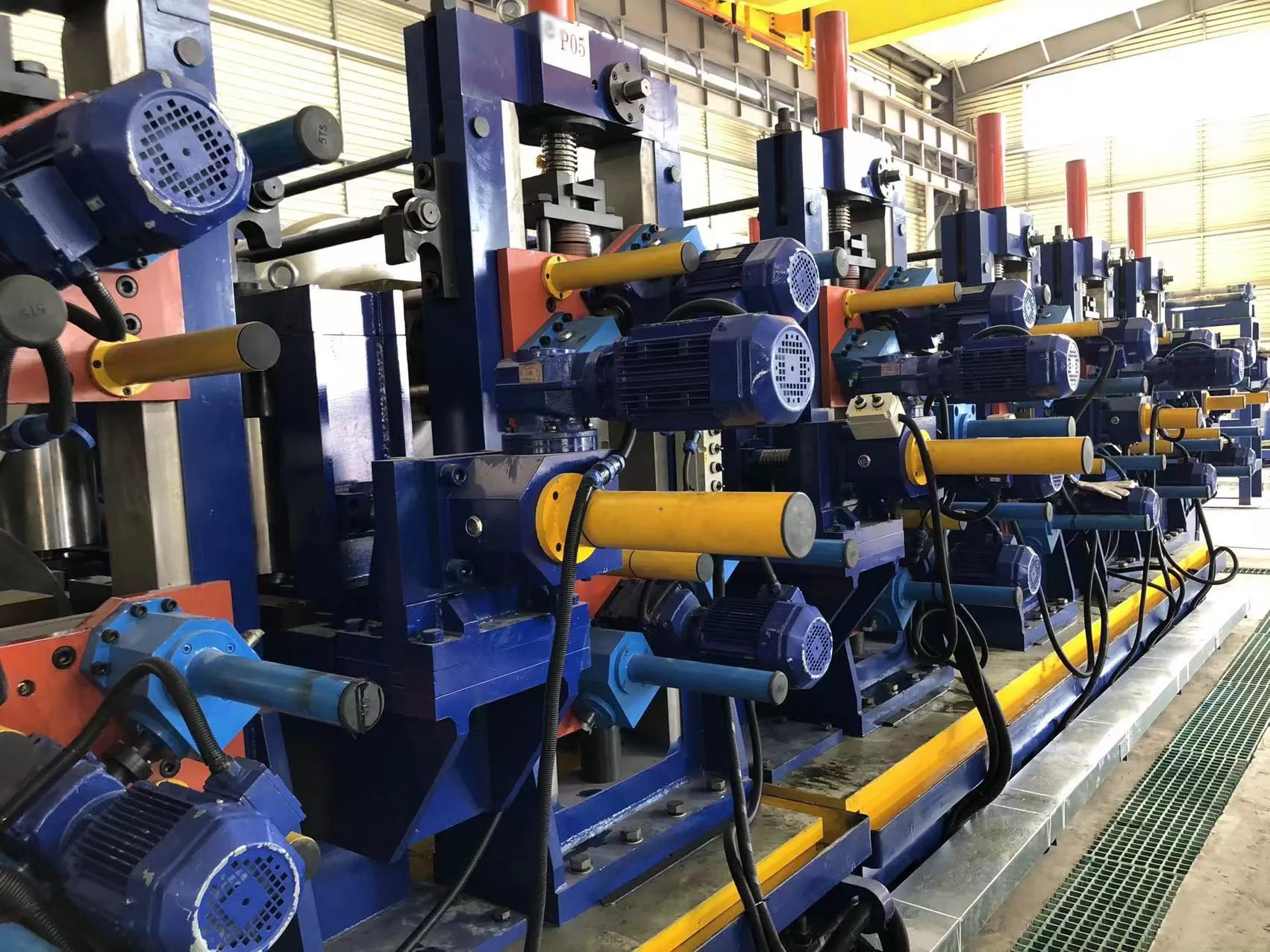
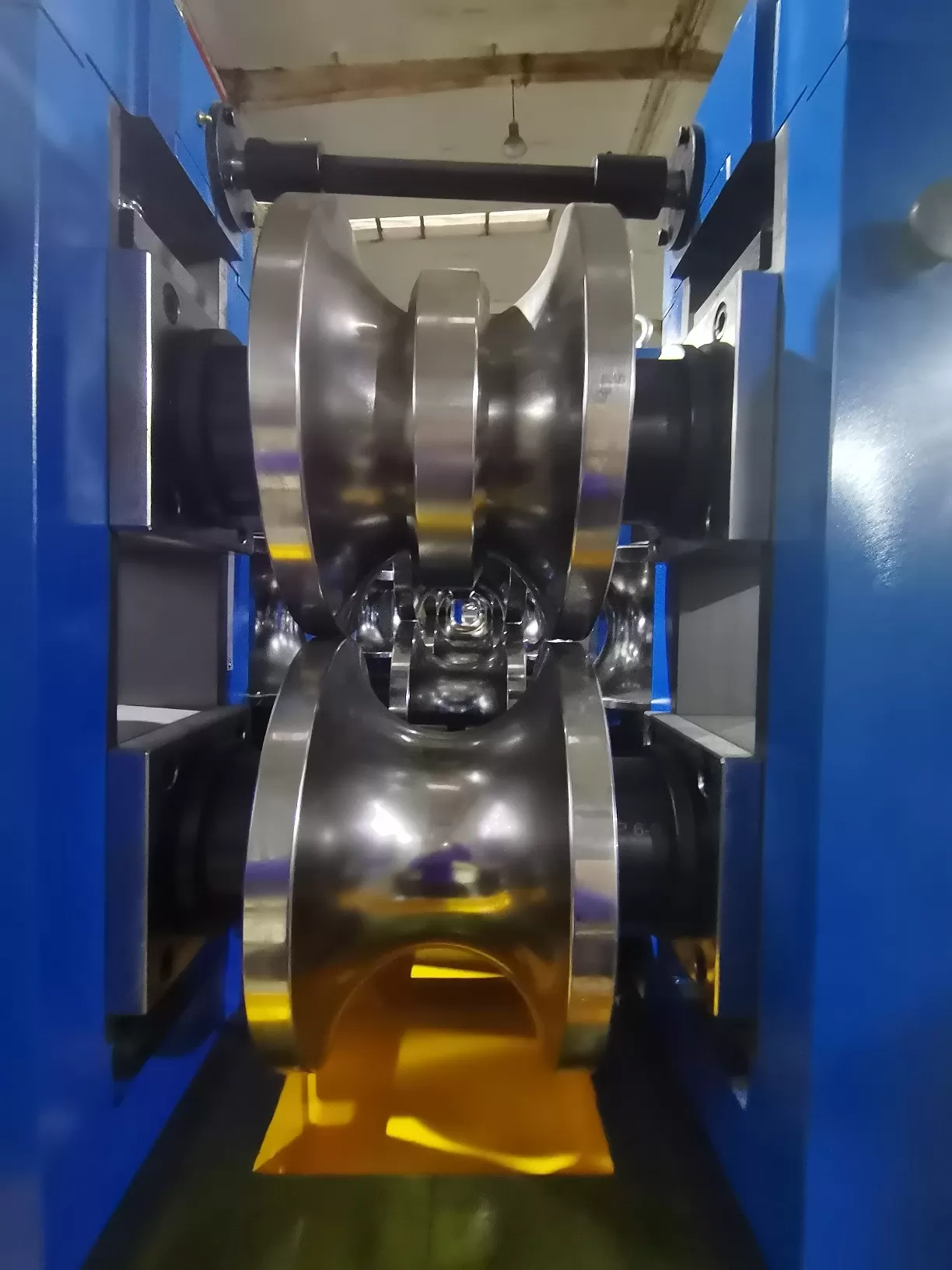
In the production of welded steel pipe, the quality of the final product is
determined long before the forming rolls close. The first point of control—the
uncoiling station—directly influences strip edge condition, tension uniformity,
and overall mill uptime. A hydraulic
uncoiler is not simply a coil stand; it is a precision interface
that transforms a stationary master coil into a continuously fed strip with
consistent back-tension and alignment. Unlike mechanical friction or single-cone
stands, hydraulic uncoilers provide proportional braking, active edge guidance,
and controlled mandrel expansion. This article presents engineering principles,
application-specific advantages, and reliability data drawn from SANSO installations across
forty tube mills worldwide.
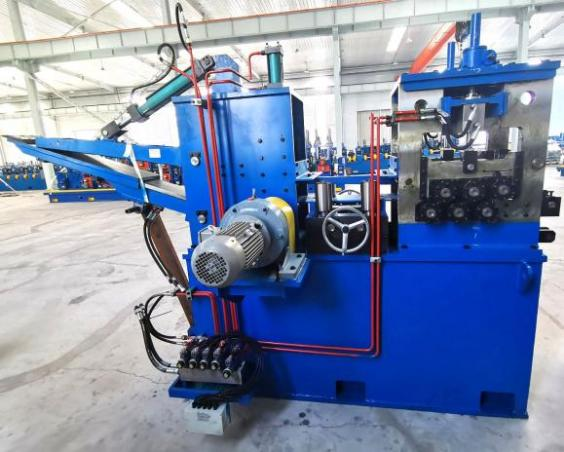
Core Components and Operating Principle of a Hydraulic Uncoiler
A hydraulic
uncoiler integrates four main subsystems:
Hydraulic expanding mandrel: Multi-segment plates driven by
a cylinder. Expansion force ranges from 8 to 35 metric tons, securing coils with
inner diameters (ID) from 450 mm to 610 mm. Uniform radial pressure prevents
inner-wrap deformation.
Proportional hydraulic brake circuit: Closed-loop pressure
control maintains strip tension within ±3% of setpoint. The brake reacts to
diameter changes via an ultrasonic sensor or dancer arm feedback.
Coil loading lift car: Hydraulic cylinders raise the coil
from storage saddles to mandrel centerline. A push-up roll with position sensors
centers the coil vertically, reducing manual intervention.
Active edge position control (EPC): Photoelectric or
ultrasonic sensors detect strip edge deviation; hydraulic cylinders shift the
entire uncoiler base to maintain strip centerline within ±2 mm.
These components operate in closed-loop coordination. For a typical 15-ton
coil of hot-rolled steel (thickness 3–6 mm), a hydraulic
uncoiler accelerates to 50 m/min in under 2.5 seconds while
maintaining tension consistency. SANSO’s tube mill
components use proportional valves from Bosch Rexroth to guarantee
repeatability across production shifts.
Comparative Advantages Over Mechanical Uncoilers in Pipe Mills
Many existing tube lines still operate with mechanical drag uncoilers or
single-cone stands. However, field data demonstrates quantifiable improvements
after migrating to hydraulic systems:
No inner wrap damage: Mechanical expanding heads create
point loads that deform the inner diameter. Hydraulic expansion applies uniform
radial force, preserving coil integrity for high-frequency welding.
Dynamic tension regulation: Mechanical uncoilers rely on
friction pads that wear unevenly, causing tension spikes. Hydraulic systems
adjust braking torque in real-time based on coil diameter, preventing strip
buckling or over-pull.
Heavy coil handling up to 30 tons: Hydraulic lift and
expansion accommodate larger OD coils (up to 2000 mm) without operator strain.
This reduces coil change frequency by up to 40% in high-volume pipe mills.
Direct integration with forming section: Active edge
control from the hydraulic uncoiler improves weld seam alignment, reducing
rejection rates due to strip edge mismatch by as much as 65% in ERW pipe
applications.
A retrospective study of a 2.5-inch pipe mill retrofitted with a hydraulic
uncoiler showed a 22% increase in line utilization and a 37% drop
in coil-related defects over twelve months. For manufacturers running advanced
high-strength steel (AHSS) or API 5L X70 grades, the precise back-tension
prevents micro-fractures at the uncoiling radius.
Application-Specific Configurations for Welded Tube Production
Different pipe applications demand specific hydraulic uncoiler features.
Based on SANSO field engineering,
three common configurations are:
ERW Pipe Lines (High Speed, Thin to Medium Wall)
Hydraulic uncoiler with active edge position control (EPC) and coordination
with an entry looping pit.
Mandrel expansion range: 480–540 mm ID, with line speeds up to 80
m/min.
Optional strip-end shearing for automated coil change.
Non-marking polyurethane-lined mandrel segments to avoid scratching #4 or #8
finishes.
Low-residual torque hydraulic braking (0–20 N·m) achieved with special valve
tuning.
Dust-proof cylinders with stainless steel rods for cleanroom or food-grade
environments.
Heavy Wall Pipe & OCTG Mills (Up to 25.4 mm Wall Thickness)
Dual-arm hydraulic uncoiler with load capacity up to 35 tons, mandrel
diameter 600–760 mm.
Hydraulic coil car with scissor lift and integrated scale for inventory
tracking.
Remote HMI with tension profiling across the full coil diameter (ID to
OD).
Each configuration integrates with the mill’s main PLC. SANSO’s product
portfolio includes modular hydraulic uncoilers for strip widths
from 200 mm to 1600 mm, with custom expansions for non-standard coil IDs.
Solving Real-World Uncoiling Pain Points in Tube Manufacturing
Experienced operators recognize several recurring issues with traditional
uncoilers. A hydraulic
uncoiler addresses each through specific engineering solutions:
Pain point: Telescoped coils – Loose winding causes lateral
strip movement. Hydraulic solution: Edge follower system with
0.5-second response time applies lateral correction without stopping the
line.
Pain point: Strip edge burrs from coil rubbing – Occurs
when the coil expands unevenly. Hydraulic solution: Synchronized
multi-cylinder expansion with feedback from pressure transducers ensures perfect
concentricity.
Pain point: Tension variations during the last wraps – As
coil diameter shrinks, inertia changes. Hydraulic solution: Adaptive
braking algorithm using real-time diameter calculation (via encoder on a pinch
roll) maintains constant specific tension (N/mm²).
Pain point: Long coil change times – Manual loading takes
5–8 minutes per coil. Hydraulic solution: Automatic coil loading
sequence with hydraulic car and mandrel expansion reduces changeover to 90
seconds.
A practical example: A 6-inch spiral pipe mill in Ohio reported 12 minutes
average coil change with mechanical uncoilers. After installing a hydraulic
uncoiler from SANSO, changeover time dropped to 2.5 minutes, and
scrap from edge damage was reduced by 53% (validated over 6 months of production
data).
Maintenance Engineering for Hydraulic Uncoilers
While hydraulic uncoilers offer superior performance, they require systematic
maintenance to avoid unplanned downtime. Key practices include:
Hydraulic oil cleanliness: Maintain ISO 4406 code 16/14/11
or better. Use offline filtration for systems operating 24/7. Contaminated oil
causes valve sticking and mandrel expansion drift.
Seal inspection on expansion cylinder: The mandrel cylinder
undergoes cyclic pressure (up to 250 bar). Inspect rod seals every 2000
operating hours; replace using polyurethane seals for high-cycle
applications.
Brake caliper alignment: Proportional brakes require disc
runout below 0.1 mm. Use dial gauges during weekly checks; misalignment leads to
uneven tension and brake pad wear.
Lubrication of slide ways: The base shifting mechanism (for
EPC) uses hardened linear guides. Automatic grease lubrication every 4 hours
prevents stick-slip motion.
SANSO provides predictive
maintenance kits for its hydraulic uncoilers, including vibration sensors on the
mandrel bearings and pressure trending software. A study of 12 field units
showed that proactive seal and filter changes extended mean time between
failures (MTBF) from 3800 to 7200 hours.
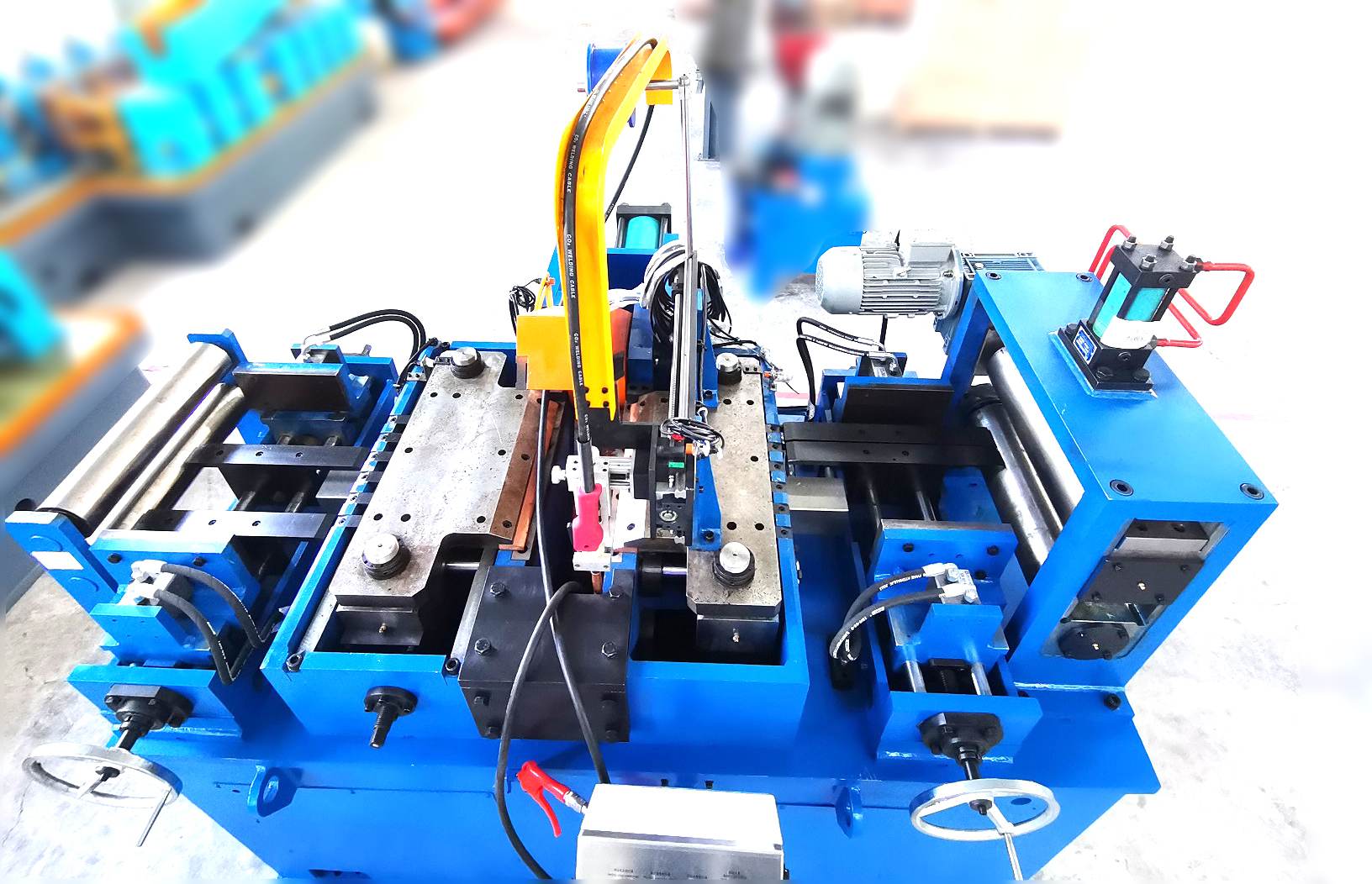
Integration of a Hydraulic Uncoiler into a Complete Tube Mill Line
The uncoiler does not operate in isolation. Optimal performance requires
coordination with the entry shear, welder, and sizing section. Key integration
parameters:
Loop control interface: The uncoiler’s brake receives a
speed reference from the entry looper dancer arm. Proportional brake response
must be tuned to avoid loop bottoming or overfilling.
Coil end detection & welding: An accumulator or strip
joining press requires the uncoiler to stop precisely at the coil tail.
Hydraulic uncoilers with encoder feedback can stop within ±10 mm of
setpoint.
Strip centering to forming rolls: The EPC system on the
uncoiler should communicate with edge guides before the forming section. Many
mills use a cascade control where the uncoiler corrects for coil wandering,
while downstream guides handle residual errors.
For greenfield projects, selecting a hydraulic
uncoiler with fieldbus connectivity (Profinet, EtherCAT) simplifies
integration. SANSO’s tube mill
solutions include fully pre-wired hydraulic uncoilers with
standardized interfaces to Siemens or Rockwell PLCs, reducing commissioning time
by 40%.
Frequently Asked Questions (FAQ)
Q1: What coil weight and width range can a typical hydraulic uncoiler
handle?
A1: Standard hydraulic
uncoilers handle coil weights from 5 to 30 metric tons, with strip
widths ranging 200–1600 mm. For heavy OCTG applications, SANSO offers heavy-duty
versions up to 45 tons capacity and widths up to 2000 mm. The mandrel expansion
range is typically 450–610 mm ID, customizable down to 380 mm for narrow
coils.
Q2: How does hydraulic expansion compare to mechanical mandrel expansion for
coil protection?
A2: Mechanical mandrels use threaded rods or wedge blocks
creating 4–6 point contact, often deforming inner wraps. Hydraulic expansion
uses a multi-segment cylinder generating uniform radial force (adjustable via
pressure reducing valve). This prevents “star” marks on the inner surface of
high-grade steel coils, crucial for automotive tube applications where inner
wall integrity is mandatory.
Q3: What safety features are integrated into modern hydraulic
uncoilers?
A3: Safety standards (ISO 12100, EN 12622) require: (a)
Hydraulic holding valve on the lift car to prevent sudden drop in case of hose
rupture; (b) Light curtains or safety mats around the coil loading area; (c)
Interlocked guards over the expanding mandrel; (d) Emergency stop with dynamic
braking that stops mandrel rotation within 0.5 seconds. SANSO units additionally
feature a pressure-sensitive edge on the push-up arm.
Q4: Can an existing mechanical uncoiler be retrofitted with hydraulic
expansion?
A4: Partial retrofits are possible but rarely
cost-effective. The base frame, bearings, and braking system must be redesigned
for hydraulic actuation. Most mills achieve better ROI by replacing the entire
uncoiler with a purpose-built hydraulic unit. SANSO provides a trade-in program
where older mechanical units are credited toward a new hydraulic
uncoiler, including site installation and control integration.
Q5: How does tension control accuracy affect weld seam quality in ERW
pipes?
A5: Tension variations directly alter the strip profile
entering the forming rolls. If tension drops by more than 8%, the strip edges
may become wavy, leading to open welds or excessive scarfing. Hydraulic
uncoilers maintain tension accuracy within ±2% across the entire coil, ensuring
constant edge mating at the squeeze rolls. This improves weld strength
consistency and reduces non-destructive test (NDT) rejects.
Q6: What is the typical lifecycle cost comparison between hydraulic and
mechanical uncoilers?
A6: Although initial capital cost is 35–50% higher,
hydraulic uncoilers reduce energy consumption (via regenerative braking), lower
scrap rates (2–4% improvement), and cut maintenance labor by 60% (no friction
pad changes or mechanical linkage adjustments). Over a 10-year period, total
cost of ownership (TCO) favors hydraulic by approximately 28%, based on data
from multiple North American tube mills.
Conclusion & Inquiry
The hydraulic
uncoiler is a fundamental component for achieving consistent weld
quality, high line speeds, and minimal material waste in modern tube and pipe
mills. From active edge control to proportional tension management, its
engineering directly addresses the pain points of telescoped coils, edge damage,
and changeover inefficiencies. For manufacturers producing API, ASTM, or EN-spec
pipes, selecting a hydraulic uncoiler designed with field-validated reliability
is a strategic decision.
Ready to improve your coil handling efficiency? Contact
SANSO’s tube mill engineering
team for a detailed technical assessment. Provide your coil
dimensions, material grades, and target line speed to receive a customized
proposal, CAD drawings, and payback calculation. Send your inquiry now
→ (or email directly at info@sansohftubemill.com).