In modern tube and pipe production, the cutting station is often the final
quality gate before value‑added processes. Selecting the ideal saw blade tct (tungsten carbide tipped) is not merely a procurement task—it directly
determines edge quality, burr levels, blade longevity, and overall operating
costs. With decades of experience in tube mill engineering, SANSO has compiled
this data‑driven guide to help production managers and process engineers master
the nuances of carbide‑tipped saw blades.
1. Metallurgical composition & tooth geometry of saw blade
tct
The performance of a carbide‑tipped blade starts at the atomic level. TCT
blades use tungsten carbide tips brazed onto a alloy steel body. The carbide
grade (micro‑grain size and cobalt content) must match the tube material:
For carbon steels (up to 450 MPa): medium‑grain carbide
with 6‑8% cobalt – excellent toughness against shock loads.
For stainless steel / exotic alloys: sub‑micro grain
carbide with 10‑12% cobalt plus Cr/Ta additives for hot hardness.
Tooth geometry: alternate top bevel (ATB) for clean cuts on
thin walls; triple‑chip grind (TCG) for heavy wall tubes; combination teeth for
general purpose mills.
A well‑designed saw blade tct also features specific clearance angles (usually 12°–15°) and rake angles (0° to
+8°) depending on material ductility. SANSO tube mills are
engineered to maintain strict spindle tolerances (≤0.02 mm TIR) so that these
micro‑geometries perform as intended.
2. Diameter, thickness & tooth count – matching the blade to your tube
range
Selecting the correct blade dimensions is a balancing act between rigidity
and kerf loss. The table below summarises common recommendations for tube
mills:
Blade diameter (Ø): for tube OD ≤ 50 mm → Ø250‑300 mm; for
OD 50‑150 mm → Ø350‑450 mm; for OD >150 mm → Ø500‑600 mm.
Plate thickness (kerf): thinner kerf (2.0‑2.5 mm) reduces
material loss but requires higher spindle stiffness – standard in
SANSO heavy‑duty flying cut‑offs.
Tooth count: a lower tooth count (40‑60 teeth) provides
aggressive chip removal for thick walls; higher count (80‑120 teeth) improves
surface finish on thin‑walled tubes.
Every time you choose a saw blade tct,
verify that the blade’s stress relief holes and expansion slots align with your
mill’s rotational speed range. High‑performance blades from tier‑one suppliers
often use laser‑cut slots to dampen vibration – a feature that synergises with
the rigid headstock of SANSO cut‑off
machines.
3. Cutting parameters: speed, feed & chip load optimisation
Running a saw
blade tct outside its ideal cutting window is the primary cause of
premature failure. Use these data‑backed starting points for carbon steel tubes
( tensile strength ~400 MPa ):
Cutting speed (Vc): 80‑140 m/min for uncoated carbide;
140‑200 m/min for TiAlN‑coated blades.
Feed per tooth (fz): 0.03‑0.08 mm depending on wall
thickness – aim for a chip load that produces a comma‑shaped chip, not
dust.
Chipload calculation: fz = feed rate (mm/min) / (RPM ×
tooth count). Adjust feed rate to maintain fz within the recommended
range.
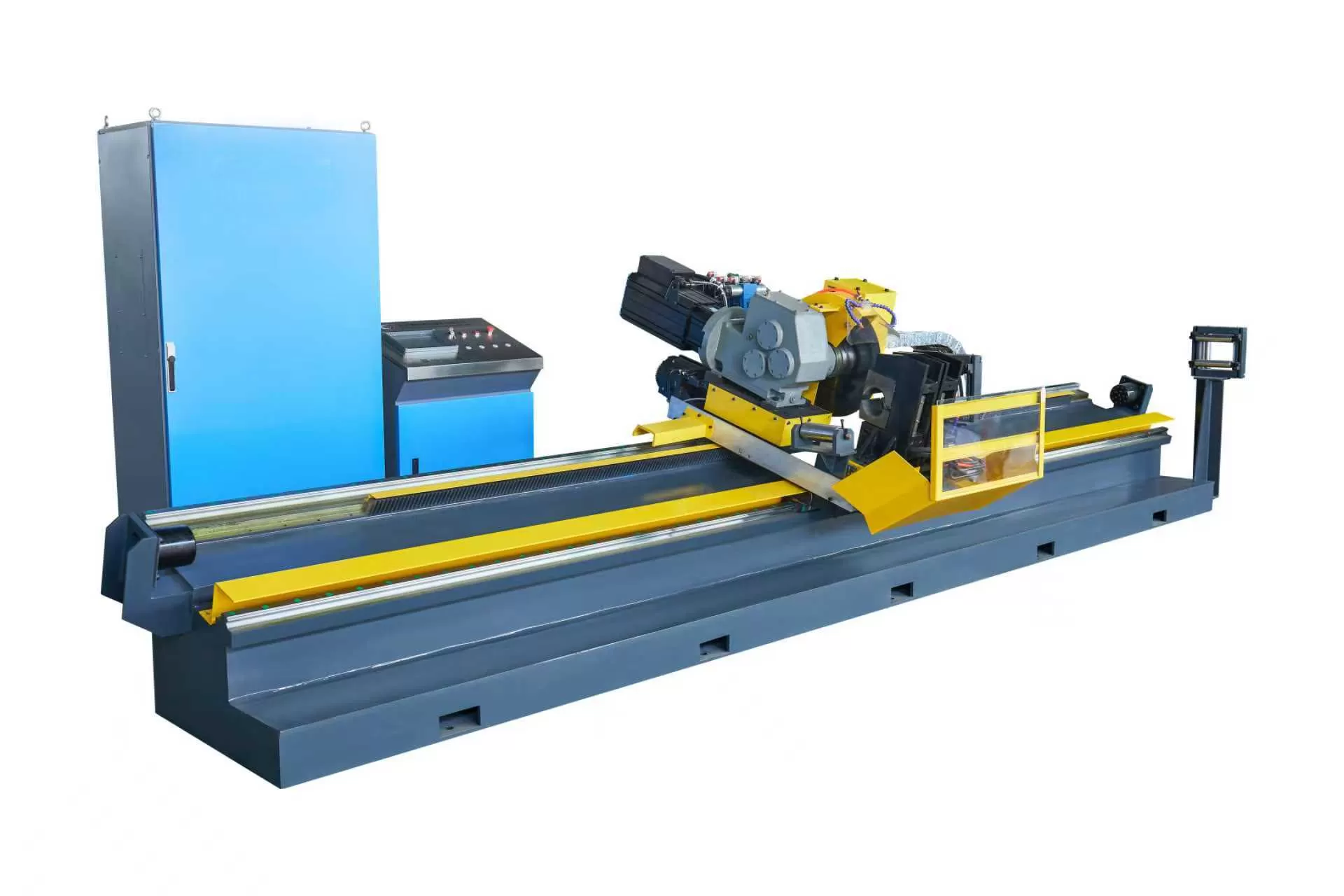
Modern tube mills, especially those designed by SANSO, offer
programmable feed curves that automatically reduce speed during the exit burst
to minimise burr formation. Integrating your saw blade tct parameters into the CNC logic can increase blade life by 35% or more.
4. Coatings, lubrication & thermal management
Heat is the enemy of carbide. Even premium saw blade tct grades begin to soften above 600°C. Advanced coatings and coolant delivery
systems mitigate this:
PVD coatings: TiN (gold) reduces adhesion; TiAlN
(violet‑grey) withstands higher temperatures; AlCrN offers superior oxidation
resistance for stainless.
Coolant strategy: through‑spindle coolant (available on
SANSO servo cut‑offs) ensures the tooth tip is lubricated
exactly at the cutting zone. Flood coolant alone often fails to penetrate the
chip pocket.
Minimum quantity lubrication (MQL): an eco‑friendly
alternative that works well with coated saw blade tct in
non‑ferrous or thin‑wall applications.
Proper thermal management also involves matching the blade’s tensioning
(hammering) pattern to the operating RPM. A blade that is not correctly
tensioned will flutter, leading to wavy cuts and rapid tip chipping.
5. Common failure modes & how to troubleshoot them with SANSO
expertise
Even with perfect selection, operational issues can arise. Here are three
frequent problems and their root causes:
Premature tip chipping: often caused by excessive runout
(spindle >0.03 mm) or by feeding too aggressively into the tube. Check
spindle bearings and feed servo tuning – SANSO service
engineers can perform laser alignment on‑site.
Burr on the inside diameter: indicates that the tooth
clearance angle is too small or that the blade is dull. Use a saw blade
tct with higher primary clearance (up to 18°) for ID deburring.
Vibration marks (chatter): could be due to incorrect
clamping, worn guides, or a blade that is too thin for the material. Consider
sandwich dampers or a thicker blade body.
Always document blade performance metrics (cuts per regrind, linear meters
cut, power consumption) and share them with your supplier.
SANSO offers a comprehensive blade testing protocol on our
pilot tube mill to validate saw blade tct performance before full production.
Frequently asked questions about saw blade tct in tube
mills
Q1: What tooth count is best for a 2 inch (50.8 mm) carbon steel tube
with 3 mm wall?
A1: For that wall thickness, a 72‑tooth blade with
triple‑chip geometry is typically optimal. It provides enough chip space while
maintaining a good surface finish. Always verify with your blade supplier’s
catalogue.
Q2: Can I use the same saw blade tct for both
stainless steel and carbon steel?
A2: It is not recommended.
Stainless steel requires a tougher carbide grade (higher cobalt) and sharper
cutting edges to work‑harden the material. Using a carbon‑steel blade on
stainless will likely cause rapid edge breakdown.
Q3: How often should a TCT blade be sharpened?
A3:
Typically after 10,000 to 20,000 cuts depending on material and feed rates.
Monitor cut quality: when burr height exceeds 0.1 mm or power consumption
increases by 15%, it is time for regrinding. Use a specialised carbide grinding
wheel and maintain original angles.
Q4: Why do I see radial cracks near the tooth
gullets?
A4: This is often a sign of excessive feed pressure or a
blade that has lost its tension (hook). It can also be caused by running the
blade below its recommended minimum RPM, leading to vibration. Reduce feed rate
and check that the blade is properly tensioned for your operating speed.
Q5: Does SANSO provide technical recommendations for saw
blade tct integration?
A5: Yes. SANSO engineers work
closely with leading blade manufacturers to offer matrix tables that match blade
specifications to our mill models. We also provide spindle run‑out certification
and can retrofit older cut‑offs with high‑precision spindles that maximise
saw blade
tct life.
Q6: What is the typical tolerance of a cut made with a high‑quality
TCT blade on a SANSO cut‑off?
A6: With proper blade selection and
machine setup, length tolerances of ±0.5 mm are achievable, and squareness
within 0.1 mm per 100 mm of diameter. This requires a stiff blade, minimal
spindle play, and optimised feed rates.
integrate blade knowledge with mill engineering
Choosing the right saw blade tct is
a multi‑faceted decision that involves metallurgy, geometry, machine dynamics,
and process data. By understanding these five critical parameters—and by
partnering with a mill builder like SANSO that prioritises
cutting performance—you can significantly reduce blade consumption, improve tube
end quality, and increase overall equipment effectiveness. Visit our products
page to explore tube mills engineered for today’s most demanding saw
blade tct applications.