In the domain of ferrous and non-ferrous pipe manufacturing, few systems
match the versatility and cost-efficiency of a modern ERW tube mill. Electric Resistance Welding (ERW)
technology continues to dominate the production of round, square, and
rectangular hollow sections for energy, construction, and automotive supply
chains. This article dissects technical parameters, common production pitfalls,
and process-optimization strategies — all derived from field-proven
installations across high-output mills. We will also highlight how SANSO integrates decades of roll forming expertise
into every mill line.
1. Core Architecture of a High-Speed ERW Tube Mill
A fully integrated ERW tube mill consists of several interdependent
stations. Any deviation in one section directly affects weld seam quality and
dimensional tolerance. The typical flow includes:
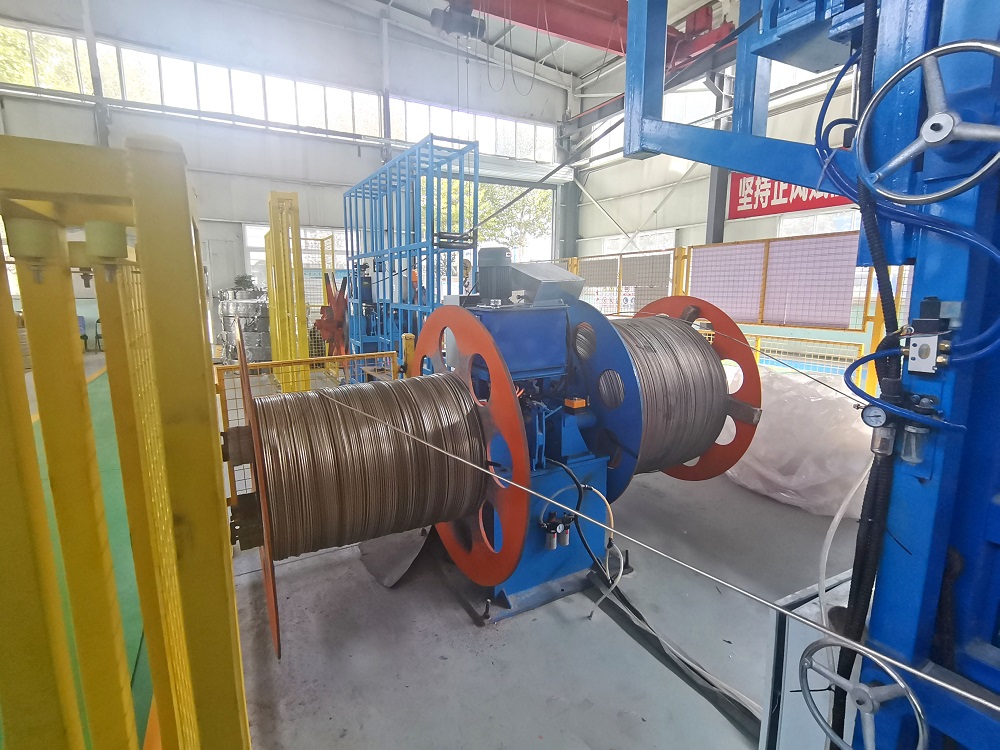
Uncoiling & strip preparation – Double-head pay-off
reels minimise downtime; strip end shearing and accumulators maintain continuous
operation.
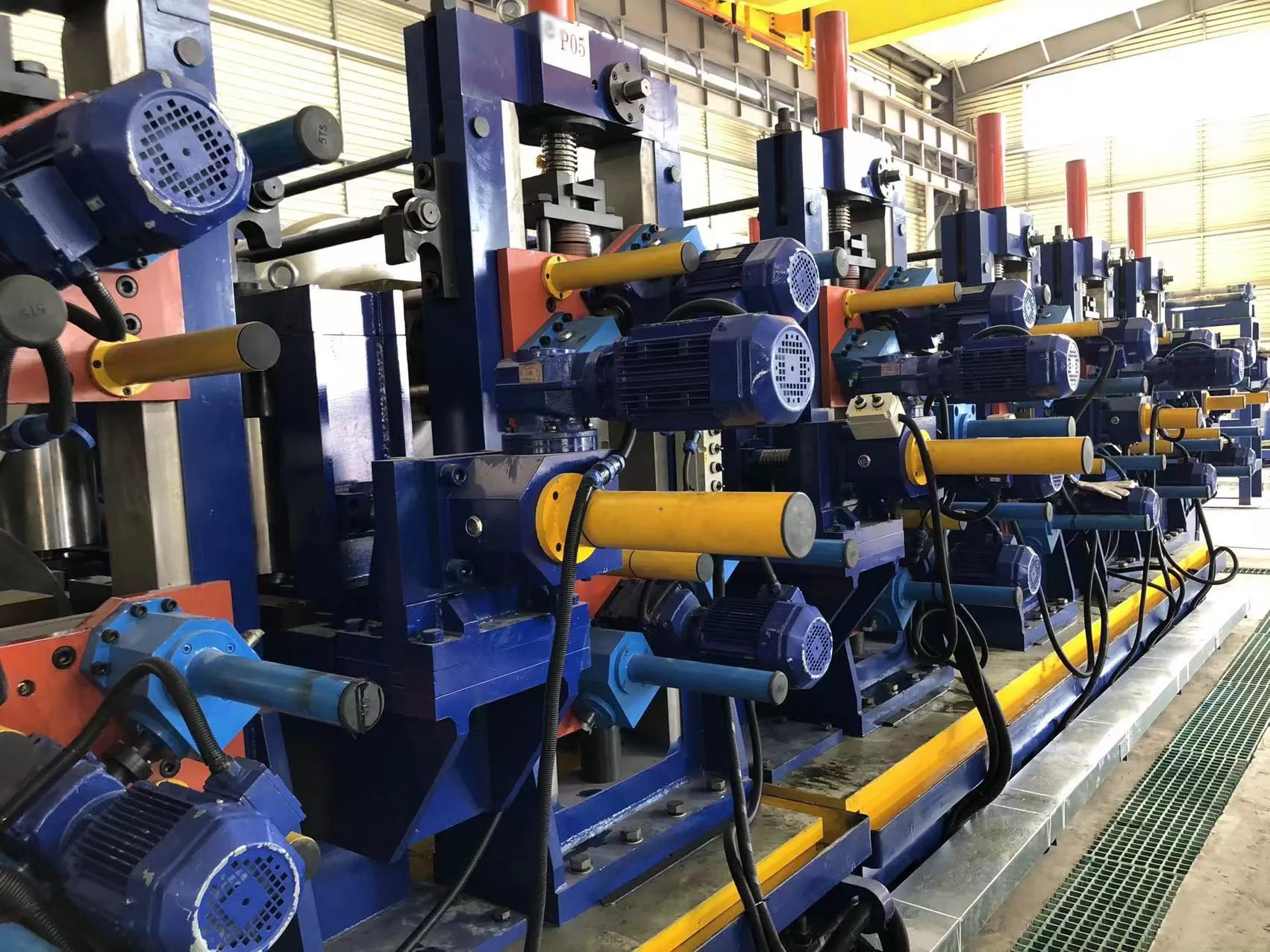
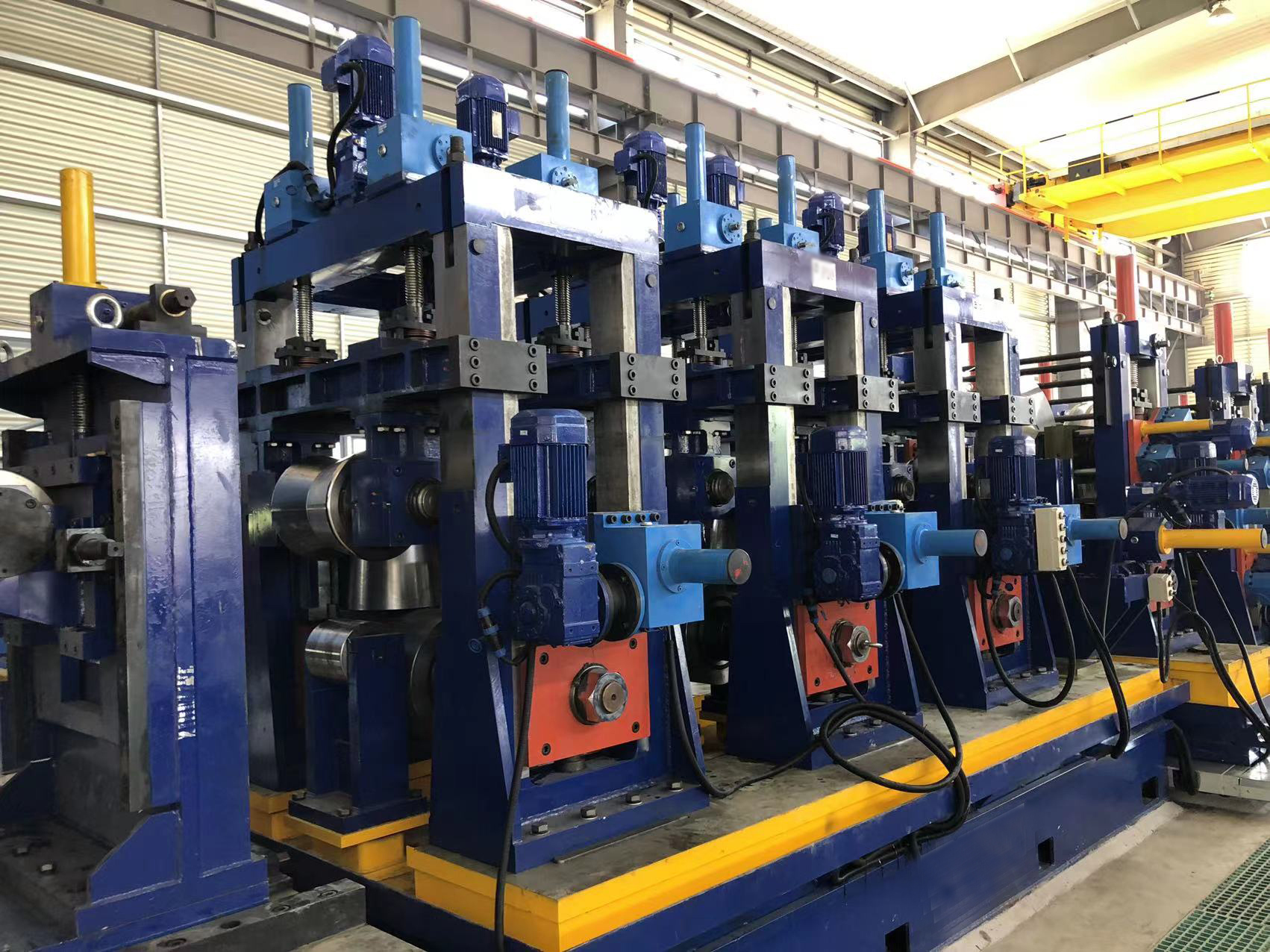
Forming section – Breakdown, cluster, and side roll stands
progressively bend the strip into an open tube profile. Roll forming passes must be precisely calibrated to
avoid edge mismatch.
Welding zone – High-frequency contact/induction coils
generate heat, while squeeze rolls forge the heated edges. Impeder design and
cooling directly impact weld ductility.
Seam conditioning – External and internal scarfing removes
upset weld metal. Insufficient scarfing leads to ID/OD defects during
hydrotesting.
Sizing & straightening – Turk’s head and multi-stand
sizing blocks calibrate final dimensions. Tungsten-carbide rolls guarantee
consistent outer diameter for high-tolerance tubes.
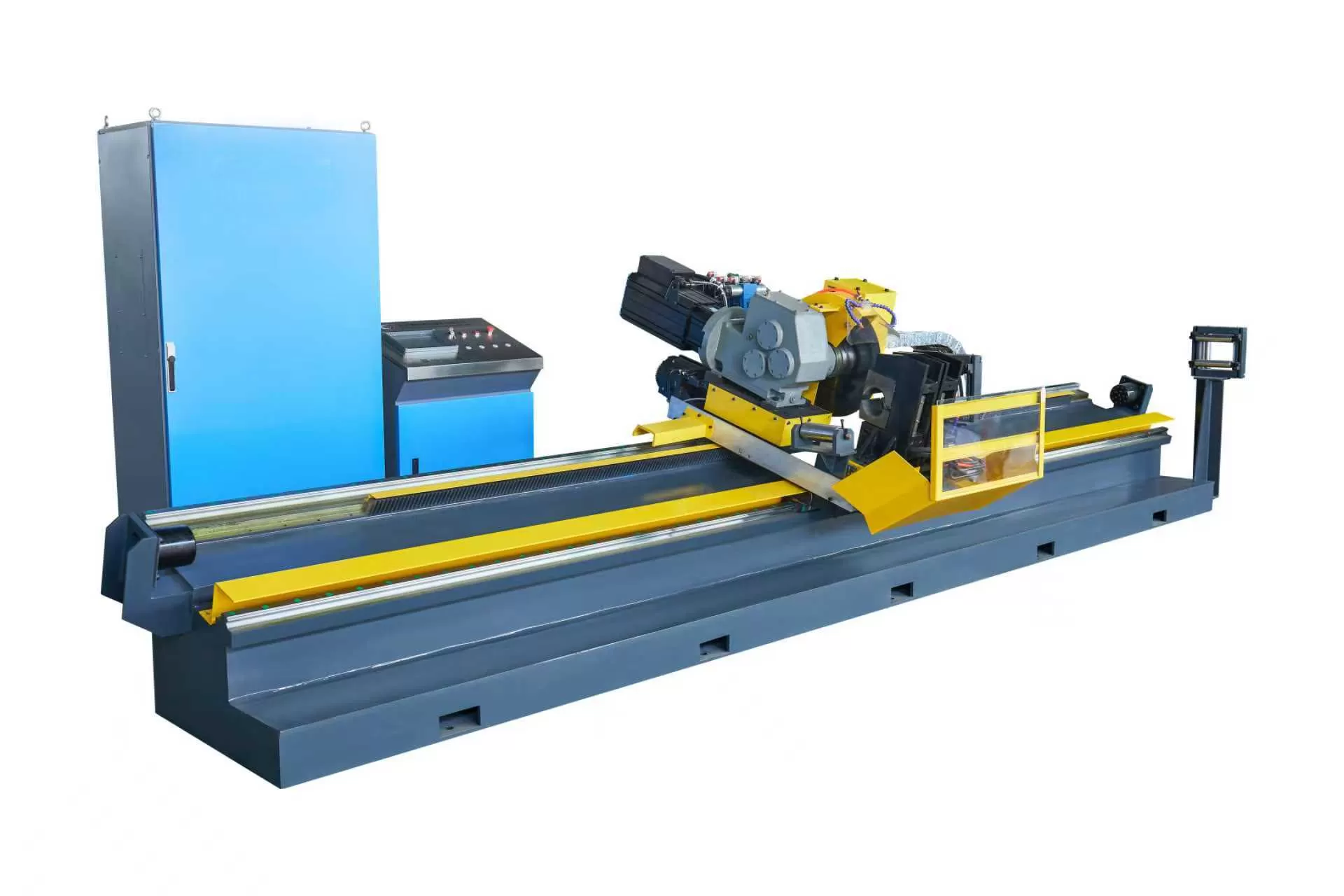
Cut-off & stacking – Flying saws or rotary cutters
divide the continuous pipe into pre-set lengths, followed by automatic
bundling.
2. Critical Industry Pain Points and Targeted Countermeasures
Even experienced operators encounter recurring issues with erw tube
mill lines. Through root-cause analysis from more than 60 mill audits,
we identified three dominant challenges and their engineering solutions.
2.1 Inconsistent weld seam penetration
Root causes: unstable strip edges, incorrect v-angle at the
weld point, or impedance saturation. Solution: Implement
real-time edge position sensors coupled with a servo-driven weld box. The
closed-loop system adjusts lateral strip alignment within 0.1 mm. Additionally,
ferro-magnetic impedance geometry should be recalculated for each steel grade
(e.g., API 5L X65 vs. S355J2H).
2.2 Rapid roll wear and marking
Frequent roll changeovers reduce OEE by up to 23% in job-shop mills. Using
D2 or PM-grade tool steel for forming rolls, combined with Cryogenic treatment, extends roll life by 300%.
Moreover, SANSO offers quick-release
cartridge stands that reduce tool swap time from 6 hours to 45 minutes.
2.3 Post-weld seam hardness exceeding standard limits
Excessive cooling rates after the squeeze roll lead to martensitic
structures, raising hardness above 85 HRBW. A dedicated in-line seam normalising
unit using multi-turn induction coils (50–80 kHz) tempers the heat-affected zone
to below 82 HRBW, fully compliant with ASTM A500 and EN 10219.
3. Technical Benchmarks: Key Parameters for ERW Mill Performance
Selecting or retrofitting an ERW tube mill demands quantitative assessment of the
following metrics.
Line speed (m/min): Thin-walled ≤2 mm – up to 120 m/min;
structural tubes 3–6 mm – 45–70 m/min; oil country casing – typically 25–35
m/min. Mill stiffness dictates maximum speeds without vibration.
Welding power (kW): Modern solid-state generators deliver
400 kW to 1200 kW with frequency ranges 200–400 kHz. Precisely matching power to
strip thickness avoids both cold laps and excessive flash.
Strip width & gauge: Most universal mills handle widths
100 mm to 800 mm, gauges 0.8 mm to 12.7 mm. For heavy-wall line pipe,
multi-radius forming edges are mandatory.
Springback compensation: High-strength low-alloy (HSLA)
steels need 2–3 additional forming passes to mitigate springback. Finite element
analysis (FEA) of roll flower patterns is non-negotiable.
4. Application-Driven Requirements for ERW Tubing
End-use sectors impose distinct quality windows that a erw tube
mill must address.
Oil & gas line pipe (API 5L): Zero defects in NDT
(ultrasonic or eddy current). Hydrostatic test pressure up to 90% of specified
yield. ERW mills for this segment include seam annealing and end-facing
stations.
Structural hollow sections: Tight corner radii and
consistent wall thickness across flat sides. Square/Rectangular tubes require a
dedicated forming sequence from round to final shape via turks’ head and sizing
passes.
Automotive driveshafts and roll cages: Near-weld
hardenability must be strictly controlled. Downstream drawing operations demand
low surface roughness (Ra ≤ 1.6 µm).
Boiler and heat exchanger tubes: Full non-destructive
testing of both OD and ID, plus flattening/flaring tests. Here, scarfing tool
geometry is critical to prevent lap defects.
5. Why SANSO ERW Tube Mills Deliver Consistent Results Over Decades
With over 380 installed mills across Southeast Asia, the Middle East, and
South America, SANSO has refined its
manufacturing approach to address the wear-tear and tolerance drift that plagues
legacy lines. Each ERW tube mill from SANSO
incorporates:
Monoblock cast-iron housings with preloaded anti-friction bearings –
eliminating roll deflection under high forming loads.
Induction weld generators with adaptive power control (patented), reacting
to speed changes within 0.2 seconds.
Laser/hydrostatic combined sizing for high-precision ovality ≤0.5% of
OD.
Predictive maintenance cloud interface that alerts operators to roll-bearing
temperature trends and lubrication cycles.
Furthermore, SANSO provides on-site commissioning and formula-based roll
design tailored to customer steel grades. This eliminates the typical six-month
ramp-up period.
6. Maintenance Strategies and Lifetime Cost Reduction
A well-structured maintenance plan triples the productive life of any
erw tube mill. Data from production logs show biggest cost
drivers are:
Roll replacement (58% of consumable budget)
Bearing failure in forming stands (22%)
Weld generator IGBT module burnout (12%)
Best-practice maintenance integrates:
Weekly geometric alignment of the strip pass line (using laser-tracked
targets).
Monthly vibration spectral analysis of sizing mill gearboxes.
Daily verification of scarfing blade gap (0.05–0.15 mm, based on wall
thickness).
Annual impedance re-certification after 5000 hours of operation.
SANSO supports clients with remote diagnostic
software that forecasts roll wear using machine learning algorithms, reducing
unplanned stops by 40%.
7. Future Outlook: Smart Automation and IIoT in ERW Mills
The next generation of erw tube mill lines incorporates
digital twins and self-correcting process loops. Real-time weld temperature
monitoring via pyrometers, integrated with mill PLC, allows dynamic adjustment
of HF power and forming pressure. Also, inline eddy-current arrays now classify
defects with 0.2 mm precision. Plants adopting these technologies report
first-pass yield rising from 92% to 98.5%. SANSO already supplies
ready-to-connect IIoT gateways that log every weld parameter to MES systems for
full traceability — a requirement for automotive and aerospace tubing.
Frequently Asked Questions (ERW Tube Mill)
Q1: What is the maximum wall thickness that a standard ERW tube mill
can handle?
A1: Conventional mills with driven forming stands can
produce wall thicknesses up to 12.7 mm (0.500 inches) for diameters up to 16
inches. For walls beyond 15 mm, tandem welded pipe mills or spiral mills are
more suitable. However, heavy-duty erw tube mill configurations from SANSO support 16 mm
wall thickness in carbon steel.
Q2: How do you prevent edge wave / wavy edges during the forming
stage?
A2: Edge wave occurs due to insufficient edge stretching or
improper breakdown roll gaps. The solution involves recalculating the roll
flower diagram using finite element analysis to adjust the bottom roll contour
and add edge-bending passes. Many outdated mills lack 2nd-stage edge
straightening rolls — SANSO’s retrofit package includes pre-forming side rolls
that eliminate edge distortion.
Q3: What is the typical tooling life (in tons) for an ERW mill
producing 2″ schedule 40 pipes?
A3: With D2 steel rolls and proper
lubrication, tooling life reaches 6,000–8,000 tons before the first re-grind.
Using PM (powder metallurgy) rolls extends to 12,000 tons. SANSO can supply
custom-vanadium rolls that push life beyond 15,000 tons for mild steel
applications.
Q4: Is it possible to switch from round pipe to square/rectangular
profiles on the same ERW tube mill?
A4: Yes — a properly designed
universal mill includes a turks’ head section and one or two dedicated sizing
stands. To switch profiles, you replace the round-shaft rolls with square rolls
and adjust side roll positions. Changeover time varies from 90 minutes (basic
sizes) to 4 hours (complex sections). SANSO provides quick-change cassettes that
reduce conversion time by over 50%.
Q5: How does the electricity cost per ton compare between induction
welding and conventional contact welding?
A5: Solid-state induction
systems consume roughly 80–120 kWh per ton (for 2–4 mm wall), while sliding
contact methods consume 110–150 kWh per ton due to friction losses and lower
efficiency. Induction also reduces electrode wear costs. However, mills
producing very small diameters (<12 mm) may benefit from contact welding for
simpler setup.
Optimise Your ERW Tube Mill Productivity Today
Engineered solutions that target weld integrity, roll wear, and rapid
changeover distinguish profitable mills from struggling facilities. Whether you
plan to upgrade an existing line or invest in a complete erw tube
mill with integrated automation, the SANSO engineering team provides
feasibility studies, roll pass designs, and on-site staff training. Our experts
have increased average line speeds by 35% while reducing scrap below 1.5% for
clients in more than 20 countries.
Ready to discuss your tube and pipe production goals? Send us your
technical inquiry (steel grade, dimension range, target annual tonnage) and
receive a detailed proposal within 3 business days.
Request a quote or technical consultation: info@sansohftubemill.com or visit www.sansotubemill.com/contact