In high‑volume tube mills, the hss saw blade is often the last component between a finished tube and a production bottleneck. Despite advances in carbide and abrasive cutting, high‑speed steel (HSS) blades remain the preferred choice for many ferrous and non‑ferrous cut‑off operations due to their toughness, ease of resharpening, and cost‑effectiveness. This article examines the metallurgical, geometric, and operational factors that determine hss saw blade longevity and cut quality, with real‑world data from installations integrated with SANSO tube mill lines.
1. Steel grade and heat treatment: the foundation of blade toughness
Not all HSS is equal. The composition of the hss saw blade determines its red hardness, wear resistance, and ability to withstand shock loads.
1.1 Molybdenum‑based (M2, M35) vs. tungsten‑based (T1) steels
M2 (6‑5‑2): The most common grade for general tube cutting. Contains 6 % tungsten, 5 % molybdenum, 2 % vanadium. Offers good balance of toughness and wear resistance. Hardness after heat treatment: 64–66 HRC.
M35 (6‑5‑2‑5): Similar to M2 but with 5 % cobalt, which improves red hardness. Suitable for cutting stainless steels and materials that generate higher temperatures at the tooth tip.
T1 (18‑4‑1): High tungsten content (18 %) provides excellent hot hardness but is more brittle. Used mainly for older machines or specific applications requiring extreme abrasion resistance.
1.2 Vacuum heat treatment and deep cryogenic processing
Modern heat treatment cycles significantly affect blade life. Vacuum furnaces prevent decarburisation and ensure uniform hardness. Adding deep cryogenic treatment (−190 °C) after tempering transforms retained austenite into martensite, improving wear resistance by 15–25 % according to tests on M2 blades used in structural tube cutting. A leading European tube producer reported that cryogenically treated hss saw blades lasted 22 % longer between regrinds when cutting 3 mm‑wall S355 steel tubes.
2. Tooth geometry and set patterns
The geometry of each tooth directly influences chip formation, cutting forces, and surface finish.
2.1 Rake and clearance angles for tube materials
Positive rake (10°–15°): Reduces cutting forces, ideal for thin‑wall tubes (≤ 3 mm) and soft materials like aluminium or mild steel.
Neutral or slightly negative rake: Used for thicker walls or harder materials to strengthen the tooth edge.
Clearance angle (typically 8°–12°): Prevents rubbing; insufficient clearance leads to overheating and rapid wear.
2.2 Tooth pitch and chip load
Variable pitch blades (e.g., 4/6 teeth per inch) reduce vibration and chatter, especially on tubes with thin walls. For a given feed rate, the chip load per tooth must stay below 0.05 mm to avoid tooth overloading. In a recent trial on a SANSO HF welded tube line cutting 2.5 mm wall thickness, switching from a constant‑pitch blade to a variable‑pitch hss saw blade reduced noise by 7 dB and extended blade life from 8 to 12 shifts.
2.3 Tooth set: alternate, wavy, or straight
For tube cutting, alternate set (raker set) is most common—each tooth bent left or right to create kerf wider than the blade body, preventing binding. Wavy set is used for thin‑wall tubes to minimise burr formation. Straight set (no set) is reserved for very thick sections where blade rigidity is paramount.
3. Coatings and surface treatments
Coatings reduce friction and heat at the tooth‑workpiece interface, allowing higher cutting speeds.
3.1 TiN (titanium nitride) and TiAlN (titanium aluminium nitride)
TiN coating (gold colour) provides a hard, low‑friction surface and is suitable for general steel cutting. TiAlN (violet‑grey) retains hardness at higher temperatures, making it ideal for stainless or high‑strength tubes. Tests on an hss saw blade cutting 304 stainless tube (1.5 mm wall) showed that TiAlN‑coated blades produced 30 % less built‑up edge and allowed a 20 % increase in cutting speed compared to uncoated blades.
3.2 Steam tempering (black oxide)
A traditional treatment that forms a magnetite layer on the blade. It retains coolant better and provides mild corrosion resistance. Often used in general‑purpose blades for carbon steel tubes.
4. Operational parameters: speed, feed, and cooling
Even the best hss saw blade will fail prematurely if not used within its design envelope.
4.1 Cutting speed (Vc) and material removal rate
For HSS blades, recommended cutting speeds for mild steel are typically 30–50 m/min, for stainless 15–25 m/min, and for aluminium 200–400 m/min. Exceeding these speeds causes rapid flank wear. Using a spindle with stable speed control (as found on SANSO cut‑off units) ensures consistent surface speed even as blade diameter reduces after resharpening.
4.2 Feed per tooth and chip thinning
Feed per tooth (fz) should be maintained between 0.02 and 0.08 mm. Too low a feed causes rubbing and work hardening; too high overloads teeth. Modern servo‑driven feed systems on SANSO tube mills maintain constant fz regardless of tube cross‑section, which has been shown to improve blade life by up to 35 % compared to hydraulic systems with variable feed.
4.3 Coolant selection and filtration
Sulphur‑based cutting oils are preferred for HSS because they provide extreme pressure lubrication and prevent built‑up edge. Water‑soluble emulsions can be used but require higher concentration (8–10 %). Filtration to < 50 µm is essential to avoid recirculating chips that erode the blade body.
5. Blade tensioning and run‑out control
A hss saw blade must be perfectly flat and tensioned to withstand cutting forces. Tensioning involves creating residual stresses in the blade body to counteract centrifugal forces at speed. Flange diameter should be at least 1/3 of blade diameter. Run‑out at the tooth tips must be below 0.03 mm to ensure even load distribution. Laser‑based run‑out measurement systems integrated into SANSO cutting spindles allow operators to detect run‑out issues before they cause blade failure.
Case study: doubling blade life in a structural tube mill
A Southeast Asian tube producer running a 4‑inch ERW line experienced average hss saw blade life of 6 hours when cutting 100 × 50 mm rectangular hollow sections (3.2 mm wall). After a full audit by SANSO engineers, the following changes were implemented:
Switched from M2 to M35 cobalt HSS blades.
Applied TiAlN coating.
Reduced cutting speed from 55 m/min to 42 m/min.
Installed a high‑pressure coolant system with 10 % semi‑synthetic oil.
Result: average blade life increased to 14 hours, with a 40 % reduction in burr height and zero scrap due to tooth breakage.
Common pitfalls and troubleshooting
Tooth chipping: Often caused by excessive feed, incorrect tooth set, or vibration. Check run‑out and reduce feed per tooth.
Premature flank wear: Cutting speed too high or insufficient coolant concentration. Verify speed and lubricity.
Rough cut surface: Dull blade, wrong rake angle, or built‑up edge. Increase coolant, consider coating.
Blade breaks at gullet: Fatigue cracks from resonant vibration. Use variable pitch blade and check blade tension.
Selecting the right hss saw blade for your tube mill
When ordering a hss saw blade, specify:
Blade diameter, arbor size, and number of teeth.
Tooth pitch (constant or variable).
Material grade (M2, M35, etc.) and hardness.
Coating requirement.
Tooth set pattern and rake angle recommendation based on tube material and wall thickness.
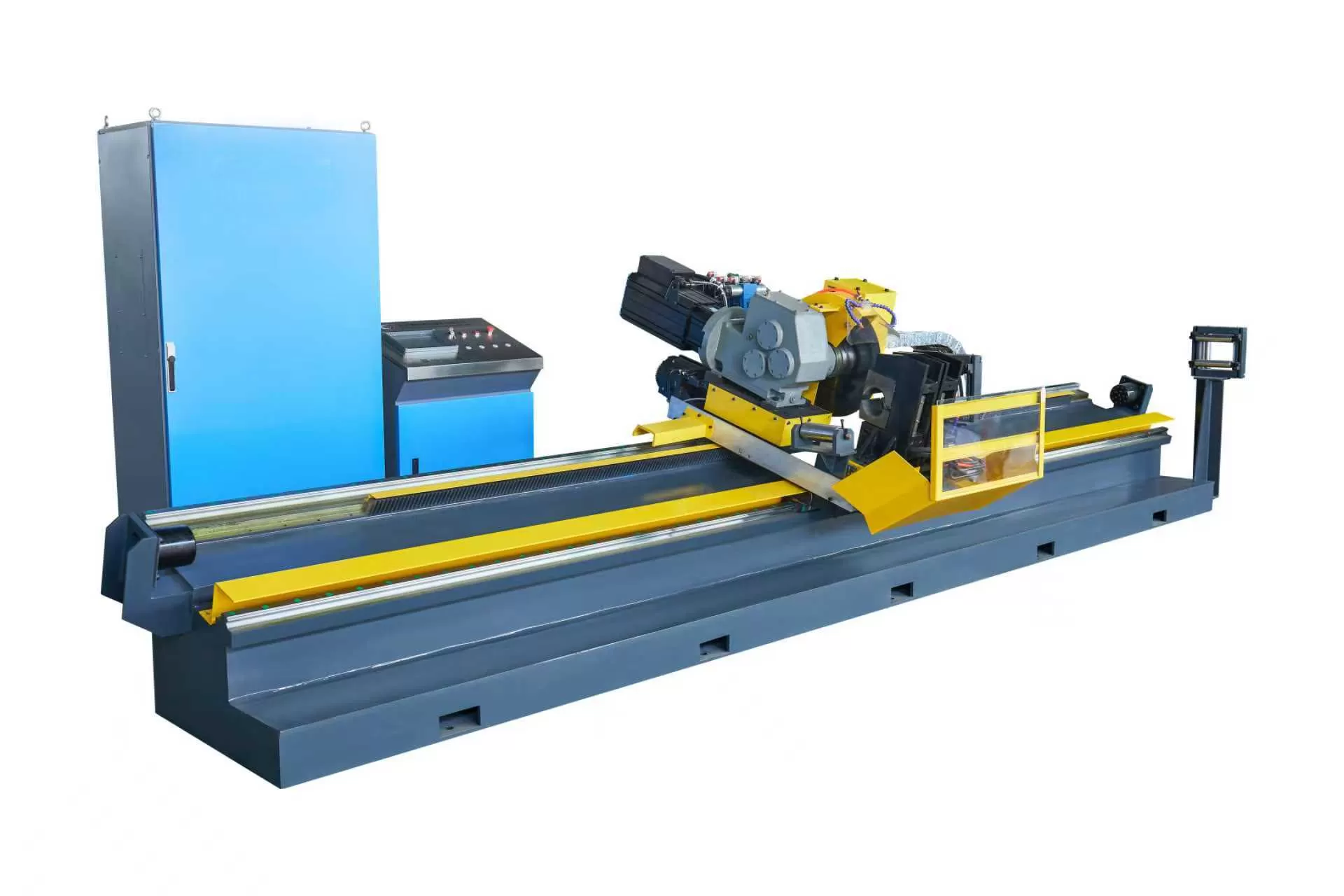
Manufacturers like SANSO often provide a blade selection matrix tailored to their cut‑off machines, taking into account spindle power, speed range, and typical tube dimensions.
Frequently Asked Questions
Q1: What is the difference between an HSS saw blade and a carbide‑tipped blade for tube cutting?
A1: HSS saw blades are made entirely from high‑speed steel, offering high toughness and the ability to resharpen many times. They are ideal for general steel tubes, especially when cut‑off machines have limited spindle power or when blade changes are frequent. Carbide‑tipped blades have teeth made of tungsten carbide, which is harder and more wear‑resistant, allowing higher cutting speeds and longer life on abrasive materials (e.g., stainless, high‑alloy). However, they are more brittle and expensive to resharpen.
Q2: How many times can an hss saw blade be resharpened?
A2: Typically 10 to 15 times, depending on the blade diameter and tooth wear. Each regrind removes about 0.2–0.3 mm from the tooth tip. After repeated sharpening, the blade diameter reduces, and the gullet depth decreases, limiting chip clearance. When the blade diameter drops below 90 % of original, it should be replaced.
Q3: What causes a hss saw blade to overheat during tube cutting?
A3: Overheating is usually due to excessive cutting speed, insufficient coolant flow, or a dull blade. It can also occur if the feed rate is too low, causing rubbing rather than cutting. Check coolant concentration (should be > 5 % for emulsions), reduce speed, and ensure the blade is sharp.
Q4: Can I use the same hss saw blade for cutting different materials (e.g., steel and aluminium)?
A4: While possible, it is not optimal. Aluminium requires higher cutting speeds and positive rake angles to prevent built‑up edge, while steel needs lower speeds and more robust tooth geometry. A blade optimised for steel may produce burrs on aluminium. Many tube mills dedicate separate blades for each material family to maximise quality and blade life.
Q5: How do I know when my hss saw blade needs resharpening?
A5: Signs include increased cutting noise, visible burr on the cut tube, higher power draw on the spindle motor, or a rough cut surface. Some automated lines monitor spindle load; when load exceeds a threshold (e.g., 15 % above baseline), it signals the need for blade change.
Q6: What is the recommended blade tension for a hss saw blade in a tube mill?
A6: Tension should be applied according to the manufacturer’s specification, typically 150–250 N/mm² of blade cross‑section. For a 2 mm thick, 300 mm diameter blade, this translates to about 20–30 kN of tension force. Over‑tensioning can crack the blade; under‑tensioning causes flutter and poor cut quality.
Q7: Does SANSO supply hss saw blades for their tube mills?
A7: SANSO provides complete tube mill solutions, including cut‑off machines, and offers a range of certified hss saw blades optimised for their equipment. They also provide technical support for blade selection and troubleshooting as part of their after‑sales service.
In summary, the hss saw blade remains a vital tool in tube production when correctly specified and maintained. By understanding the interplay of material, geometry, coating, and operating parameters, mill operators can achieve consistent cut quality and lower cost per cut. Partnering with experienced mill builders like SANSO ensures that the blade is matched to the machine’s capabilities and the production demands.