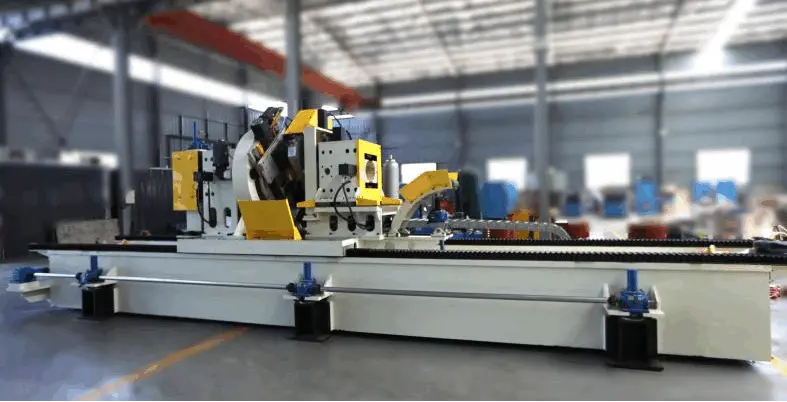
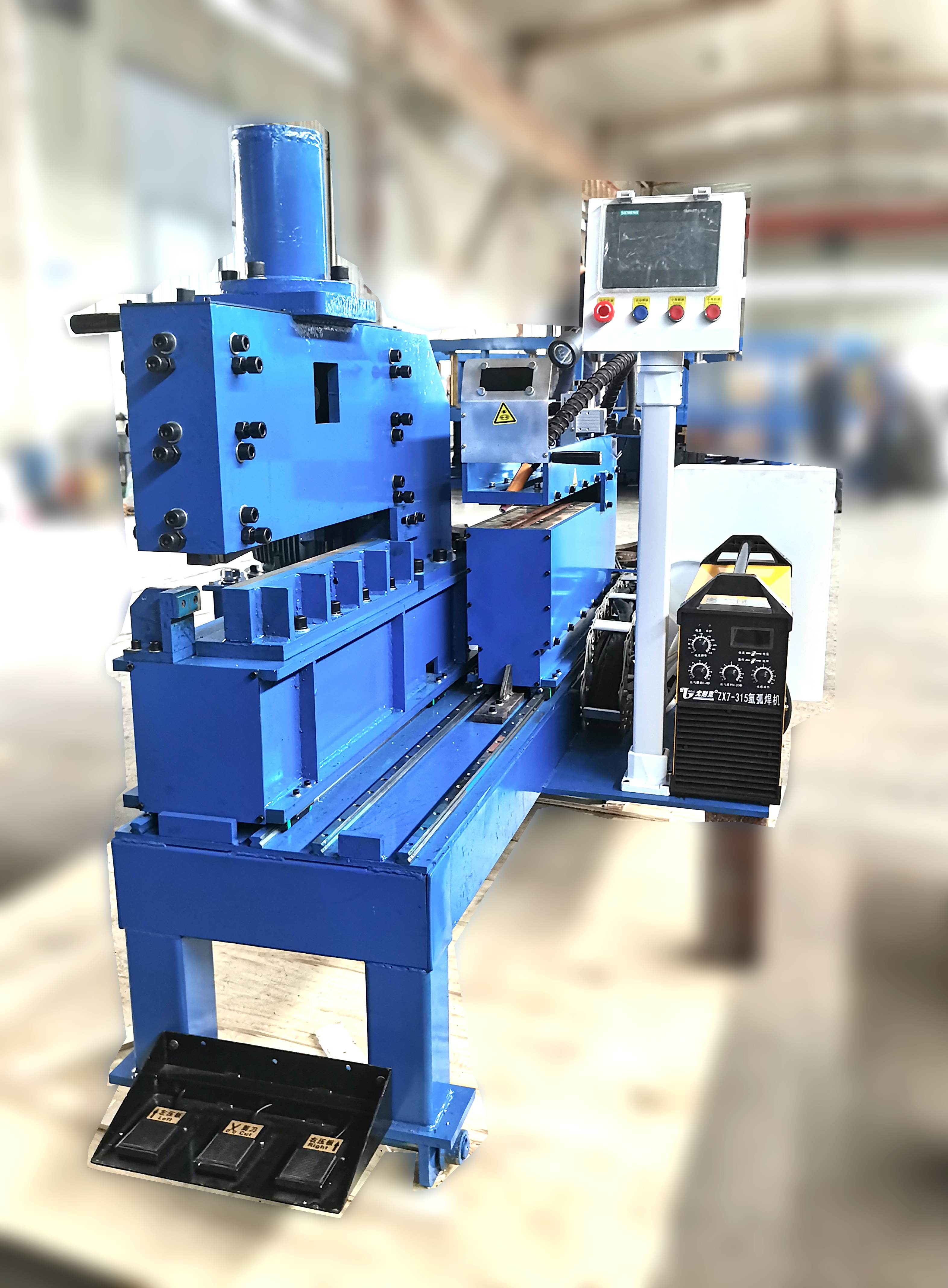
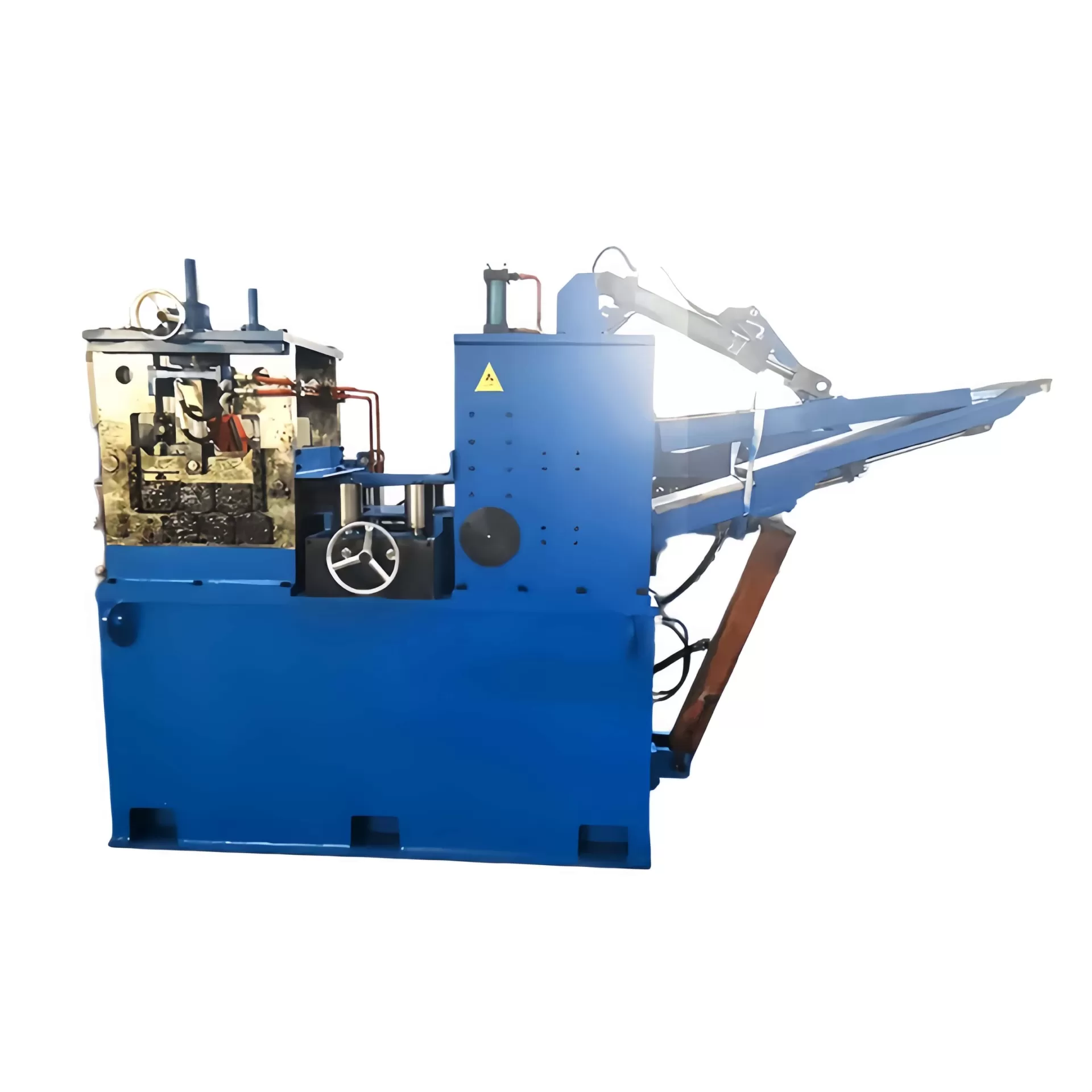
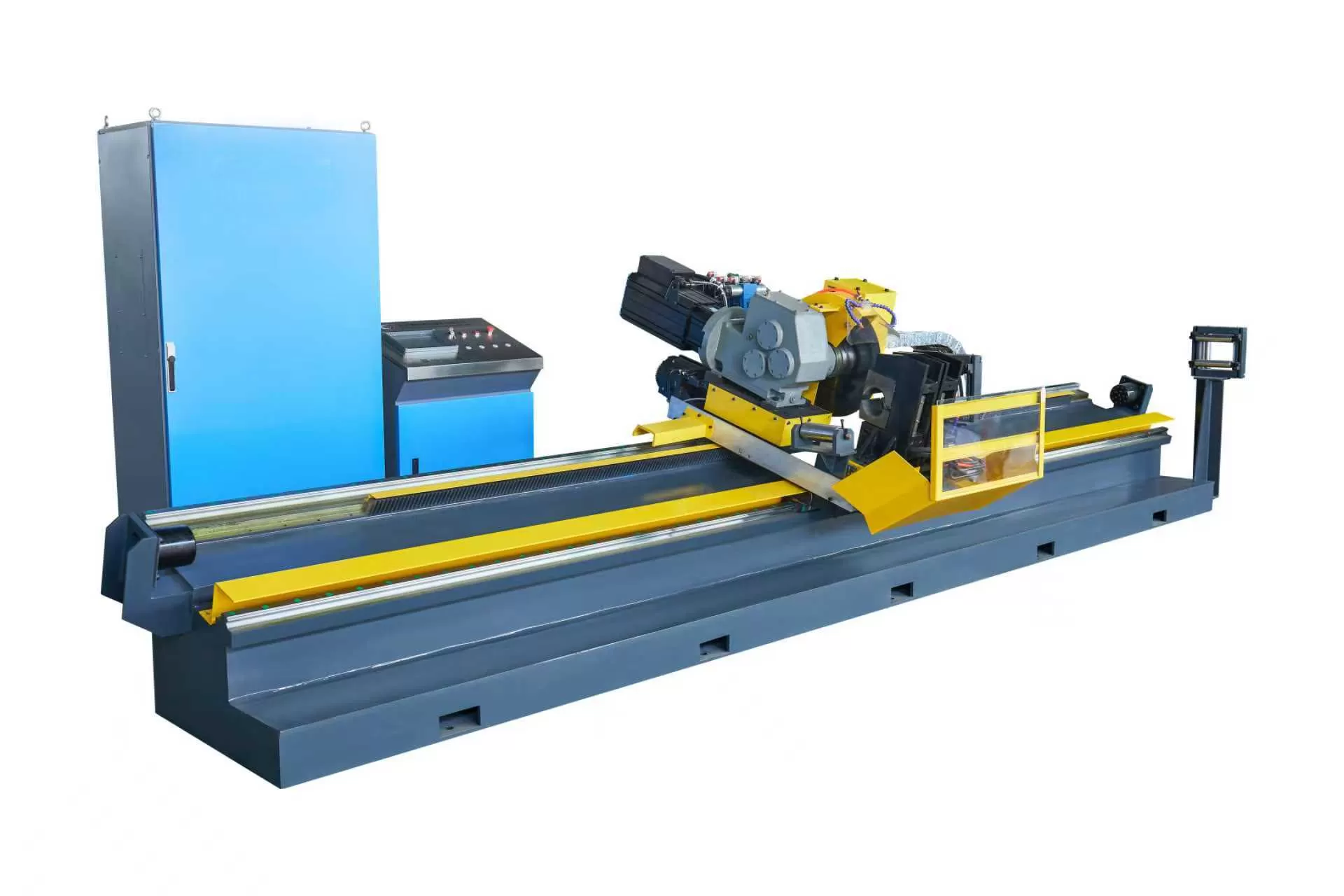
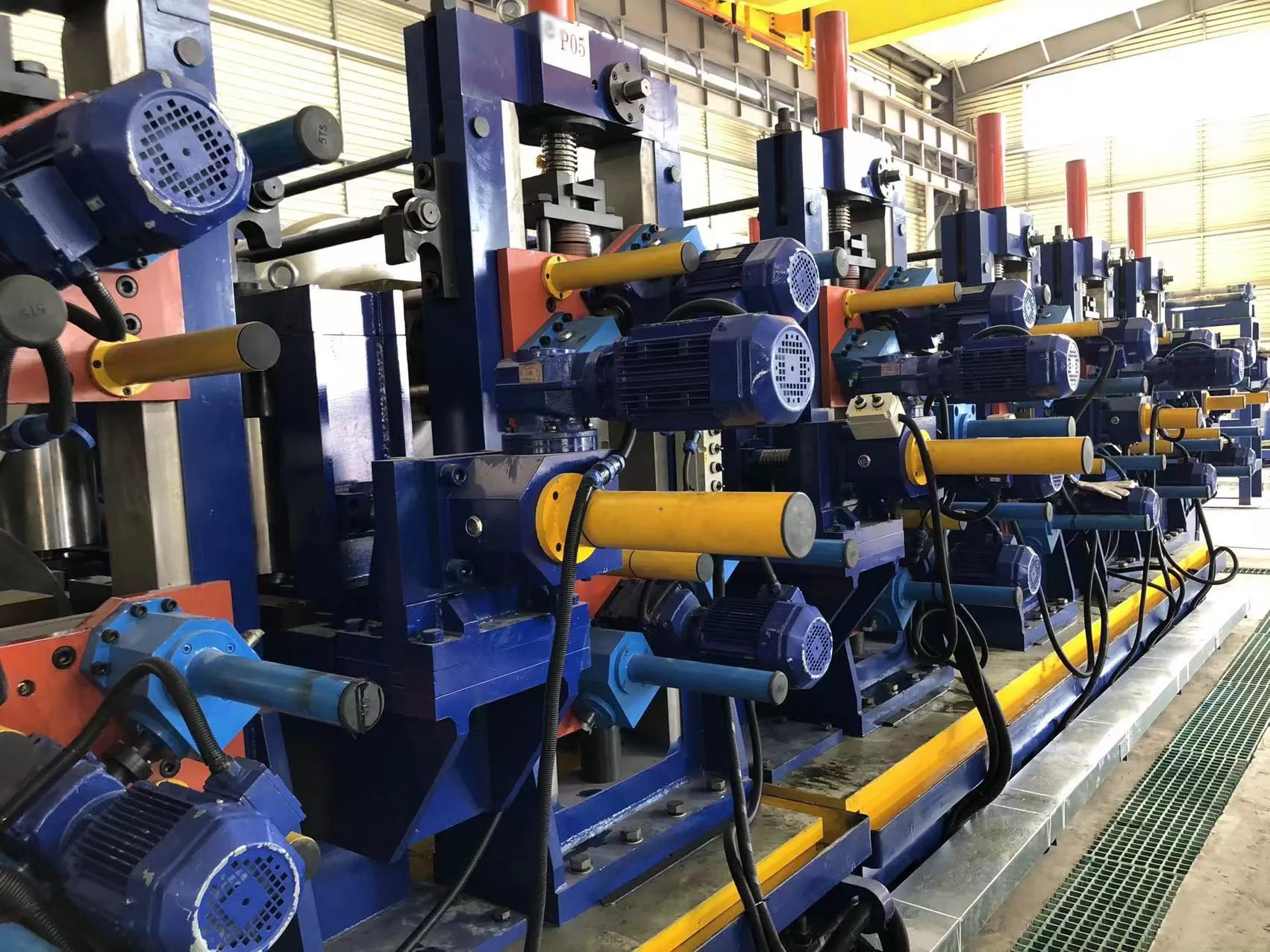
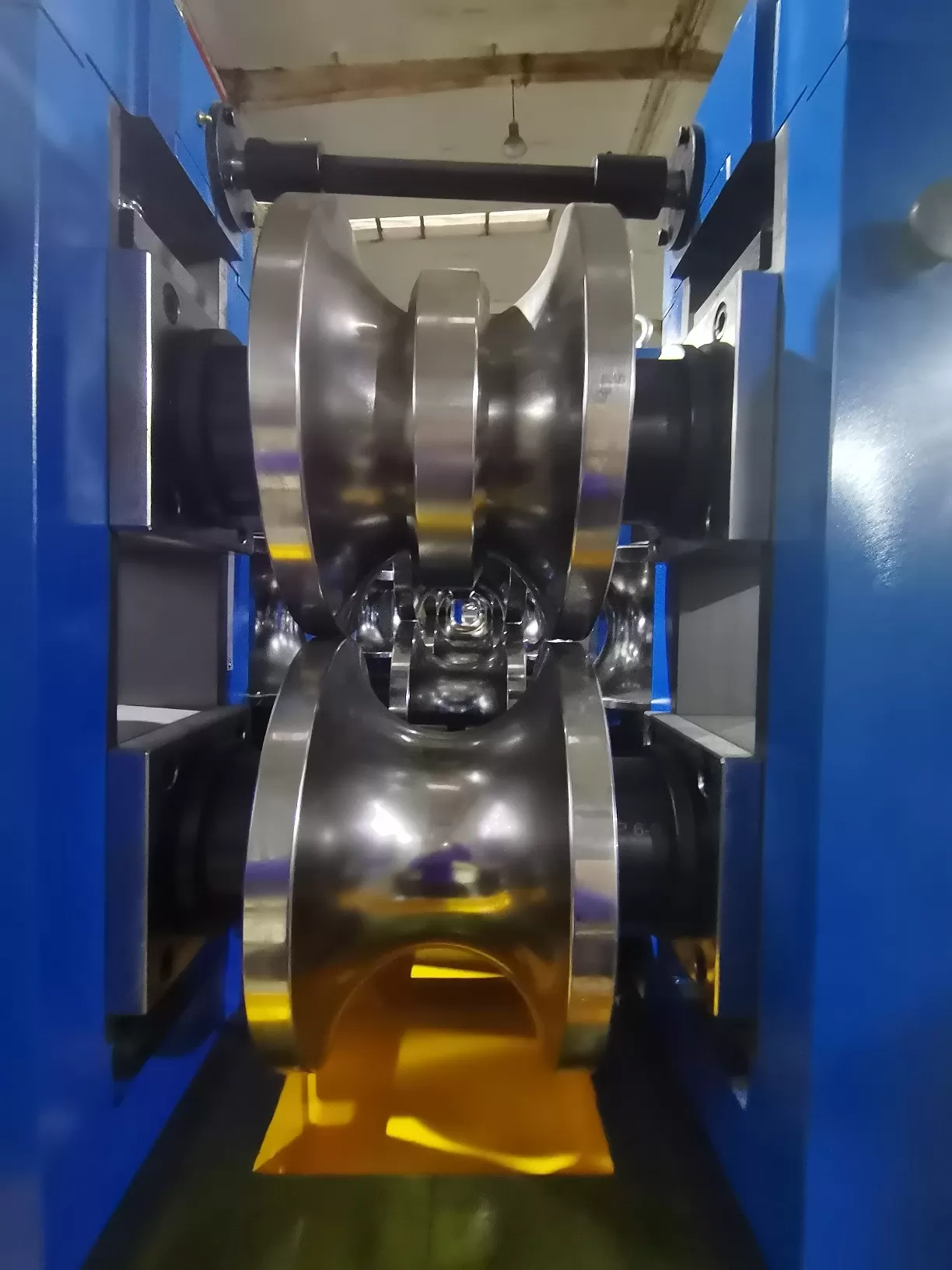
In continuous tube and pipe manufacturing, the transition from endless welded
tube to finished cut lengths is performed by a flying saw.
Unlike stationary saws, a flying saw moves synchronously with the tube during cutting, eliminating the need to stop
the line. This capability directly determines production throughput, cut length
accuracy, and end squareness. For mill operators targeting 60+ meters per minute
line speeds, selecting the right flying saw involves trade-offs between mechanical complexity, blade wear, and control
system response. This technical reference covers saw types, motion control
algorithms, blade metallurgy, and integration with forming/welding lines.
SANSO engineers custom
flying saw systems for tube diameters from 12 mm to 500 mm, with cut length tolerances of
±0.5 mm.
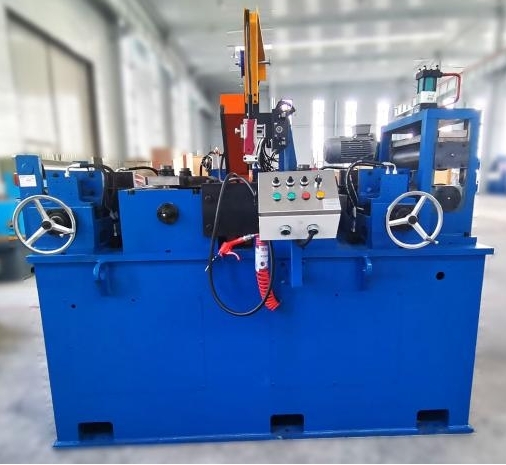
1. The Critical Role of a Flying Saw in Tube Mill Synchronization
A tube mill operates as a continuous process: strip enters the forming
section, passes through welding, sizing, and finally cut-off. The flying saw must:
Accelerate from home position to match tube speed (typically 20–80 m/min)
within 0.3–0.7 seconds.
Clamp the tube without marking or deforming the surface.
Perform the cutting cycle (saw blade descent, cut through, retract) during a
0.2–0.5 second dwell at synchronous speed.
Return to home position before the next cut length passes.
Any
delay or position error leads to length deviations, burrs, or scrap. Modern
flying saw systems achieve cut-to-length accuracy of ±0.5 mm at 70 m/min, with changeover
between lengths under 2 seconds. SANSO provides integrated
solutions with servo-driven flying saws that reduce scrap rates by up to 40%
compared to pneumatic systems.
2. Classification of Flying Saw Technologies: Servo vs. Hydraulic vs.
Cam-Driven
Based on the saw carriage drive and cutting actuation, flying saw systems fall into three main categories. Each suits different production volumes
and tube dimensions.
2.1 Servo-Electric Flying Saw
Uses a linear servo motor or ballscrew-driven carriage with a brushless DC
spindle for the blade. Advantages:
Highest positioning accuracy (±0.2 mm).
Programmable acceleration/deceleration profiles.
Low maintenance (no hydraulic oil leaks).
Energy efficiency (regenerative braking).
Limitations: Higher
initial cost; limited to tube diameters below 200 mm and line speeds under 60
m/min due to inertial constraints. Ideal for precision automotive tubes and
thin-wall stainless lines.
2.2 Hydraulic Flying Saw
Hydraulic cylinders drive the carriage and saw blade up/down. Widely used for
heavy-wall pipes (up to 500 mm diameter) and thick wall thickness (6–25 mm).
Features:
High cutting force (up to 50 kN).
Robust design for 24/7 operation.
Lower cost for large diameters.
Downsides: Oil contamination risk
near tube surfaces; slower acceleration; position accuracy ±1 mm typical.
Requires regular hydraulic oil filtration.
2.3 Cam-Driven Mechanical Flying Saw
A rotating cam mechanism drives carriage motion and blade descent
simultaneously. Used in very high-speed lines (up to 120 m/min) for
small-diameter tubes (12–60 mm). Benefits:
Disadvantage: Fixed cut length (cannot change
without cam replacement). Only suitable for mass production of same-length tubes
(e.g., hydraulic cylinders or furniture tubes).
For most tube mills producing 15–150 mm OD pipes with varying lengths, a
servo-hydraulic hybrid flying saw (servo carriage, hydraulic clamping/cutting) offers the best balance. SANSO manufactures both pure
servo and hybrid systems based on customer production profiles.
3. Industry Pain Points and Engineering Solutions for Flying Saw
Operations
Even advanced flying saw systems face recurring challenges. Below are four documented issues and
field-proven countermeasures.
3.1 Cut Length Inaccuracy Due to Carriage Slippage or Backlash
Mechanical backlash in rack-and-pinion drives or worn linear guides causes
the saw carriage to lag behind tube speed, resulting in cut lengths 2–5 mm
longer than setpoint. Solutions:
Replace rack-and-pinion with direct linear servo motor (zero backlash).
Install a non-contact laser encoder on the tube surface for true speed
feedback (instead of carriage encoder).
Implement adaptive control algorithm that adjusts carriage speed based on
real-time error.
A 2024 upgrade on a 3” tube mill reduced length
deviation from ±2 mm to ±0.4 mm after switching to linear motor flying saw.
3.2 Burrs and Rough Cut Ends
Excessive burr height (>0.3 mm) or angled cuts often result from dull
blades, incorrect blade tooth pitch, or improper clamping pressure. Measurement:
burr height per ISO 8501. Fixes:
Use carbide-tipped circular saw blades with negative rake angle for
stainless/high-strength tubes.
Match blade tooth pitch to wall thickness (e.g., 3–4 mm pitch for 2 mm
wall).
Ensure clamping pressure is sufficient (2–3 kN per 100 mm diameter) but not
enough to ovalize tube.
Add a deburring station after the flying saw (rotary wire brush or chamfering unit).
Field data shows that proper
blade selection reduces burr height by 70% and extends blade life from 50,000
cuts to 200,000 cuts.
3.3 Vibration and Chatter Marks on Cut Surface
High-frequency chatter (200–500 Hz) produces visible striations on the cut
end, which can cause seal leakage in hydraulic tubing applications. Root causes:
Solutions:
Perform a modal analysis of the flying saw structure; add damping materials (polymer concrete) to saw frame.
Use a variable frequency drive to shift spindle speed away from
resonance.
Install an outboard steady rest for tubes longer than 6
m.
SANSO designs flying saw
frames with FEA-optimized ribbing to minimize vibration amplitude below 0.05
mm/s².
Blade life of less than 10,000 cuts indicates problems with sawing parameters
or material. Investigation steps:
Check blade peripheral speed: recommended 80–120 m/min for carbon steel,
50–70 m/min for stainless.
Feed rate per tooth: 0.03–0.08 mm/tooth; too fast causes tooth breakage, too
slow causes rubbing and work hardening.
Use coolant (MQL mist or flood) to reduce friction heat. Without coolant,
blade life drops by 80%.
Ensure blade tensioning (for friction saws) is within 50–60
N/mm².
A
flying saw that incorporates automatic blade wear monitoring (via spindle current) can
alert operators to change blades before failure.
4. Key Technical Specifications for Flying Saw Selection
When procuring a flying saw,
the following parameters must be matched to your mill output:
Tube OD range – min/max diameter (e.g., 12–219 mm).
Wall thickness range – 0.8–10 mm (for circular saws), up to
25 mm for friction saws.
Line speed range – 10–80 m/min (standard), 100+ m/min
(high-speed).
Cut length range – 0.5–12 m (standard), longer on
request.
Cut length tolerance – ±0.5 mm for servo, ±1.5 mm for
hydraulic.
Cut squareness tolerance – ≤0.3 mm per 100 mm diameter (per
ISO 13920).
Cycle time – from 0.8 sec (small tubes) to 2.5 sec (large
heavy-wall).
Saw blade diameter – 350–800 mm depending on tube OD.
Spindle power – 5.5 kW to 37 kW.
Clamping system – pneumatic for thin wall, hydraulic for
thick wall.
SANSO provides a
selection worksheet to calculate required saw power based on tube cross-section
and material shear strength.
5. Integration with Mill Control Systems: Flying Saw as Part of the
Line
The flying saw does not operate alone. It must communicate with:
The forming/welding line PLC – to receive line speed and acceleration
data.
The length measurement system (encoder wheel or laser) – to trigger cut at
precise length.
The discharge conveyor and bundling station – to coordinate tube
removal.
Modern
flying saw controllers (typically Siemens S7-1500 or Beckhoff CX series) use EtherCAT or
Profinet for real-time synchronization. A 2023 survey of 50 tube mills found
that lines with integrated flying saw and mill drive control achieved 98.5% OEE
compared to 89% for standalone saw controllers.
6. Maintenance and Troubleshooting Guide for Flying Saw Systems
To achieve >99% uptime, follow this preventive maintenance schedule:
Shiftly – Inspect blade for cracks or missing teeth; check
coolant flow; verify clamp pad wear.
Weekly – Measure carriage guide clearance (should be
<0.02 mm). Lubricate linear rails. Check saw belt tension.
Monthly – Perform cut length accuracy check using a
calibrated ruler; recalibrate encoder if error exceeds ±0.8 mm.
Quarterly – Replace hydraulic filter; check spindle runout
(dial gauge ≤0.01 mm).
Annually – Replace all bearings in carriage and blade
spindle. Re-grind clamp pads.
SANSO supplies diagnostic
software that predicts saw carriage linear guide wear based on cycle count and
friction torque monitoring.
7. Performance Comparison: Pneumatic vs. Servo Flying Saw in Real
Production
The table below compares two flying saw configurations installed on identical 2.5” ERW tube mills (3 mm wall, 40 m/min
line speed).
| Parameter | Pneumatic Flying Saw | Servo-Electric Flying Saw (SANSO) |
|---|
| Cut length tolerance (3m length) | ±2.0 mm | ±0.4 mm |
| Cycle time (cut + return) | 1.8 sec | 1.1 sec |
| Blade life (cuts per sharpening) | 8,000 | 18,000 |
| Scrap rate due to length errors | 2.8% | 0.5% |
| Energy consumption per cut | 0.12 kWh | 0.07 kWh |
| Changeover time (new cut length) | 5 min (manual) | 30 sec (recipe-based) |
The servo flying saw delivers a 18-month payback through reduced scrap and higher throughput.
8. Future Trends: Digital Twin and AI-Based Cut Optimization
Next-generation flying saw systems incorporate:
Digital twin simulation – Predicts optimal
acceleration/deceleration profiles before physical commissioning, reducing
tuning time by 80%.
AI blade wear prediction – Neural networks analyzing
spindle current, vibration, and cut count to schedule blade changes just before
failure.
Adaptive cut length correction – Using a downstream laser
micrometer to measure actual cut length and feed error back to the saw
controller.
Remote condition monitoring – SANSO offers a cloud
dashboard for real-time flying saw performance across multiple
mills.
Early adopters report a 50% reduction in unscheduled downtime
after implementing predictive analytics on their
flying saw lines.
Frequently Asked Questions (FAQ) About Flying Saw Systems
Q1: What is the difference between a flying saw and a
stationary cut-off saw?
A1: A stationary saw requires the tube
line to stop or be decelerated for each cut, which limits production speed. A
flying saw moves with the tube at line speed, enabling continuous mill operation. This
increases throughput by 30–50% and eliminates length variations caused by
stop-start cycles.
Q2: Can a flying saw cut rectangular or square tubes?
A2: Yes, with appropriate clamping and
blade orientation. For rectangular tubes, the
flying saw must have a rotating blade head (mitering) or the tube must be rotated. Most
mills use a double-blade system or a guillotine shear for shapes.
SANSO offers shape-specific
clamping jaws.
Q3: How do I choose the right saw blade for my flying
saw?
A3: Blade selection depends on tube
material (carbon steel, stainless, aluminum), wall thickness, and line speed.
For carbon steel tubes with wall ≤3 mm, use HSS blades with 80–100 teeth and
negative rake (-5°). For wall >3 mm, use carbide-tipped blades with 40–60
teeth and positive rake (+10°).
SANSO provides a
blade recommendation chart with every flying saw.
Q4: What safety devices are mandatory on a flying saw?
A4: Per ISO 16092-1: transparent safety
guards with interlock switches, emergency stop pull-wire along the saw travel
path, light curtain at infeed/outfeed, and a blade brake that stops rotation
within 2 seconds of guard opening.
SANSO machines
include all CE/OSHA required safety features.
Q5: How to request a customized flying saw from SANSO?
A5: Provide your tube OD range, wall
thickness, material grade, line speed (m/min), target cut length range, and
acceptable tolerance.
SANSO will
send a 3D model, cycle time simulation, and quotation within 7 days. Use the
inquiry form below to start the technical discussion.
Need
a high-accuracy flying saw for your tube mill? SANSO designs and
manufactures servo, hydraulic, and hybrid flying saw systems with integrated control. Request a free line audit, cut quality
analysis, and ROI calculation. Fill out the form below to receive a technical
datasheet and pricing.
Send Flying Saw Inquiry →
© 2026 SANSO – Precision tube mill equipment. Performance data based on
field tests and customer production reports.