In high-frequency welded pipe production, operational profitability is
determined by continuous runtime. Every stoppage for coil changeovers directly
affects weld quality, accelerates roll wear, and introduces thermal instability
in the induction welding zone. Studies within international welded tube mill
manufacturing suggest that entry-section stoppages can account for up to 25% of
total unplanned mill downtime.
The primary barrier to achieving uninterrupted production is the seamless
joining of consecutive steel coils. A robust tube mill
Accumulator resolves this challenge by storing sufficient strip
material to feed the forming mill while the entry section is stationary for
shearing and end welding. Understanding the mechanical dynamics of this
component is critical for modern B2B buyers looking to improve plant yield.
As international manufacturers demand higher speeds and thinner wall
profiles, the engineering specifications of entry-line components have become
increasingly complex. Industry leader SANSO designs integrated
entry-line systems that balance structural reliability with precise strip
tension control, ensuring high-speed processing without strip deformation.
The Operational Imperative of Uninterrupted Strip Feeding
To understand the value of a tube mill
Accumulator, one must analyze the consequences of stopping the
forming process. When a tube mill stops to weld coil ends, the induction welder
experiences temperature fluctuations. This heat imbalance often results in cold
welds or burn-through zones when the mill restarts, leading to scrap material
that must be cut out and discarded.
Furthermore, stopping and starting a mill under load causes localized
friction wear on forming rolls. A continuous feed, managed by a reliable
tube
mill Accumulator, stabilizes the roll-forming pressure and
maintains uniform welding parameters. This constant motion is necessary to
produce high-grade structural pipes and API-spec casing.
By decoupling the continuous forming mill from the intermittent entry line,
operators can run the uncoiler, leveler, and shear welder at variable speeds.
This buffering capacity protects delicate strip edges from stretching, a common
issue in entry sections lacking precise loop control and tension regulation.
Horizontal Spiral vs. Vertical Cage Accumulators
Selecting the correct design of a tube mill
Accumulator depends largely on floor space, strip thickness, and
material sensitivity. The two primary configurations used in modern tube
production are the horizontal spiral accumulator and the vertical cage
accumulator, each offering distinct mechanical advantages.
| Feature/Parameter | Horizontal Spiral Accumulator | Vertical Cage Accumulator |
|---|
| Footprint Requirement | Compact, integrated design | Requires significant vertical headroom |
| Strip Thickness Range | Typically 1.0 mm to 6.0 mm | Best suited for light-gauge profiles (< 3.0 mm) |
| Surface Sensitivity | Excellent protection; minimal roll contact | Higher risk of friction marking on soft metals |
| Storage Capacity | High capacity relative to occupied floor area | Limited by vertical cage height limits |
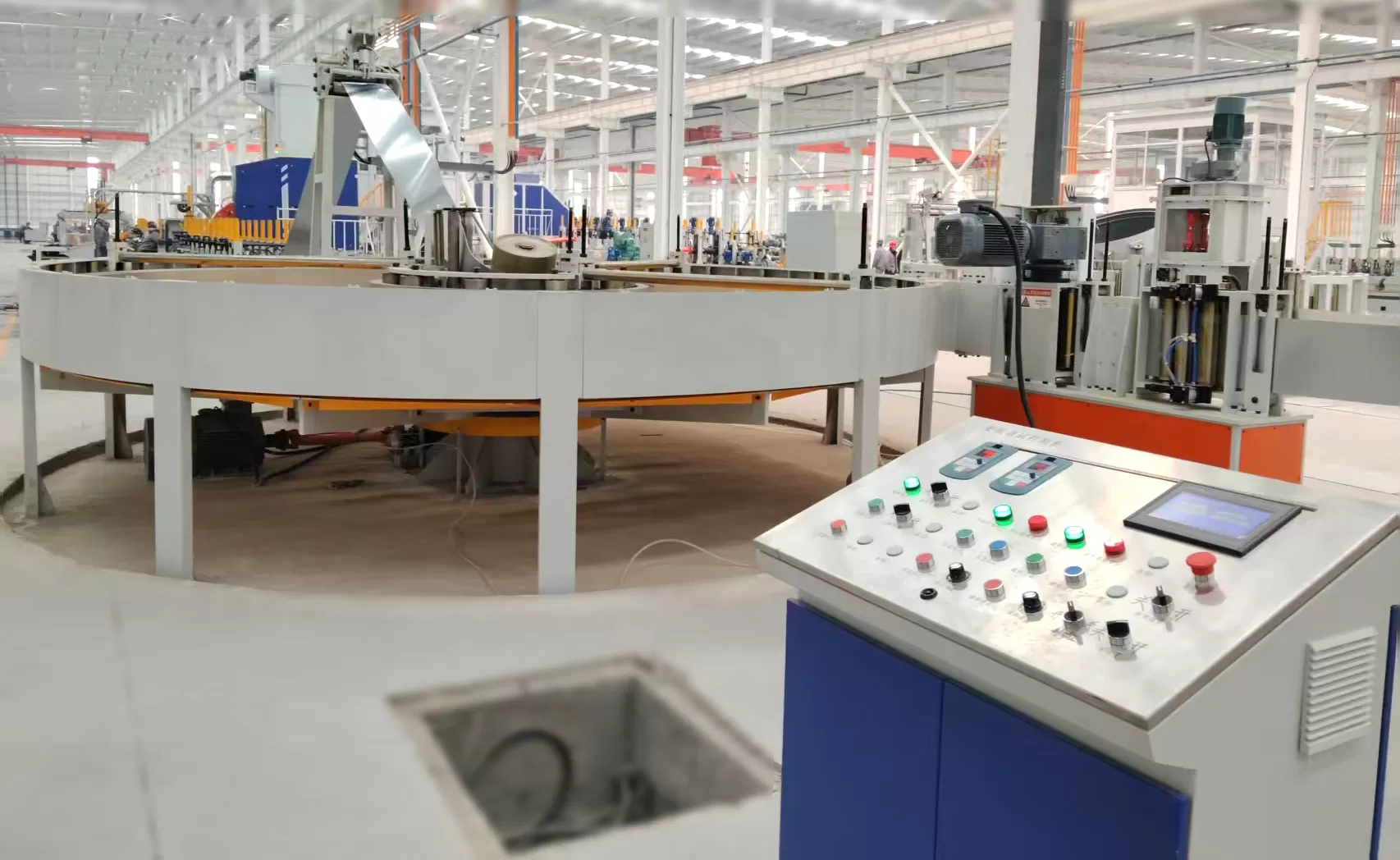
Horizontal spiral systems store strip material in concentric loops,
minimizing contact between the steel surface and the guiding rolls. This design
is highly beneficial for stainless steel or galvanized profiles where surface
scratching is a critical quality concern. It is a configuration frequently
integrated by SANSO for clients focused on
high-aesthetic architectural tubes.
Vertical cage designs, while simpler in mechanical construction, rely on
gravity and vertical guides to retain the loop. They are suitable for heavy
structural mills with thick carbon steel strips where minor surface markings do
not compromise the final product's market value. However, high-speed lines
usually favor spiral systems due to their superior stability during
high-velocity discharge.
Tension Control Dynamics and Strip Edge Protection
An often overlooked aspect of tube mill
Accumulator operation is tension control. When the strip is drawn
from the inner diameter of a spiral loop, centrifugal and frictional forces can
cause fluctuations in exit tension. If this tension spikes, the strip edge can
stretch, leading to forming defects downstream.
Advanced systems utilize pneumatic or hydraulic central expanders within the
tube
mill Accumulator basket. These expanders adjust dynamically to
maintain a constant back-tension. This prevent "whipping" effects when the
accumulator transitions from filling mode (running at 1.5 to 2 times the mill
speed) to discharging mode.
For high-strength low-alloy (HSLA) steels, which exhibit high spring-back
properties, active tension control is essential. Standard accumulator loops can
collapse or twist if tension is not managed precisely. Modern manufacturing
systems address this by integrating closed-loop load cells that monitor tension
in real time, adjusting the pinch rolls accordingly.
Addressing Common Operator Doubts
Doubt 1: Does a larger accumulator capacity always guarantee better
mill efficiency? Not necessarily. While larger storage capacity
provides a wider time window for coil joining, an oversized tube mill
Accumulator increases the risk of strip twisting and demands a
larger footprint. The goal is to optimize the capacity to match the
shear-and-weld cycle time, plus a 20% safety margin.
Doubt 2: Can we run heavy-gauge strips through a horizontal spiral
accumulator? Heavy-gauge strip steel (above 6.0 mm) possesses high
bending resistance. While horizontal spiral configurations can handle heavy
gauges, they require powerful pinch rolls and robust pre-bending units. For
extremely thick structural profiles, vertical loop pits or overhead loop systems
are sometimes preferred.
Doubt 3: How does accumulator tension affect weld quality in the
sizing section? Tension variations in the accumulator can propagate
through the forming cages to the welding squeeze rolls. If the strip enters the
weld box under variable tension, the weld seam can wander, leading to
intermittent weld defects. A stable discharge from a premium tube mill
Accumulator ensures a consistent weld seam alignment.
The Kinetic Buffer Framework (KBF) for Sizing
To prevent over-engineering or under-sizing entry equipment, we implement the
Kinetic Buffer Framework (KBF). This engineering model
calculates the minimum required storage capacity based on line variables,
ensuring continuous operation without unnecessary capital expenditure.
The KBF balance formula is defined as:
Vmin = (Smax × Tw) ×
Kf
Where:
Vmin = Minimum accumulator storage volume
(meters)
Smax = Maximum line speed of the forming mill
(meters/minute)
Tw = Total cycle time required for coil
shearing, welding, and entry-side resets (minutes)
Kf = Safety factor (typically 1.15 to 1.25 to
account for operator delay)
By applying this framework, plant managers can determine if their existing
tube
mill Accumulator can support a planned speed upgrade of the forming
section, or if the entry-side pinch rolls must be upgraded to decrease the fill
cycle time.
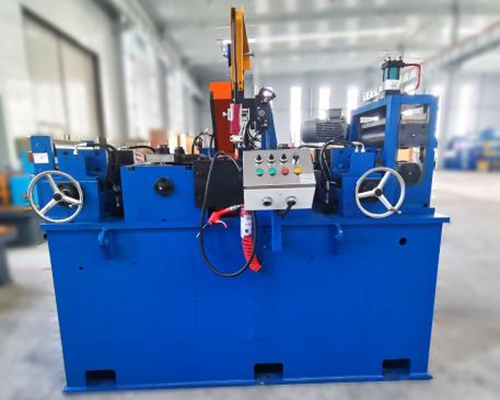
Before purchasing or retrofitting a tube mill
Accumulator, technical decision-makers should evaluate their
production parameters against this operational checklist:
[ ] Material Compatibility: Ensure the guiding roll
materials (e.g., polyurethane coating or hardened steel) match the surface
requirements of your product range (e.g., stainless steel, galvanized, or carbon
steel).
[ ] Maximum Strip Thickness: Confirm that the coil entry
pinch rolls and pre-bender have sufficient torque to process your maximum
yield-strength material.
[ ] Fill-to-Mill Speed Ratio: Verify that the accumulator
fill speed is at least 1.5 to 2.0 times faster than the maximum forming mill
speed to ensure complete refilling between coil joints.
[ ] Tension Control System: Assess whether the accumulator
uses passive friction braking or active, variable closed-loop tension
control.
[ ] Footprint and Overhead Clearance: Measure available
plant space; determine if a horizontal spiral fits the floor plan or if a
vertical cage is constrained by ceiling heights.
[ ] Automation Integration: Ensure the PLC of the
accumulator can communicate seamlessly with the shear-welder and uncoiler
systems for automated cycle synchronization.
[ ] Wear Component Accessibility: Check that internal guide
rolls, bearings, and drive belts are easily accessible for routine maintenance
to minimize planned downtime.
Frequently Asked Questions
Q1: What is the primary function of a tube mill
accumulator?
A1: The primary function of a
tube
mill Accumulator is to store a buffer of strip steel, allowing the
forming mill to continue running at a constant speed while the entry section
stops to weld the tail end of the depleted coil to the leading edge of the new
coil.
Q2: How do you choose between a vertical cage and a horizontal spiral
accumulator?
A2: Choose a horizontal spiral
accumulator for surface-sensitive materials (like stainless steel) and thicker
ranges where controlled looping is required. Choose a vertical cage for
lighter-gauge carbon steel lines where space constraints or budget limitations
make a simpler vertical design more practical.
Q3: Can a poorly maintained tube mill accumulator damage stainless
steel strip surfaces?
A3: Yes. If the accumulator's
guide rolls stall, suffer from bearing wear, or collect metal debris, they can
cause friction scratches on the strip surface. Systems designed by SANSO utilize non-marking
polyurethane or specialized alloy rollers to prevent this issue.
Q4: What is the typical fill speed required for a tube mill
accumulator?
A4: To ensure the accumulator is fully
refilled before the next coil change, the entry section's fill speed is
typically designed to be 1.5 to 2.5 times the maximum operating speed of the
forming and sizing sections.
Q5: How does SANSO customize accumulators for high-strength steel
processing?
A5: SANSO integrates heavy-duty
pre-bending units, high-torque hydraulic pinch rolls, and robust loop tension
sensors specifically designed to manage the high yield strengths and spring-back
tendencies of HSLA steels.
Conclusion: Choosing the Right Entry Partner
Investing in a high-efficiency tube mill
Accumulator is not just about expanding storage capacity; it is
about protecting strip surface quality, stabilizing tube mill tension, and
extending the operational lifespan of forming tooling. By matching the
mechanical configuration to specific material properties and utilizing
structured selection frameworks like the KBF, B2B buyers can ensure high returns
on investment.
For operations aiming to modernize their welded pipe production line,
selecting a manufacturer with proven engineering experience is critical. To
evaluate how optimized entry equipment can enhance your continuous mill yield,
consider consulting the technical team at SANSO for a detailed system
audit and tailored equipment recommendations.