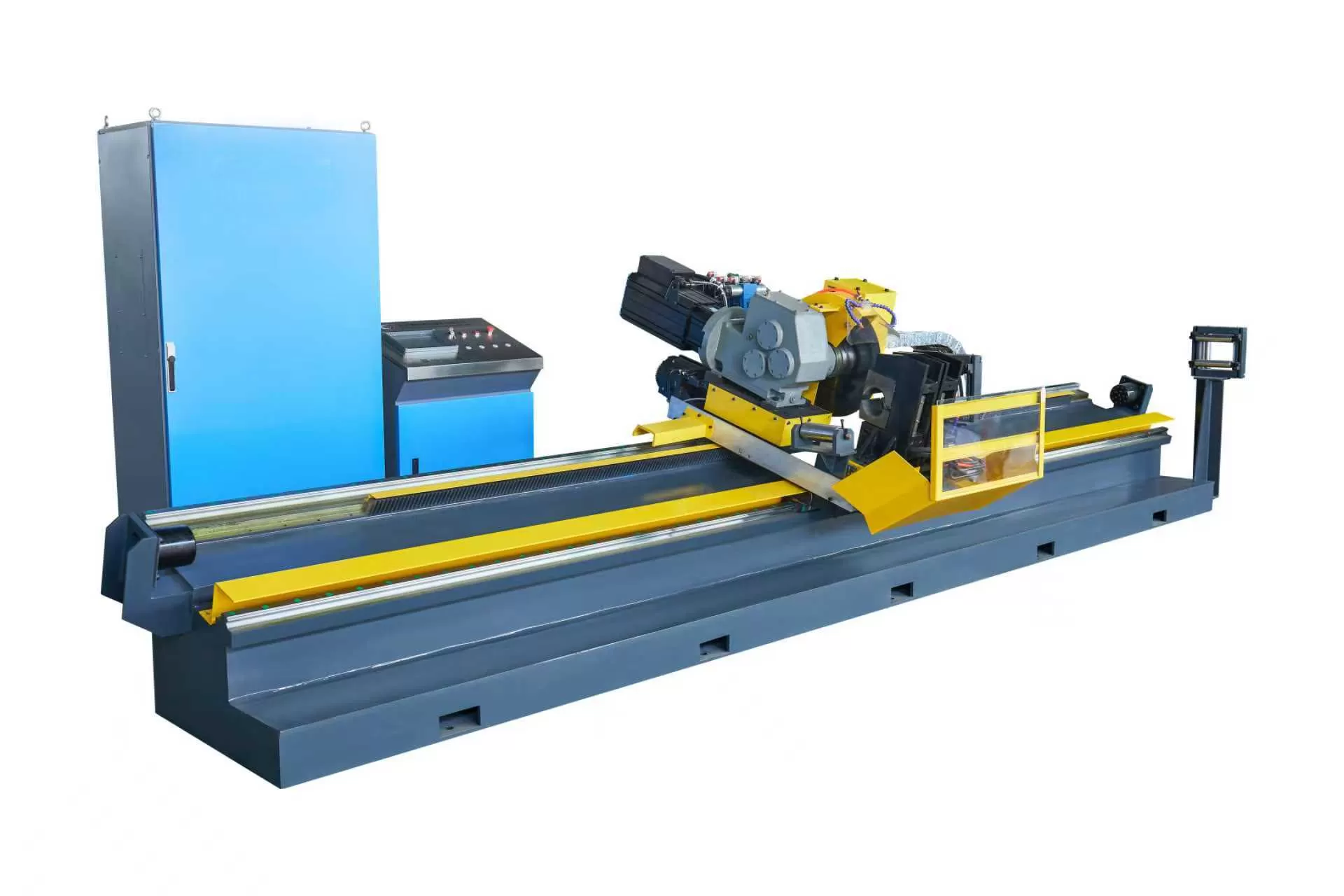
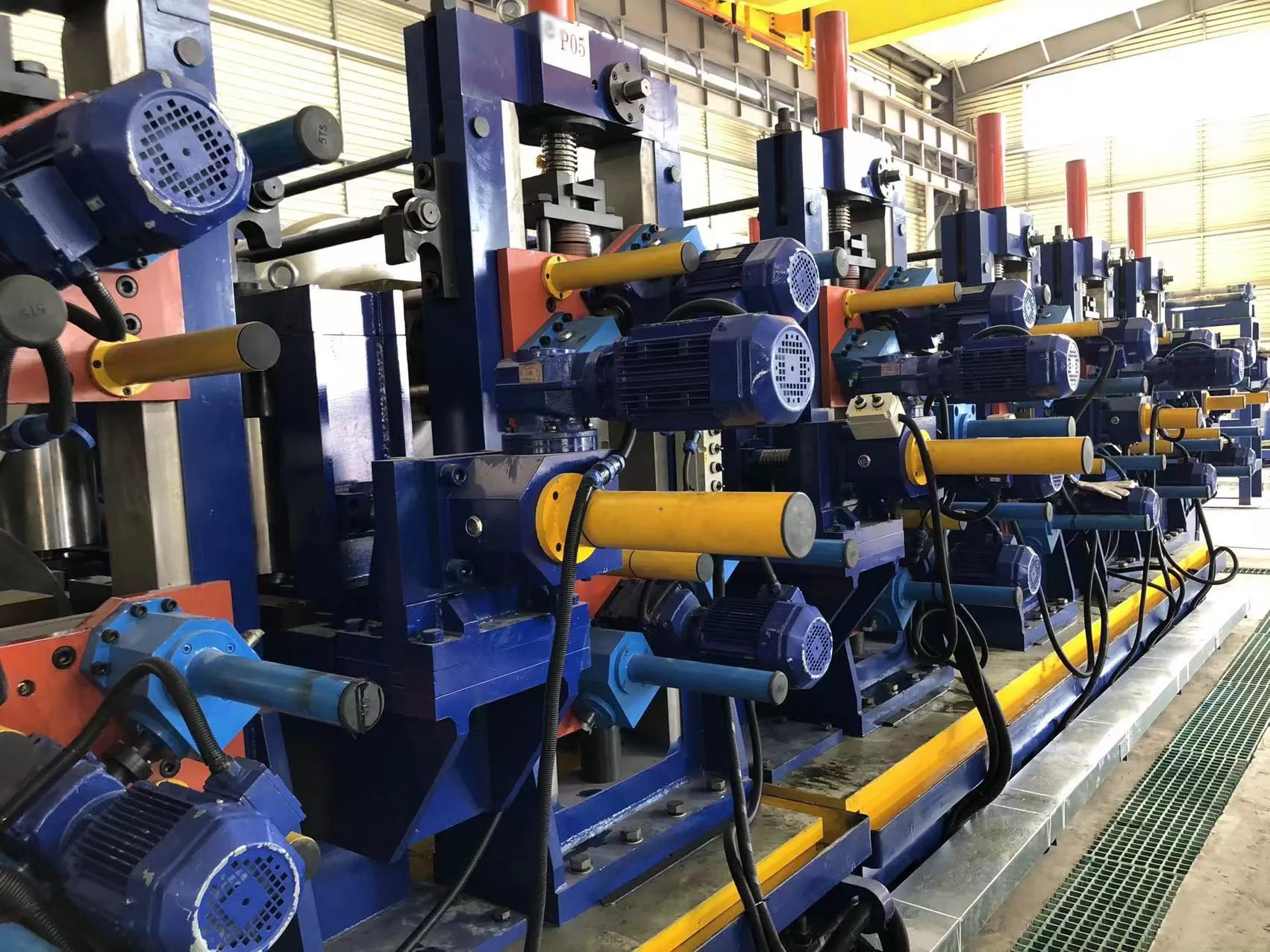
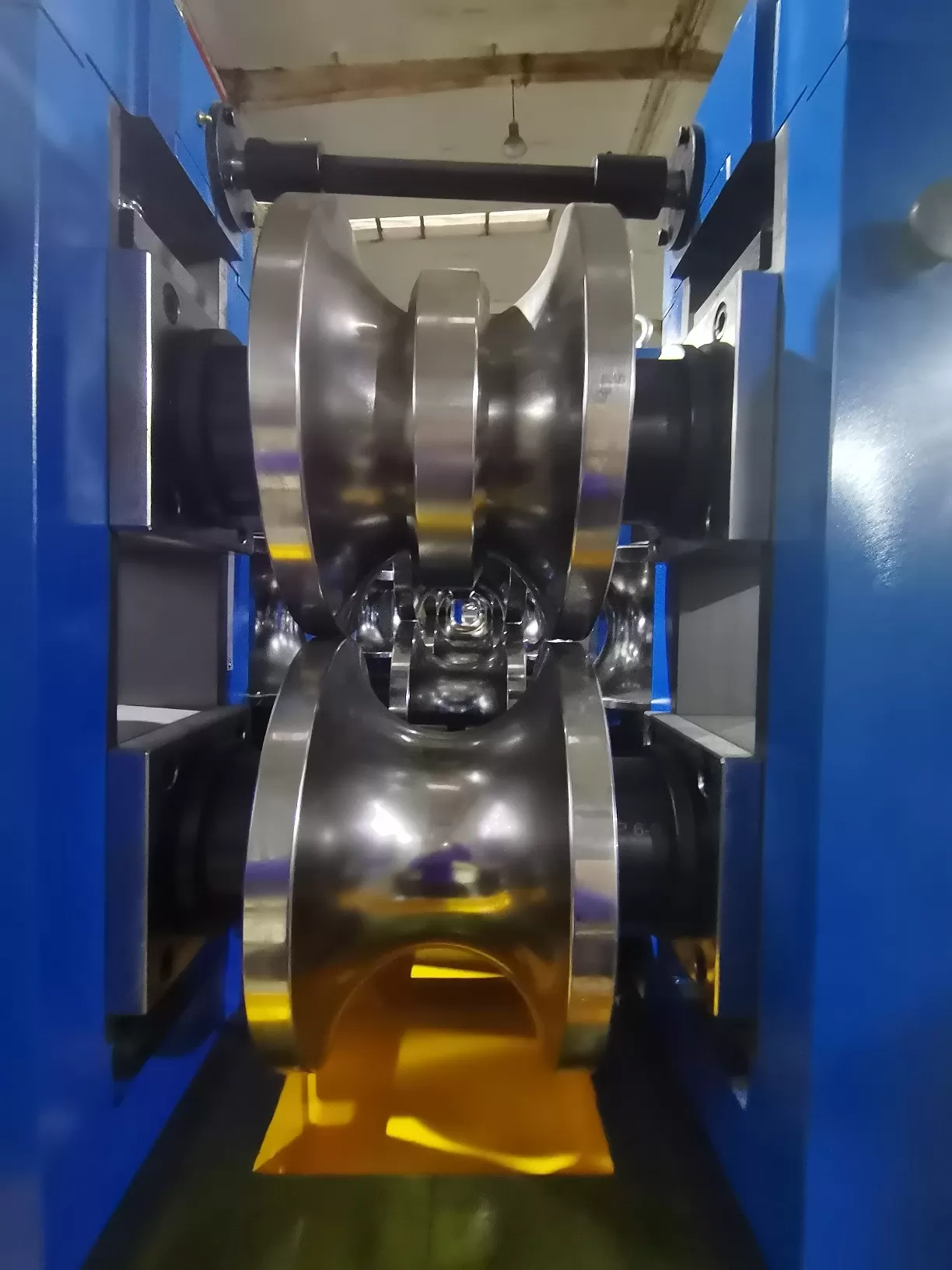
High-frequency induction (HFI) and laser welded tube production demand
continuous, high-speed inspection methods to identify structural flaws
immediately after the welding process. Among non-destructive testing (NDT)
methodologies, electromagnetic inspection plays a central role. Implementing
Eddy Current
Testing of Tubes allows manufacturers to identify surface and
near-surface discontinuities, weld seam pinholes, and dimensional variations
without interrupting the production workflow.
For industrial tube manufacturers, detecting flaws early prevents down-line
processing failures and material waste. Achieving consistent detection accuracy
requires understanding the relationship between material electromagnetic
properties, coil configurations, and the physical installation parameters within
the tube mill line.
Operating Principles of Electromagnetic Tube Inspection
Electromagnetic testing operates on the principle of electromagnetic
induction. An alternating current is passed through an excitation coil, creating
a primary magnetic field around the coil. When a conductive tube passes through
or near this field, eddy currents are induced in the material loop. These
induced currents generate a secondary magnetic field that opposes the primary
field.
Any structural variation, metallic discontinuity, or localized change in
chemical composition alters the flow of these eddy currents. This disruption
changes the overall electromagnetic impedance of the coil system. By monitoring
impedance variations, processing equipment can pinpoint localized flaws. The
depth to which these currents penetrate is governed by the skin depth
equation:
$$\delta = \frac{1}{\sqrt{\pi f \sigma \mu}}$$
Where:
δ (Skin Depth) is the depth at which the current density
drops to approximately 37% of its surface value.
f is the excitation frequency of the test coil.
σ (Electrical Conductivity) is the conductivity of the tube
alloy.
μ (Magnetic Permeability) is the magnetic permeability of
the tube alloy.
Selecting appropriate excitation frequencies is necessary to balance
penetration depth with sensitivity to small defects. High frequencies provide
superior sensitivity to minute outer diameter (OD) surface cracks but suffer
from low penetration. Low frequencies penetrate deeper into the tube wall,
allowing detection of inner diameter (ID) anomalies, though at the cost of
reduced surface sensitivity.
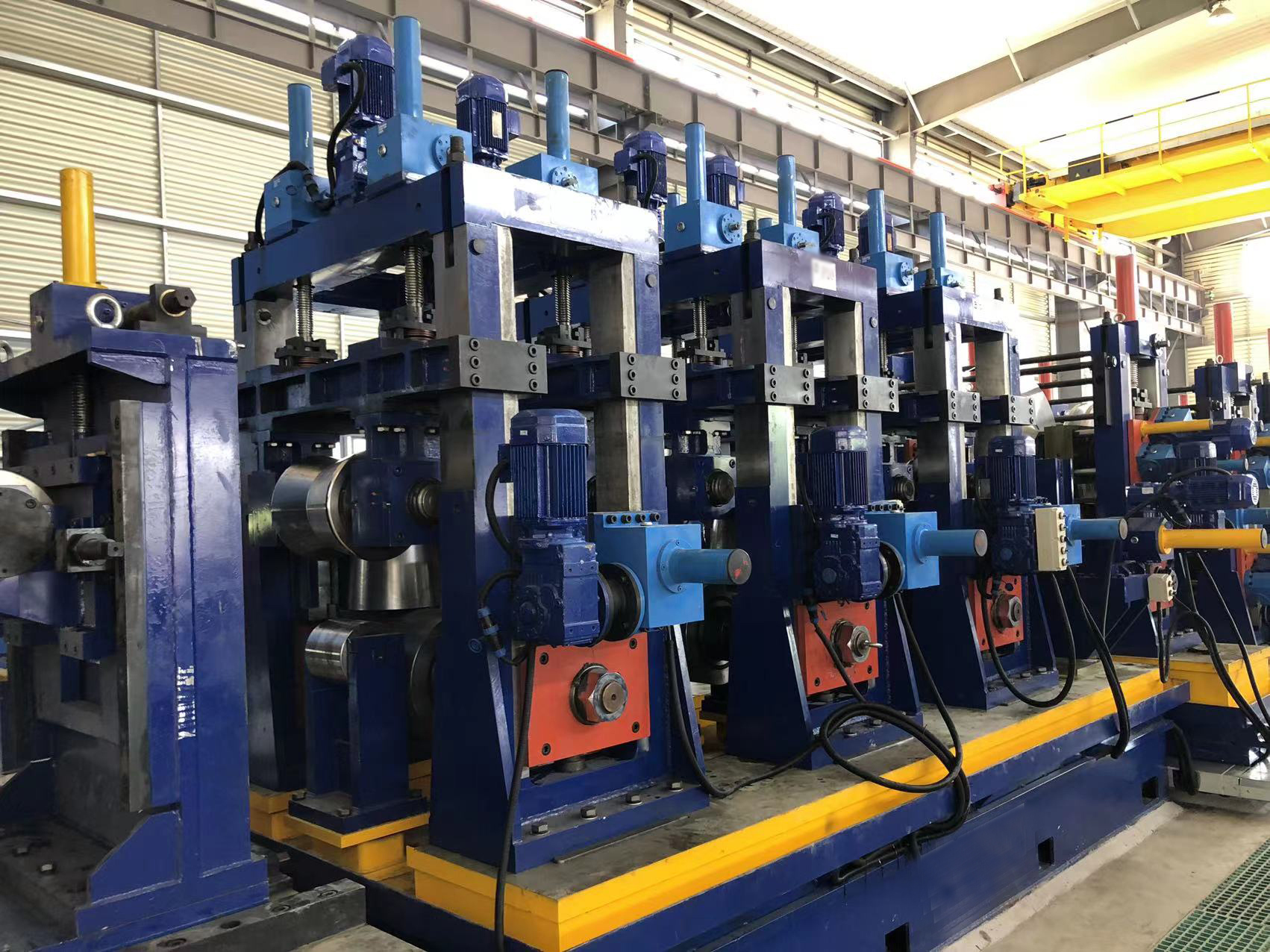
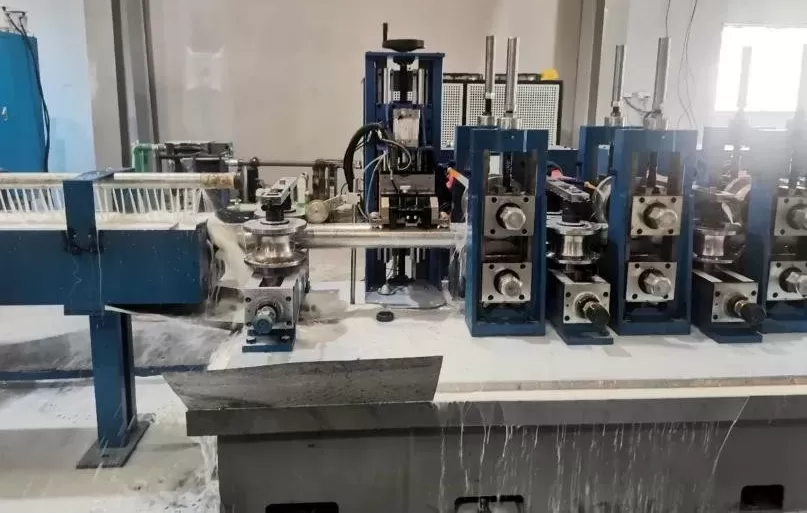
When engineering inline solutions, SANSO configures
high-frequency tube mills to support electromagnetic inspection units
immediately following the sizing stand. This positioning ensures that any weld
defects or dimensional inconsistencies are captured prior to the cutting
phase.
Sensor Configurations and Coil Assemblies for Tube Mills
Implementing Eddy Current Testing of
Tubes requires selecting the correct sensor configuration based on
the tube manufacturing process and target defect specifications. The industry
utilizes three primary coil arrangements:
Encircling Coils
Encircling coils completely surround the outer circumference of the tube. As
the tube moves axially through the coil assembly, the entire circumference is
inspected simultaneously. This configuration is highly efficient for detecting
longitudinal cracks, transverse cracks, pinholes, and general raw material
defects. However, encircling coils are sensitive to vibration and require
precise guiding mechanisms to prevent lift-off variations from skewing the
inspection data.
Sector or Segment Coils
Unlike encircling coils, sector coils cover only a portion of the tube
perimeter. In welded tube production, sector coils are positioned directly over
the longitudinal weld seam. This focused scanning configuration optimizes the
signal-to-noise ratio by ignoring the stable base metal and concentrating
electromagnetic energy on the heat-affected zone (HAZ). This targeted inspection
is beneficial for detecting weld-specific flaws like cold welds, stitching, and
localized porosity.
Probe or Pencil Coils
Pencil probes scan localized areas and are typically mounted on rotating
heads for high-precision finishing lines or used in manual verification
stations. In high-speed inline tube production, rotating probe systems are
sometimes implemented after the sizing section to provide helical scan paths,
offering high resolution for surface micro-cracks.
In addition to physical geometry, the electrical connection of the coils
determines the detection characteristics. The primary modes of operation
include:
Absolute Mode: Utilizes a single detection coil to measure
absolute changes in electromagnetic properties. This mode is suitable for
detecting gradual variations, such as wall thickness changes or slow alloy
drift.
Differential Mode: Employs two adjacent coils wound in
opposition. As the tube passes, the system compares the signal from one coil to
the other. Since gradual changes affect both coils simultaneously, the
differential mode ignores them, focusing instead on sudden, localized
discontinuities like cracks or pinholes.
Overcoming Metallurgical and Mechanical Challenges
Implementing reliable inline Eddy Current Testing of
Tubes involves addressing several material-related variables that
can interfere with signal clarity. Carbon steel and other ferromagnetic
materials present a major challenge due to high and variable magnetic
permeability.
Localized variations in permeability generate significant background noise,
masking actual material defects. To resolve this issue, inspection systems
incorporate magnetic saturation yokes. These yokes subject the tube to a
powerful direct-current (DC) magnetic field prior to passing through the test
coils. Saturating the material magnetically reduces its relative permeability to
near unity, making the ferromagnetic tube behave magnetically like a non-ferrous
material (such as stainless steel or copper). This eliminates permeability
noise, allowing the testing system to detect structural discontinuities
clearly.
Another major obstacle on the factory floor is mechanical vibration. As the
tube travels from the welding section through the sizing stands, mechanical
misalignments can cause the tube to bounce or shift within the test coil. This
shifting, known as lift-off, alters the distance between the coil and the tube
surface, generating false alarm signals. Industrial line configurations designed
by SANSO address
this by using heavy-duty guide roll assemblies and non-magnetic stabilizing
sleeves to keep the tube centered through the inspection zone.
Additionally, the heat-affected zone (HAZ) of the weld often exhibits
different electrical and magnetic properties compared to the parent metal due to
localized thermal cycling. If testing occurs immediately after welding without
proper cooling, thermal variations can distort the electromagnetic signals.
Water cooling jackets and precise positioning downstream are necessary to allow
the tube temperature to stabilize before it enters the testing field.
Calibration Standards and Signal Interpretation
To ensure compliance with international quality standards such as ASTM E309,
ASTM E426, and ISO 10893-2, calibration procedures must be executed regularly.
Calibration involves passing a reference standard tube containing artificial
defects through the inspection system.
Common artificial calibration standards include:
Drilled Holes: Flat-bottom or through-wall holes drilled at
specified diameters to define amplitude thresholds for localized material
loss.
Longitudinal and Transverse Notches: Precise
electro-discharge machined (EDM) notches placed on both the internal and
external surfaces to establish sensitivity levels for surface cracks.
The signal received by the testing equipment is displayed on an impedance
plane, representing both signal amplitude and phase angle. Phase angle analysis
is the primary method for distinguishing between genuine material defects and
harmless variables such as lift-off or surface scale.
By adjusting the phase angle, operators can rotate the signal display so that
lift-off noise occurs along a horizontal axis, while true defect signals project
vertically. This phase discrimination prevents false rejects and ensures that
only tubes with structural voids, cracks, or weld discontinuities are flagged
for rejection.
High-Speed Inline Integration and Production Solutions
Integrating Eddy Current Testing of
Tubes into a continuous mill requires coordination between the
mechanical tube former, the welding station, and the NDT instrumentation. The
inspection unit is typically installed after the sizing section, where the final
outer diameter and ovality of the tube are established.
Modern tube manufacturing lines utilize automated marking and sorting
systems. When the inspection unit detects a signal that exceeds the pre-set
threshold, it sends a high-speed signal to a PLC (Programmable Logic
Controller). The PLC tracks the position of the defect as the tube moves
forward, activating an automatic paint sprayer to mark the exact location of the
flaw. Once the tube is cut to length by the flying saw, a sorting gate
automatically diverts the marked tube to a separate reject pocket.
For high-capacity manufacturing operations, SANSO integrates structural
mechanical frames, precise guide rolls, and automated marking systems directly
into their tube production lines. This structured setup guarantees that testing
equipment functions under stable physical conditions, reducing false reject
rates and maximizing line throughput.
Frequently Asked Questions
Q1: What materials can be inspected using eddy current
testing?
A1: This testing method is suitable for all electrically conductive metals.
This includes non-ferrous materials such as copper, brass, aluminum, and
austenitic stainless steels, as well as ferrous materials like carbon steels,
provided that a magnetic saturation system is used to suppress magnetic
permeability variations.
Q2: Can eddy current testing detect defects on both the inside and
outside of a tube?
A2: Yes, but the ability to detect internal diameter (ID) defects depends on
the tube wall thickness, material conductivity, and the excitation frequency.
For thicker walls, lower testing frequencies are required to allow the
electromagnetic field to penetrate to the inner surface, though this reduces
overall sensitivity to small outer diameter (OD) flaws.
Q3: What is the main difference between absolute and differential
coils in tube testing?
A3: Absolute coils measure the total electromagnetic properties of a single
area, making them ideal for detecting gradual variations like wall thinning.
Differential coils use two opposing windings to compare adjacent areas, making
them highly sensitive to sudden, localized defects like pinholes and cracks
while ignoring gradual dimensional drifts.
Q4: Why is magnetic saturation necessary for testing carbon steel
tubes?
A4: Carbon steel is highly ferromagnetic, meaning its magnetic permeability
varies widely across the material due to internal stresses and crystal structure
variations. These variations cause significant electromagnetic noise that masks
defects. A magnetic saturation yoke applies a strong DC magnetic field to
saturate the material, reducing permeability fluctuations to near zero and
allowing clean defect signal detection.
Q5: How does line speed affect the performance of eddy current
testing systems?
A5: Modern systems can easily inspect tubes at speeds exceeding several
hundred meters per minute. However, high speeds require high-frequency
instrumentation to maintain sufficient sampling density along the tube length.
Precise synchronization between the line speed, the PLC tracking system, and the
marking device is necessary to accurately locate and reject defective
sections.
Inquiry and Support Path
For detailed engineering specifications regarding tube mill integration,
inline inspection options, or custom manufacturing solutions, please direct
inquiries to our technical support and sales team via our official communication
channels: