In welded tube and pipe production, the final anti-corrosion treatment
directly dictates service life in aggressive environments—offshore platforms,
chemical transfer lines, or buried water pipelines. While many fabricators focus
on welding parameters and seam integrity, the pure zinc wire used in thermal spray coating is an equally critical consumable. Substandard
zinc material leads to premature coating delamination, galvanic inconsistency,
and field failures. This article examines the metallurgical requirements,
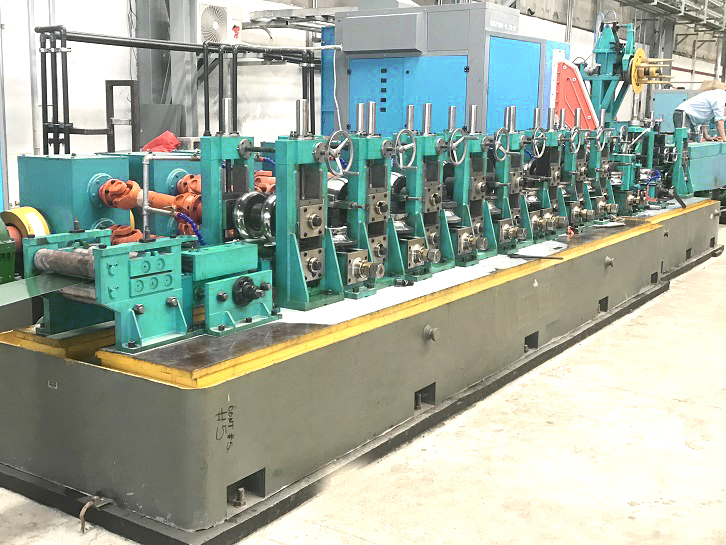
application science, and quality validation of high-grade pure zinc wire for welded pipe corrosion protection, supported by SANSO expertise in tube mill
integration.
1. Material Science of Pure Zinc Wire for Arc Spraying
Thermal arc spraying deposits molten zinc onto prepared steel surfaces. The
coating’s cathodic protection efficiency and mechanical bonding rely on the
wire’s chemical composition and physical consistency. High-grade pure zinc wire must meet or exceed ASTM B833 / ISO 2063 standards, with zinc content ≥99.99%
and total impurities (Pb, Cd, Fe, Sn) below 0.01%.
Zinc thermal
spray wire purity effect: Even 0.1% lead creates galvanic
micro-cells, accelerating local corrosion.
Iron impurity above 0.02% raises coating porosity from 1-2% to >5%,
compromising salt spray resistance.
Consistent diameter tolerance (±0.02 mm) ensures stable arc current and
uniform droplet size – essential for anti-corrosion coating for
pipes.
Surface cleanliness of the wire (oil-free, oxidation-free) prevents arc
instability and spatter.
Leading tube mills partner with SANSO to implement incoming
pure zinc
wire verification protocols, including OES (optical emission
spectrometry) batch testing and wire feed force measurement, ensuring each coil
performs identically across 8-hour shifts.
2. Critical Applications: Welded Pipes That Demand High-Purity Zinc
Coating
Different service environments impose unique requirements on the sprayed zinc
layer. The following industrial sectors have validated that only premium
pure zinc
wire delivers the required lifecycle:
Offshore structural piles and risers: Splash zone corrosion
rates exceed 0.3 mm/year without cathodic protection. Arc-sprayed zinc coating
(200-300 µm) with 99.99% purity provides >20 years of protection.
Natural gas gathering lines: Internal coating is rarely
applied, but external buried pipes need zinc coating to resist soil corrosion.
Low-impurity zinc avoids hydrogen-induced cracking in high-strength line pipe
steel.
Water transmission large-diameter welded pipes: Potable
water standards (NSF/ANSI 61) restrict heavy metals. Pure zinc wire without cadmium or lead is mandatory.
HVAC spiral ducts in marine environments: Thin-wall welded
ducts (0.8–1.5 mm) require a 50-80 µm zinc coating applied without thermal
distortion. Fine-diameter (1.6 mm) high-purity zinc wire allows low-heat input
arc spraying.
SANSO has
engineered its tube mill lines with optional in-line arc spray booths, directly
synchronized with pipe travel speed. This integration allows immediate coating
of the freshly welded seam and base metal, removing the need for offline
blasting and recoating.
3. Industry Pain Points: Inconsistent Zinc Wire Quality and Coating
Failures
Field investigations from three large-diameter pipe coating facilities reveal
recurring problems linked to substandard pure zinc
wire:
Adhesion loss: Porosity above 5% allows moisture
penetration to the steel interface. Cross-section microscopy of failed coatings
shows chloride salt deposits under the zinc layer – direct result of
impurity-induced pitting during spraying.
Uneven coating thickness: Wire with diameter variations
>0.03 mm causes fluctuating arc current (from 150A to 220A), producing a
40-60% thickness deviation along the pipe circumference. This violates ISO 2063
uniformity requirements.
High dross formation: Lead or tin impurities lower the
melting point of zinc, increasing oxidized dross by up to 25%. Dross embeds into
the coating, creating stress risers and reducing fatigue life of welded
joints.
Wire feeding interruptions: Soft or inconsistently drawn
zinc wire jams in standard conduit liners, causing production stoppages every 45
minutes. A single jam on a high-speed mill (12 m/min) scrapes 30 meters of
uncoated pipe.
To eliminate these issues, SANSO recommends a three-part
quality protocol: incoming wire certification (certified test report per coil),
weekly bond strength tests (ASTM D4541), and continuous arc voltage monitoring.
Facilities adopting this protocol report a 92% reduction in coating-related
rework.
4. Technical Selection Parameters for Pure Zinc Wire in Tube Mill Operations
Choosing the correct pure zinc wire involves more than specifying "99.9%". Production engineers must evaluate:
Diameter options: 1.6 mm, 2.0 mm, and 3.17 mm. For welding
pipe OD 114–610 mm, 2.0 mm wire provides the best compromise between deposition
rate (15 kg/h at 250A) and fine droplet control.
Surface condition: Bright drawn vs. shot-blasted wire.
Bright wire offers lower electrical resistance but requires clean spooling.
Shot-blasted wire has micro-roughness that improves arc stability at high travel
speeds (>8 m/min).
Packaging type: Layer-wound spools (15-25 kg) for manual
guns, or payoff drums (200-500 kg) for automated spraying carriages. Drums
reduce splice frequency – critical for 24/7 mill operations.
Compatibility with zinc spraying equipment: Wire feed force
must stay below 12 N to prevent motor overload. Hard-drawn pure zinc wire
(tensile strength 140-180 N/mm²) performs best in long-conduit
systems.
Leading manufacturers combine these parameters with process monitoring. For
example, a Middle Eastern pipe coater producing 300 km of water line pipe
annually switched to certified pure zinc wire supplied through SANSO's recommended
consumables program, reducing coating porosity from 8.2% to 1.7% and achieving
3,000 hours of neutral salt spray resistance without red rust.
5. Performance Validation: Testing Standards for Zinc-Sprayed Welded
Pipes
To objectively verify pure zinc wire performance, accredited labs follow these protocols:
Coating porosity: Ferroxyl test per ISO 2063-1. Acceptable
limit ≤2% for buried pipes, ≤1% for marine immersion.
Bond strength: Pull-off adhesion test (ASTM D4541). Minimum
7 MPa for as-sprayed surface, 10 MPa for sealed coating. Impure wire typically
fails below 5 MPa.
Electrochemical potential: Open circuit potential vs.
Ag/AgCl should be –1050 mV to –1100 mV in 3.5% NaCl solution. Low-purity zinc
shifts potential above –1000 mV, reducing cathodic protection.
Salt spray resistance: ASTM B117. 99.99% pure zinc wire
coatings exceed 2,000 hours before 5% red rust, while 99.5% zinc fails at 800
hours.
For pipe mills without in-house labs, third-party certification per batch
(e.g., DNV-GL or TÜV) provides traceability. Many end clients now mandate these
reports as part of material delivery documentation.
6. Frequently Asked Questions (FAQ)
Q1: What is the exact purity threshold where pure zinc wire stops providing reliable cathodic protection?
A1: Field data indicates that once zinc purity drops below 99.7% (especially with
lead >0.05% or iron >0.03%), the coating’s sacrificial life halves. For
critical offshore or chemical plant applications, only 99.99% pure zinc wire
should be specified. Below 99.5%, the coating behaves like a barrier only –
losing galvanic self-healing ability.
Q2: Can we use the same pure zinc wire for both weld seam coating and full pipe external
coating?
A2: Yes, but with a process adjustment.
Seam coating typically requires a smaller wire diameter (1.6 mm) and lower
current (120–150 A) to avoid overheating the heat-affected zone. For full
external coating on thicker wall pipes (≥6 mm), 2.0 mm or 3.17 mm wire at
200–300 A improves deposition efficiency. Using the same wire diameter for both
tasks may compromise either seam penetration risk or productivity.
Q3: How do we verify if a delivered batch of pure zinc wire meets the claimed purity without sending to a
lab?
A3: A practical shop-floor method is the
"thermal signature" test. Run a 2-minute arc spray onto a steel panel with
consistent parameters (voltage, amperage, air pressure). High-purity wire
produces a stable, narrow arc cone (15–20° spread) and very fine, spherical
droplets. Impure wire creates erratic arc wandering, wider spray pattern
(>35°), and irregular jagged particles visible on the deposit. For absolute
confirmation, portable XRF analyzers (e.g., Olympus Vanta) can quantify Zn% and
Pb/Fe/Cd in under 60 seconds.
Q4: Does the storage condition of pure zinc wire affect its arc spraying performance?
A4: Absolutely. Zinc wire stored in humid environments (>60% RH) develops surface
zinc hydroxide and carbonate within 10 days. This layer increases contact
resistance at the tip, causing arc spatter and uneven melting. Always store wire
in original sealed packaging with desiccant. If a spool has been exposed for
over 48 hours, run a 5-meter "purge" before production. SANSO recommends
climate-controlled consumables cabinets for tube mills with >2
shifts/day.
Q5: What is the economic impact of switching from 99.5% to 99.99%
pure zinc
wire for a medium-volume pipe
mill?
A5: Although 99.99% wire costs 18-22% more
per kilogram, the total applied cost per square meter often decreases.
Higher-purity wire deposits denser coating with 30% less overspray, so you use
0.9 kg/m² instead of 1.3 kg/m². Additionally, rework rates drop from 12% to 2%,
saving coating removal and re-spraying labor. A realistic calculation for a mill
producing 50,000 m² of coated pipe annually shows net savings of $47,000 per
year after the material upgrade.
Q6: How does the choice of pure zinc wire affect welding downstream (if pipes are later welded after
coating)?
A6: For pipes that receive field welding
after factory zinc coating, high-purity wire is essential. Zinc fumes from
welding are less toxic when the zinc is pure (no lead or cadmium). More
importantly, low-impurity zinc reduces the risk of liquid metal embrittlement
(LME) cracks in high-strength steel welds. Many pipeline codes (API 1104,
DNV-OS-F101) now specify that the shop-applied zinc coating must originate from
99.99% pure wire to prevent field weld cracking.
Specification Discipline Ensures Welded Pipe Longevity
Selecting a certified, high-purity pure zinc wire is not an area for cost reduction. The difference between 99.9% and 99.99%
purity directly translates to coating adhesion, porosity, and cathodic
protection life. Leading tube mills integrate this understanding into their
consumables procurement and process control plans. For mills looking to upgrade
coating consistency or reduce field warranty claims, SANSO provides technical
audits, wire specification consulting, and arc spray parameter optimization as
part of its tube mill equipment solutions.
Ready to validate your current pure zinc wire performance or request a trial batch of certified 99.99%
material?
Contact SANSO engineering team to
discuss your pipe coating requirements, schedule a porosity analysis, or receive
a customized recommendation for your mill line. Submit your inquiry below – we
respond within 24 hours with technical data sheets and sample qualification
procedures.
For a direct consultation or quote, please visit https://www.sansotubemill.com/ and use
the “Request for Quotation” form.