Every welded pipe mill begins with uncoiling. If you feed the line poorly at
the entry stage, the entire forming and welding process suffers. Strip
misalignment, erratic back-tension, and uncoiling slop directly cause
high-frequency welding defects and line shutdowns.
Many mill operators overspend on high-end hydraulic units when a rugged,
well-engineered manual uncoiler machine fits their production schedule better.
At SANSO, we help tube manufacturers balance line efficiency and capital
investment from the very first entry point of the tube mill line.
Are you planning a new ERW line or replacing a worn-out decoiler unit?
Request a custom proposal from our engineering team today to lock in your machinery specs and lead times.
1.1 Working Principle & Role in Tube Mill Lines
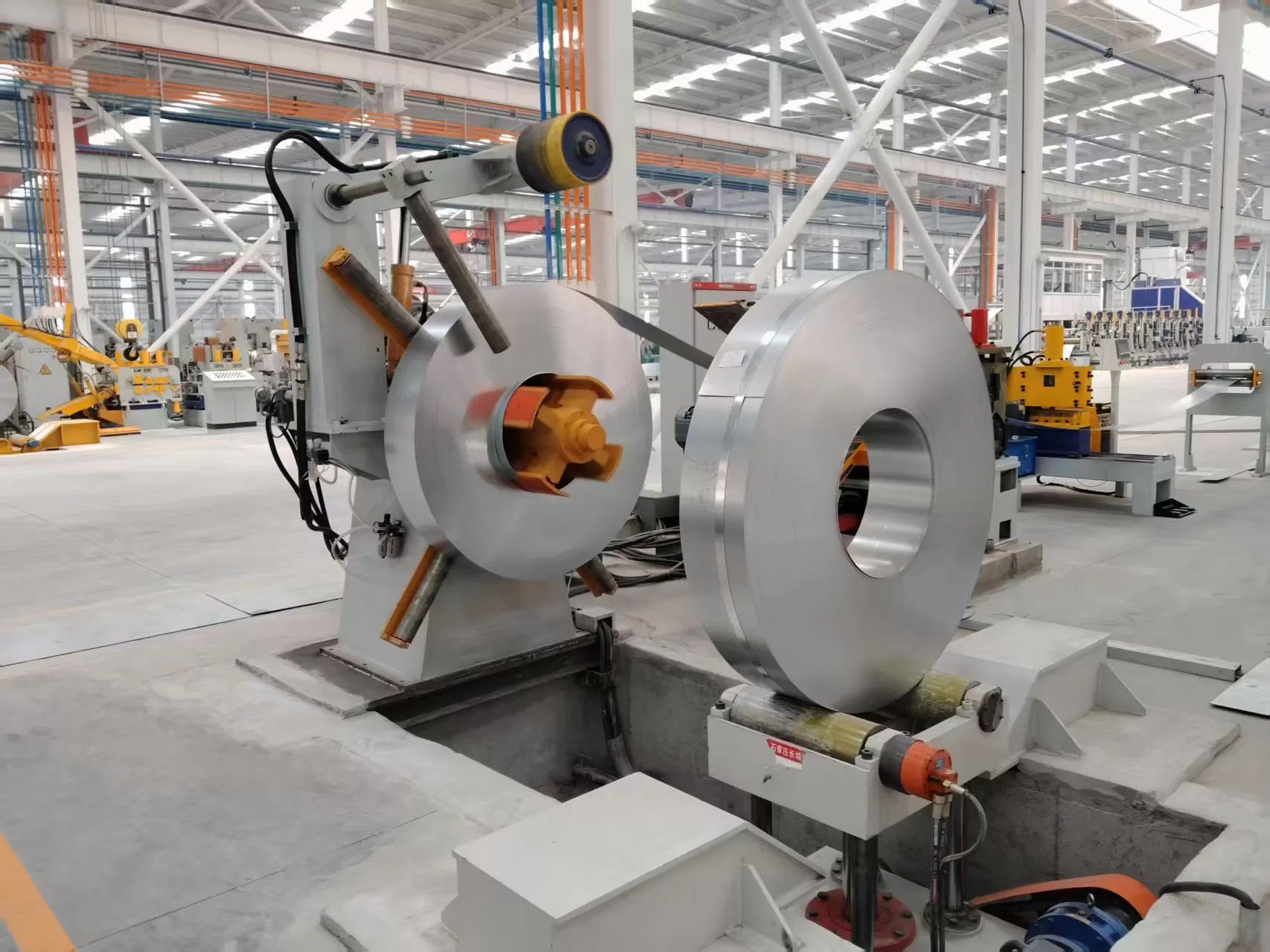
A manual decoiler machine holds the metal coil, centres it relative to the
mill pass-line, and payoffs the strip smoothly. Unlike hydraulic units that rely
on hydraulic power packs to expand mandrel segments, a manual unit uses a
mechanical hand-crank, screw-and-wedge setup, or link mechanism to expand the
mandrel jaws against the coil inside diameter (ID).
The decoiler does not just spin freely. It must resist the pull of the
breakdown stands or entry flattener with controlled drag. Without precise
friction braking, coil inertia causes loose wraps, tangling, and unexpected
strip wander.
1.2 Manual vs. Hydraulic Decoiler: When to Choose Manual?
Choosing between manual and hydraulic expansion comes down to coil mass,
cycle frequency, and budget.
- Capital & Maintenance Cost: Manual decoilers cost a
fraction of hydraulic machines. They eliminate hydraulic pumps, valves, hoses,
seals, and oil leaks.
- Target Pipe Diameters: They suit small-to-medium diameter
tubes (such as 1/2-inch to 2-inch OD round or equivalent square/rectangular
sections).
- Weight Profile: Manual decoilers shine with coils under 3
to 5 metric tons. Beyond 5 tons, manual cranking becomes excessively tiring for
operators.
- Simplicity: Fewer electrical and hydraulic tie-ins mean you
can install and commission the unit within hours.
2. Core Technical Parameters to Consider
2.1 Coil Weight Capacity
Always specify your manual decoiler machine based on your heaviest incoming
master coil. Standard ratings range across 1.5-ton, 2-ton, 3-ton, and 5-ton
thresholds.
Never size your machine exactly at maximum coil weight. We recommend a safety
factor of 15% to 20% over your heaviest coil. Shock loading occurs when the
crane drops the coil onto the mandrel, and spindle deflection will ruin bearings
prematurely if you run right at the design limit.
2.2 Inner (ID) and Outer (OD) Diameter Range
Steel mills deliver slit coils with standardized inside diameters, commonly
508 mm (20 inches), 406 mm (16 inches), or occasionally 610 mm (24 inches). Your
manual coil expansion range must bridge these sizes.
A good manual expansion spindle typically covers 470 mm to 520 mm through its
internal linkage. If your factory sources coils across multiple ID standards,
specify clip-on adapter shoes or rubber expansion sleeves to expand the reach
without buying a second decoiler.
2.3 Strip Width and Thickness Limits
Calculate your maximum strip width based on your largest tube profile:
Strip Width = π × (Pipe OD - Wall Thickness)
Add edge trim margins if you run an online slitter or edge miller. Thin
gauges (0.5 mm to 1.5 mm) pull easily but deform under uneven mandrel pressure.
Thick strips (over 3.0 mm) resist bending and require a rigid spindle to avoid
shaft deflection under high pull loads.
2.4 Braking System & Strip Tension Control
A manual decoiler in a tube mill line cannot rely on loose rotation. Inertia
will overrun the strip during line deceleration, throwing loops of uncoiled
steel across the floor.
Look for a mechanical friction brake, such as a leather/composite band brake
or a disc brake with an adjustable handwheel. Operators can tighten or loosen
drag depending on whether the coil is full (maximum inertia) or near the core
(minimum inertia).
3. Types of Manual Decoilers for Welded Pipe Production
3.1 Single-Arm Manual Decoiler
The single-arm, single-mandrel machine is the most compact and economical
design. It has one cantilevered spindle fixed to a stationary base.
This design fits lower-speed batch operations, thick-wall lines with long run
times per coil, or workshops with severe floor space limits. The main drawback
is downtime: when a coil finishes, the whole tube mill stops while you unclamp,
load, expand, and thread the next coil.
3.2 Double-Head / Dual-Mandrel Manual Decoiler
The double-head manual uncoiler is the industry standard for
production-oriented welded pipe lines. It features two mandrels mounted on a
central rotating pedestal that pivots 180 degrees.
This design offers several practical production advantages:
- Zero Waiting for Loading: While Mandrel A uncoils into the
line, the operator uses the overhead crane to load and expand a new coil onto
Mandrel B.
- Fast Coil Turnaround: Once Mandrel A runs empty, the
operator pulls the locking pin, swivels the carousel 180 degrees, locks it into
place, and begins payoff immediately.
- Seamless Welder Integration: It keeps your strip
accumulator full and minimizes idle time at the shear and end-welder
station.
4. Integration with Welded Pipe Line Equipment
Welded tube mills operate continuously using either a vertical cage or
horizontal spiral strip accumulator. The decoiler does not feed the tube mill
directly at forming line speed. Instead, it feeds the entry pinch-roll and
flattener, which run at up to double the mill speed to refill the accumulator
basket.
Ensure your manual uncoiler bearings and drag brake handle these high-speed
fill bursts without overheating. If the brake fades due to heat during quick
fill cycles, strip tension collapses.
4.2 Handling Different Materials
Strip surface requirements vary greatly across materials:
- Carbon Steel (HR/CR): Tolerates standard steel mandrel
segments, but demands sturdy brakes to control heavier, greasy coils.
- Galvanized Steel (GI): Spindle pads should not shear or
flake the zinc coating, which can build up inside the forming rolls.
- Stainless Steel (SS): Requires polyurethane, nylon, or
rubber pads fitted over the mandrel segments. Direct contact between carbon
steel segments and stainless steel can embed iron particles, causing surface
rust on the finished pipe.
SANSO builds custom mandrel segments and upgraded spindle shafting to meet
these specific metallurgic challenges across international tube mill
standards.
5. Operational Safety, Ergonomics & Maintenance
5.1 Safe Loading & Anti-Uncoiling Measures
High-tensile coils store huge amounts of spring energy. When workers cut the
packaging straps, the coil outer wrap can whip outwards violently.
Equip your manual decoiler with a manual hold-down roll or a mechanical
snubber arm. This keeps the outer layer pressed down securely while an operator
snips the band, preventing serious shop-floor injuries.
5.2 Daily Inspection Checklist
Manual machines are tough, but they are not maintenance-free. Keep this
checklist by the operator console:
- Weekly Spindle Lubrication: Grease the internal expansion
screw threads and the sliding wedges. Dried grease creates high crank
resistance.
- Brake Lining Wear: Check the thickness of the friction band
lining. Replace it before the steel band contacts the brake drum.
- Main Bearing Play: Check the spindle nose for vertical play
using a pry bar every month to catch bearing wear early.
- Locking Pin Integrity: On double-head models, verify that
the 180-degree indexing pin seats fully into the base plate before starting line
payoff.
6. 2026 Buying Checklist & ROI Evaluation
When selecting your machine, balance upfront expenditure against continuous
operator productivity. Use this technical comparison to guide your decision:
| Parameter / Feature | Single-Head Manual | Double-Head Manual | Light Hydraulic Decoiler |
|---|
| Coil Weight Range | 1.0 - 3.0 Tons | 1.5 - 5.0 Tons per side | 3.0 - 10.0+ Tons |
| Coil Changeover Time | 8 - 15 minutes | 1 - 2 minutes (Indexed) | 2 - 4 minutes |
| Maintenance Complexity | Minimal (Pillow blocks) | Low (Pivot ring + brakes) | Medium to High (Hydraulics) |
| Operator Effort | Moderate | Moderate | Minimal (Push-button) |
| Relative Equipment Cost | Base (1.0x) | ~ 1.6x - 1.8x | ~ 2.8x - 3.5x |
Calculating ROI: If your mill runs 10 coils per shift, a
single-arm unit causes roughly 100 minutes of downtime each shift without an
accumulator. Upgrading to a double-head manual unit cuts that downtime to 15
minutes. The recovered output often pays for the machine difference within two
to three months.
Frequently Asked Questions (FAQ)
Q1: What is the maximum practical coil weight for a manual decoiler
machine?
A1: The industry ceiling is typically 5
metric tons. Beyond 5 tons, expanding the mandrel jaws manually requires massive
mechanical leverage, which tires operators and slows down production. For coils
above 5 tons, hydraulic expansion mandrels are the standard choice.
Q2: Can a manual decoiler keep up with high-speed tube
mills?
A2: Yes, provided it works alongside a strip
accumulator. The decoiler does not feed the weld box directly; it only needs to
spin smoothly while the pinch-roll fills the accumulator. With a well-balanced
spindle and smooth friction brakes, manual units operate safely at high payoff
speeds.
Q3: How does the operator adjust the inside diameter on a manual
unit?
A3: Most manual units use a front-facing
crank or nut connected to a central acme screw. Turning this screw pushes
internal wedge blocks or scissor linkages outward, forcing the steel curved
leaves to expand uniformly against the coil core.
Q4: Why does my strip wander or skew as it enters the forming
mill?
A4: Strip wander usually traces back to poor
mandrel alignment or uneven brake drag. If the decoiler spindle is not set
strictly perpendicular (90 degrees) to the mill centerline, the strip tracks
sideways. Mandrel droop from overloaded bearings also causes this issue.
Q5: Can I convert a manual uncoiler to motorized drive
later?
A5: Yes. Many fabricators start with a
purely passive (pull-off) manual decoiler and add an electric gear motor with an
inverter and loop sensor later. This setup is common when running very thin
strips that stretch under manual pulling loads.
7. Conclusion & Next Steps
Selecting the right manual decoiler machine comes down to realistic
production planning. You do not need expensive automated systems if your product
mix relies on moderate coil weights and steady cycle times. A properly
engineered double-mandrel manual unit provides the durability, back-tension
control, and continuous coil readiness your line needs to run profitably.
Evaluate your coil parameters, check your inner and outer diameter
tolerances, and insist on heavy-duty brake construction.
Ready to upgrade your tube mill entry section? Contact SANSO
today to discuss your pipe dimensions and coil specifications. Our
engineering team will supply detailed mechanical layouts, braking torque
calculations, and a direct quotation tailored to your plant requirements.