In the competitive world of ERW pipe and tube manufacturing, the entry
section of your tube mill defines the ceiling for your entire production line's
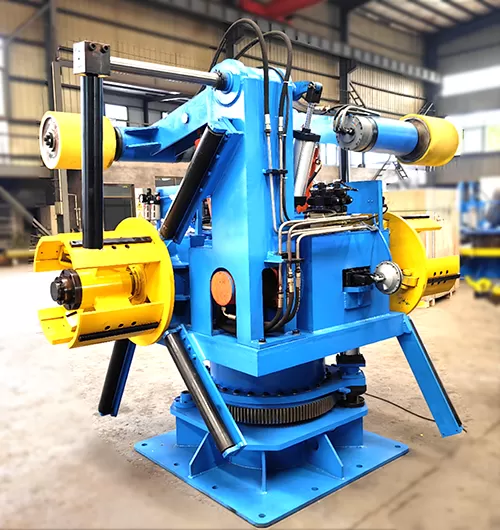
efficiency and product quality. The decoiler
machine, often underestimated as a simple payoff reel, is actually
a sophisticated piece of material handling and pre-processing equipment. A
suboptimal decoiler introduces strip camber, causes edge damage, and creates
costly downtime during coil changes. This article provides a deep technical
analysis of modern decoiler systems, focusing on how to select and operate a
decoiler machine that aligns with the principles of lean
manufacturing and total productive maintenance (TPM) in the tube and pipe
industry.
1. The Critical Role of the Decoiler in Tube Mill Linearity
The primary function of a decoiler machine extends beyond
simply holding and rotating a coil. Its core responsibilities include:
Centric Coil Positioning: Ensuring the coil's centerline is
perfectly aligned with the entry pinch roll and forming mill.
Back Tension Control: Providing precise, adjustable
resistance to prevent overrun and maintain strip tension for the accumulator and
forming section.
Damping Vibration: Absorbing mechanical shocks during weld
flash or speed changes to protect upstream components.
For tube mills running at speeds exceeding 60 m/min, the inertia of a 20-ton
steel coil becomes a significant force. Modern decoiler machine designs, particularly those from industry leaders like SANSO, integrate hydraulic
braking systems and proportional valve controls to manage this inertia
dynamically, ensuring the strip feeds smoothly regardless of the coil's
decreasing diameter.
2. Technical Anatomy of a Heavy-Duty Decoiler
To meet the demands of modern ERW lines, a decoiler machine must be built with specific mechanical and hydraulic features. Here are the
critical subsystems to evaluate:
2.1 Mandrel Expansion and Support
The mandrel is the heart of the decoiler. For high-yield strength materials
(above 600 MPa), a standard mechanical expansion is insufficient. Hydraulic
expansion mandrels are now the industry standard. Key specifications
include:
Expansion Range: Typically from 480mm to 620mm ID to
accommodate standard coil inner diameters.
Number of Segments: 4-segment or 6-segment designs. More
segments provide better grip and reduce coil ID deformation.
Overhung vs. Supported: For coils wider than 800mm, a
decoiler machine with a traveling outer support (a "swing arm") is
non-negotiable to prevent mandrel deflection and strip "telescoping".
2.2 Hydraulic Power Pack and Control Logic
The precision of a decoiler lies in its hydraulics. A closed-loop hydraulic
system with accumulators ensures instantaneous response to line speed changes.
Look for systems that offer:
Proportional Pressure Control: To fine-tune back tension
from near-zero for light gauges up to several tons for heavy wall pipe.
Edge Control (EPC) Interface: While the EPC cylinder
usually acts on the stand or a side roller, the decoiler must provide a rigid,
low-friction base for these corrections to be effective.
3. Integrating the Decoiler with Pinch Rolls and Flatteners
The performance of a decoiler machine is intrinsically
linked to the downstream pinch roll and flattener (or breaker roll). In modern
mill design, these are often considered a single system.
A common industry pain point is "coil set"—the natural curvature of the
strip. If the decoiler pulls the strip directly into a set of pinch rolls
without breaking this curvature, the forming mill will struggle with uneven
edges. The solution is a decoiler machine paired with a
multi-roll flattener.
SANSO engineers typically recommend a configuration where
the decoiler feeds into a 4-high or 6-high flattener before entering the
accumulator. This ensures that by the time the strip reaches the forming rolls,
the yield point has been neutralized, significantly reducing spring-back and
improving roundness consistency in the finished pipe.
4. Selecting the Right Decoiler: Key Parameters and Data
Choosing a decoiler machine requires a data-driven approach.
Relying on general specs can lead to bottlenecks. Use the following table as a
starting point for your technical inquiry with manufacturers:
| Parameter | Light Gauge Line | Medium Structural Line | Heavy Wall / API Line |
|---|
| Coil Weight Capacity | 3 - 8 tons | 10 - 15 tons | 20 - 30+ tons |
| Strip Width | 100 - 400 mm | 300 - 800 mm | 600 - 2000 mm |
| Mandrel Type | Mechanical / Pneumatic | Hydraulic, 4-segment | Hydraulic, 6-segment w/ Outer Support |
| Back Tension (Max) | 0.5 - 2 tons | 2 - 5 tons | 5 - 10+ tons |
Don't just look at the maximum weight. Evaluate the brake torque capability
at low rpm. A decoiler machine that can maintain consistent
tension at threading speeds (5-10 m/min) is just as critical as one that
performs at 100 m/min.
5. Maintenance Strategies for Maximum Uptime
The decoiler is subject to high shock loads and contamination from mill
scale. A proactive maintenance protocol is essential. Focus on these three
areas:
Bearing Lubrication: The main mandrel bearings take the
full radial load. Use an automatic greasing system with high-pressure lithium
complex grease. Monitor for vibration spikes indicating bearing wear.
Hydraulic Fluid Cleanliness: Maintain ISO 4406 cleanliness
codes of 18/16/13 or better. Contaminated oil is the primary cause of
proportional valve failure, leading to erratic tension control.
Wear Pad Inspection: On supported-arm decoilers, the wear
strips on the traveling support are sacrificial. Check them monthly and replace
before they wear through to the cast iron base, which would require a costly
machining realignment.
6. Economic Impact: Calculating the ROI of a Precision Decoiler
Investing in a premium decoiler machine is not just about
CapEx; it's about reducing operational costs. Consider these factors:
Reduced Scrap: Precise tension control prevents strip
slippage and scratching. If a decoiler upgrade reduces scrap by just 0.5% on a
line processing 50,000 tons/year, that's 250 tons of saved material—a
significant financial return.
Faster Changeovers: Hydraulic expansion and automated coil
cars on a modern decoiler machine can cut coil change time from 5 minutes to
under 2 minutes. For a line with 10 coil changes per shift, this recovers nearly
30 minutes of production time daily.
Tooling Life: A decoiler that delivers a flat, centered
strip reduces uneven wear on forming rolls. Extending roll life by 20% directly
impacts your tooling budget and reduces downtime for roll changes.
The decoiler machine is the foundation upon which
high-quality tube is built. By treating it as a precision instrument rather than
just a coil holder, manufacturers can achieve substantial gains in efficiency,
quality, and profitability. Whether you are upgrading an existing mill or
specifying a new line, prioritizing robust engineering—like the hydraulic
systems and rigid frames found in SANSO equipment—is an
investment that pays dividends in reduced downtime and superior product
consistency. For specific technical specifications and integration support,
consulting directly with engineering teams who specialize in coil processing is
the recommended next step.
Frequently Asked Questions (FAQ)
Q1: What is the difference between a single-cone and a
double-cone decoiler?
A1: A single-cone decoiler uses one
expanding cone on a cantilevered shaft and is suitable for narrower coils
(typically under 600mm width). A double-cone decoiler machine features two opposing cones that clamp the coil from both ends. This design is
essential for wider and heavier coils as it eliminates the need for a separate
outer support arm and provides superior centering, preventing the coil from
telescoping during high-speed unwinding.
Q2: How do I calculate the required back tension for my
decoiler?
A2: Required back tension is a function of
material yield strength, strip thickness, and width. A common rule of thumb is
to set tension to approximately 10-20% of the material's yield strength
multiplied by the cross-sectional area. However, the optimal setting is often
found empirically: you need enough tension to prevent the coil from overrunning
and to keep the strip tight against the entry pinch rolls, but not so much that
you stretch or yield the strip, causing width reduction.
Q3: Can the same decoiler machine handle both hot-rolled and
cold-rolled steel coils?
A3: Yes, a well-designed heavy-duty
decoiler machine can handle both. However, the key
consideration is the inner diameter (ID) tolerance and the condition of the
coil. Hot-rolled coils often have rougher edges and tighter IDs. The decoiler's
mandrel must have sufficient expansion force to grip the rough ID without
slipping. For cold-rolled or coated strips, the focus shifts to non-marking
surfaces on guide rollers and the mandrel segments to prevent surface
damage.
Q4: What causes "telescoping" coils during unwinding, and
how can the decoiler help?
A4: Telescoping—where the strip layers slide
sideways—is often caused by a poorly wound upstream coil or uneven tension.
However, the decoiler can mitigate this. A rigid mandrel with full-length
support prevents deflection. More importantly, integrating the decoiler's
control with an active edge guide (EPC) system that shifts the entire decoiler
base or a set of steering rolls is the most effective way to correct telescoping
in real-time, ensuring the strip centerline remains true to the
mill.
Q5: How often should the expansion slides on a hydraulic
mandrel be replaced?
A5: The replacement interval for mandrel
slides depends heavily on the number of coil changes and the environment. In a
high-volume mill running 24/7, inspection every 3-6 months is recommended. You
should replace them when the hardened surface wears down by 2-3mm. Running with
worn slides creates play in the expanded position, leading to coil slippage and
damage to the mandrel segments themselves. Always use OEM-specified bronze or
engineered plastic slides to protect the steel mandrel body from
wear.