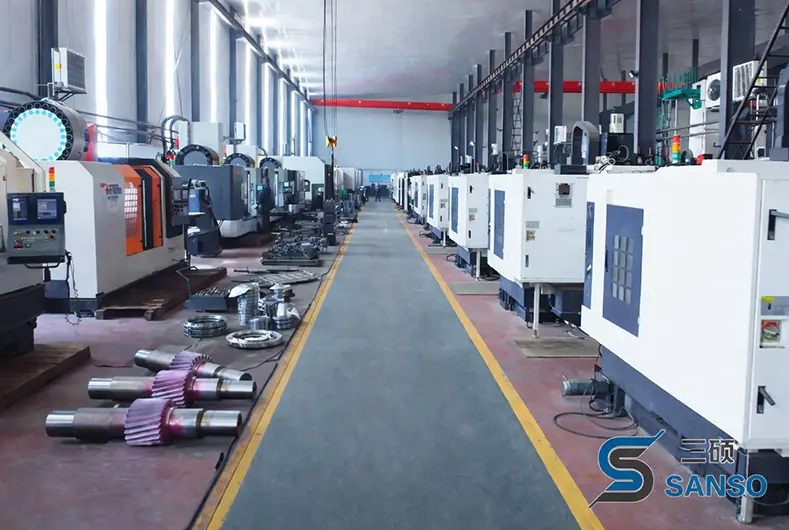
2026年剪切焊机指南:最大化管材轧机效率和正常运行时间
2026-08-31
Every minute a tube mill stands idle during a coil changeover directly cuts into plant profitability. For plant managers and operations directors, unplanned line stoppages, weld joint breaks in the roll forming section, and damaged tooling remain costly bottlenecks.
A high-performance shear welder eliminates these bottlenecks. By squaring the coil ends, aligning the strips, and producing a dependable weld seam, a modern coil joiner keeps downstream equipment running at full line speed. Leading equipment builders like SANSO 设计 automated joining systems that cut changeover cycles down to seconds, protecting both your accumulators and your bottom line.
This guide analyzes modern strip joining technologies, key buying metrics, welding processes, and practical return-on-investment calculations to help you select the right machine for your production facility.
What is a Shear Welder and Why is it the Heart of Continuous Tube
Production?
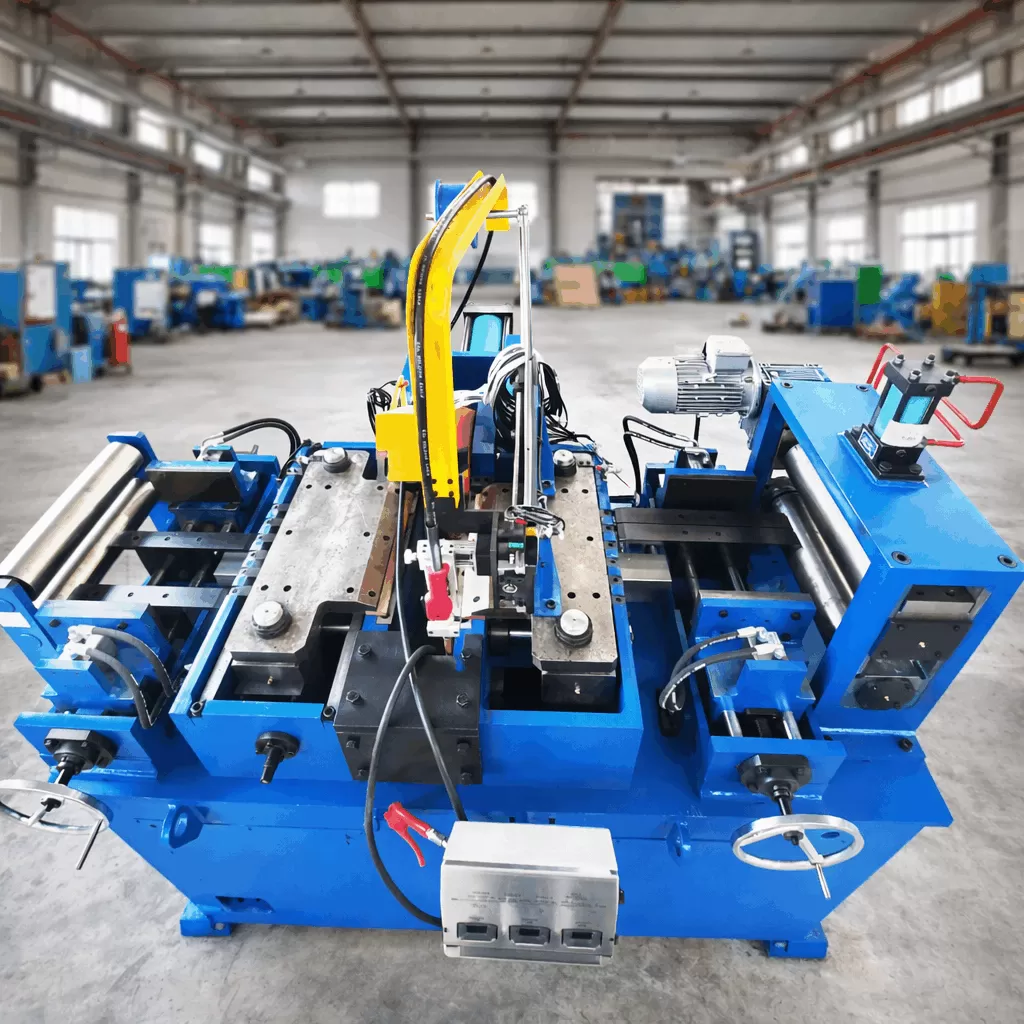
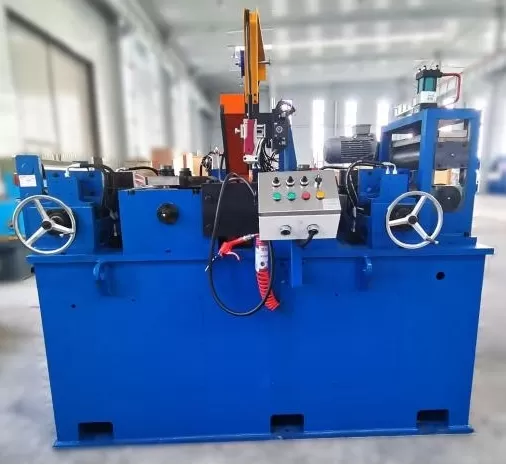
A shear welder (also known as a strip joiner or coil end welder) is an inline machine positioned between the 开卷机/flattener and the strip accumulator on an ERW (Electric Resistance Welded) tube mill or roll forming line. Its primary objective is simple: join the tail of an expiring steel coil to the lead end of a fresh coil.
The operational sequence follows four critical stages:
Double Crop Shearing: High-tonnage hydraulic or pneumatic shear blades trim both the tail end and the new lead end simultaneously or sequentially. This eliminates distorted, out-of-square edges and burrs.
Precision Alignment: Centering guides align the two strip edges against a common centerline or reference edge to prevent tracking errors.
Clamping and Joining: Heavy-duty clamp bars hold the strip flat against a copper backing bar while an automatic torch or beam welds the joint.
Entry into Accumulator: The welded joint feeds directly into the accumulator, allowing continuous downstream forming without slowing the main mill.
Without an efficient coil end welder, operators must manually feed each new coil through the breakdown passes, fin passes, and sizing stands. That manual process wastes 15 to 30 minutes per coil and drastically increases the risk of roll tooling damage.
Types of Shear Welders: Choosing the Right Setup for Your Line
Tube mills differ significantly in strip width, material thickness, and line velocity. Selecting the right strip joiner depends on the level of automation required and the optimal welding process for your specific metallurgical grade.
1. Classification by Automation Level
Manual / Portable Shear Welders: Compact, budget-friendly units featuring manual clamping and hand-guided or semi-manual shears. These suit offline repair stations, low-speed offline processing, or entry-level lines running narrow, thin-gauge strip.
Semi-Automatic Shear Welders: These units integrate powered hydraulic or pneumatic shear blades with automated weld torch travel. The operator loads and aligns the strip, pushes a button to shear, clamps the material, and initiates the automated weld cycle.
Fully Automatic CNC Shear Welders: Fully autonomous systems featuring automated strip centering, push-button double-cut crop shearing, programmable weld parameters, and integrated weld seam planishing. These machines deliver the fastest cycle times for high-output, 24/7 continuous operations.
2. Classification by Welding Technology
TIG (GTAW - Gas Tungsten Arc Welding): The industry standard for carbon steel, stainless steel, and non-ferrous alloys. TIG produces clean, flush joints with minimal spatter. While welding speeds are moderate (typically 15–35 inches per minute), weld quality and joint flatness are exceptional.
MIG/MAG (GMAW - Gas Metal Arc Welding): Uses continuous filler wire to deliver fast deposition rates on heavy-gauge strip (above 4.0 mm). However, MIG leaves a raised weld crown that requires downstream grinding or roll mashing to avoid damaging forming rolls.
Fiber Laser Strip Welding: The fastest-growing choice for modern, high-speed tube lines. Fiber laser shear welding generates a concentrated, narrow heat-affected zone (HAZ) with zero filler wire. The resulting joint has virtually the same thickness as the base metal, passing through fin passes without resistance.
Solid-State Plasma Arc Welding (PAW): Provides deeper single-pass penetration than TIG on medium-to-thick wall gauges while maintaining a stable, constricted arc at high travel speeds.
Key Technical Metrics to Evaluate Before Buying
Specifying a tube mill shear welder requires reviewing several engineering parameters to ensure smooth integration with your current entry section.
| Technical Parameter | Critical Specification Range | Operational Impact |
|---|---|---|
| Strip Width Capacity | 50 mm to 2,000+ mm | Must accommodate maximum master coil slit widths plus future line expansion. |
| Strip Thickness Range | 0.5 mm to 16.0 mm | Dictates clamping tonnage, shear frame rigidity, and torch power capacity. |
| Total Cycle Time | 25 to 90 seconds | Must be short enough to prevent emptying the strip accumulator at full mill speed. |
| Shear Blade Material | AISI D2 / H13 / Premium Tool Steels | Determines blade sharpening intervals when shearing high-tensile materials. |
Cycle Time vs. Accumulator Capacity Matching
Your shear welder cycle time directly dictates the required capacity of your strip accumulator. Calculate your line balance using this basic relationship:
Minimum Accumulator Strip Storage (meters) = [Total Shear & Weld Cycle Time (seconds) + Operator Handling Buffer (seconds)] × [Mill Running Speed (meters/second)]
If your tube mill runs at 120 m/min (2 m/s) and your total changeover cycle takes 60 seconds, your accumulator must store at least 120 meters of strip plus a safety margin. Shortening the weld cycle directly reduces the required accumulator size and footprint.
Clamping Rigidity and Seam Profile
High-yield-strength strip tends to bow or lift during cutting. Hydraulic clamp bars must provide sufficient hold-down force across the entire width. If the strip edges lift off the copper chill plates, arc blow, burn-through, and misaligned joints will occur, leading to breaks inside the breakdown stands.
2026 Trends: Smart Innovations in Strip Joining Technology
The manufacturing sector's shift toward Advanced High-Strength Steels (AHSS) and corrosion-resistant alloys has transformed coil joining requirements. Modern installations incorporate several advanced technical developments:
Automatic Edge Centering and Vision Guidance: Optical sensors and servo positioning units align strip centerlines automatically, eliminating operator error on wide coil lines.
High-Yield AHSS and Zinc-Aluminum-Magnesium (ZM) Compatibility: Modern automated welders, such as advanced units engineered by SANSO, apply multi-stage heat control programs. These programs preheat and pulse-weld coated and high-tensile steels to prevent embrittlement across the joint.
Integrated Weld Seam Planishers (Mashers): Hydraulic planishing rolls flatten the weld bead immediately after joining. Planishing reduces joint thickness back to nominal strip gauge, preventing tooling marks on polished decorative or automotive tubing.
Digital Recipe Management: Operators select the material grade and strip thickness on an HMI screen. The machine automatically adjusts shear gap clearance, clamping pressure, welding speed, gas flow rate, and arc voltage.
Total Cost of Ownership (TCO) & ROI Calculation
Investing in a high-efficiency automatic shear welder delivers measurable returns by eliminating line stoppages and reducing scrap. Use the following model to estimate your annual financial payback:
1. Downtime Savings:
Annual Downtime Savings = (Hourly Cost of Mill Downtime) × (Number of Coil Changes per Year) × (Minutes Saved per Change ÷ 60)
For example, if your mill costs $600 per hour to operate, runs 4,000 coils per year, and a fast shear welder saves 4 minutes per changeover:
Savings = $600 × 4,000 × (4 ÷ 60) = $160,000 per year
2. Tooling Protection and Scrap Reduction:
A clean, straight strip joint travels smoothly through the forming, welding, and sizing passes without snapping. Eliminating just two major strip breaks per month saves thousands in damaged carbide roll tooling, welder re-threading labor, and scrap steel.
Most commercial tube producers recover the capital cost of a high-performance strip joiner within 6 to 12 months of installation.
Maintenance Best Practices to Prevent Mill Stoppages
Consistent preventative maintenance ensures dependable joints and prevents unexpected machine breakdowns:
Maintain Precise Shear Blade Clearance: Set blade gap according to steel gauge (typically 7% to 10% of strip thickness for mild steel, tighter for thin stainless). Rotate 4-edge tool steel blades before dull cutting edges create heavy rollover burrs.
Inspect Clamping Fingers and Copper Backing Bars: Regularly clear slag, spatter, and zinc buildup from the copper backing bars. Clean grooves ensure proper shielding gas coverage and consistent arc grounding.
Calibrate Pneumatic and Hydraulic Pressure Regulators: Inconsistent clamping pressure allows heavy-gauge strip to shift during torch transit, causing weld seam distortion.
Monitor Gas Flow and Torch Consumables: Inspect gas lenses, tungsten electrodes, and laser protective windows daily to avoid joint porosity and lack of penetration.
Frequently Asked Questions (FAQ)
Q1: How does shear welder cycle time affect accumulator
sizing?
A1: The accumulator must store enough steel to feed the tube
mill continuously while the shear welder cuts, clamps, and joins the strip ends.
A faster shear welder cycle reduces the required accumulator capacity, lowering
machinery footprint and overall line investment costs.
Q2: Can one shear welder handle both stainless steel and galvanized
carbon steel?
A2: Yes, provided the machine has programmable welding
controls. Stainless steel requires precise TIG or laser heat management with
specialized backing gas (argon or argon/hydrogen), whereas galvanized material
requires parameter optimization to vent zinc vapor cleanly without creating weld
porosity.
Q3: What causes strip breakages at the weld seam during roll
forming?
A3: The most common causes are poor edge squareness,
incomplete joint penetration, excessive heat buildup causing a brittle
heat-affected zone, or excessive weld reinforcement (flash) catching inside the
fin roll passes.
Q4: When should a tube producer choose fiber laser welding over TIG
for strip joining?
A4: Fiber laser strip welding is ideal for
high-speed mills, lines processing advanced high-strength steels (AHSS), or
operations running thin-wall tubing where any joint buildup would damage
delicate roll tooling or internal scarfing inserts.
Q5: Is a weld seam planisher strictly necessary?
A5:
While not mandatory for thick-walled, non-critical structural tubing, a weld
planisher is strongly recommended for high-speed ERW lines, precision automotive
tubing, and visual-grade products. Flattening the joint eliminates mechanical
shock loads as the weld passes through breakdown and fin stands.
Upgrade Your Tube Mill Entry Section
Maximizing overall equipment effectiveness (OEE) begins at the entry end of your line. Whether you are modernizing an existing ERW line or designing a high-speed tube mill from the ground up, selecting the right strip joining technology safeguards your downstream productivity.
SANSO delivers rugged, precision-engineered shear welders designed to withstand rigorous tube production demands. Contact our engineering team today to review your line parameters, calculate cycle times, and request a detailed technical quotation.
邮箱:
国际商务: info@sansohftubemill.com
国内业务: sanshuojidian@163.com
Web: www.sansotubemill.com
文章标签: